Tell us what we are supposed to be doing, don’t ask us to use common sense….
Looking back with the benefit of ‘2020 hindsight’ the week started with what Boris might have called ‘an inverted pyramid of confusion’ with lots of unanswered questions following his Sunday evening address to the nation. The well-trailed/leaked message of ‘we’re coming out of lockdown’, the ‘meat of the story at the top’ was followed by the fragmented uncertainty of what was actually said, and the shrinking detail of how that would work – the narrowing at the bottom of the pyramid.
‘Stay at Home’ was replaced with ‘Stay Alert’ and we were told that ‘coming down the mountain is sometimes harder than going up’. He announced a government plan to ‘ease the lockdown’ in the next few months. Some of the measures had been widely trailed in the media in a way that I don’t fully understand. All journalists have their ‘sources’ and back-door channels into government departments. Indeed it seems that some cabinet ministers are happy to ‘leak’ when it suits them, or perhaps to gain an advantage in the game of getting more power by a higher profile. The problem was that some people were waiting to hear that they could see more family members, start planning a late summer holiday or going for a beer at a pub that has an outside garden or space.
What we heard instead was ‘go back to work tomorrow’, ‘from Wednesday we can go out more, sunbathe or play sports’, ‘schools and some shops will be opening at the start of June’, ‘hospitality being open from 4th July’. The new alert system was underpinned by scientific advice and monitoring of the now infamous ‘R-number’. Monday morning brought more confusion when ministers didn’t appear to have details on some of the ‘rules’ and how they would be applied. Could we meet mum and dad in the park or was it only mum (presumably while dad sat in the car and waited his turn next). The situation was not surprising as the more detailed 60-page official document was not published until later on Monday and news programmes were full of traffic jams and crowded tube trains as the ‘rush back to work’ started.
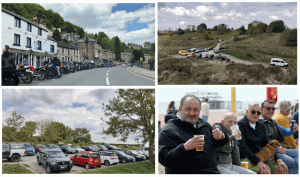
By this weekend crowds were taking advantage of the warm weather to travel long distances to beauty spots in the countryside and on the coast. Some interviewed for the evening news expressed surprise at the number of people there and the lack of social distancing.
I mentioned a couple of weeks ago the need for careful planning of how workplaces could open with ‘social distancing’ and ‘re-engineering’ of processes. Any business or workplace that had wasted the last seven weeks of the lockdown and wasn’t planning how the changes could happen prior to the announcement, can’t complain if they fail in the future. Talking to Steve, an accountant friend of mine, about how his small business customers were coping, he said there were two groups; those who had panicked and taken short term decisions, and those who had changed. He mentioned restaurant businesses who had turned into takeaway services and were now making more money as they didn’t realise just how much customers liked their dishes. We agreed that the ‘good’ well-run businesses who treat their teams well will come out of this stronger.
Trade Union Leaders were calling for their involvement in helping businesses get back working in a safe way. They have many trained ‘Health & Safety Reps’ that can help companies and reassure their members that safe-working practices are in place. Although the TUC had been on a conference call with the Prime Minister on Sunday evening, no mention of help from the unions was made by ministers in the daily round of the breakfast news media organisations. The phrase ‘it is just common sense’ was often used. The government did produce some detailed guidance on workplace changes, staff shifts, social distancing and deep cleaning measures for eight areas of work from manufacturing, offices, restaurants etc. But I repeat, most businesses should have been thinking about these things before this week.
Wednesday was the day we could all begin to get out more and play sport, but we decided to stay home and see if the beauty spots, parks and garden centres became crowded with people, as had been the concern when it was announced. It was a mixed picture and the mood was captured by a cartoon in one of the newspapers of a golfer playing a round on his own whilst his wife took a towel to sunbathe in the bunker. On seeing the queue of 30 or more customers to get into a garden centre we decided that we weren’t that desperate to get some more plants for our garden.
Parents, teachers, and their unions were raising concerns about how social distancing would be in place for reception, year one and year six classes, the first designated to go back. For some it was literally a matter of ‘life and death’ with some parents accusing ministers of treating them and their children as ‘guinea pigs’ for an experiment and saying that they definitely wouldn’t be sending their children back until schools were ‘100% safe’. Of course there is no such thing as 100% safe statistics were quoted on the risk of being injured in a car journey or playing in a park. There is also a risk of harm if younger children see parents in a state of terror about letting them out for the ‘virus to get them’. We watched an interview with a head teacher from the UK and a teacher in a primary school in Denmark that had been open for a few weeks and put in place measures to help. They put the children in small groups of 4-5 and played a game whereby they had to keep away from the other groups in the school. Washing hands at the start and end of the morning and afternoon became a physical education (PE) class where children lined up two metres apart and did various exercises such as squats, jumps, stretches as they moved closer to the sinks and after washing their hands they went back to the classroom to do a paper exercise. The UK head teacher appeared to take an interest and be willing to learn some lessons from this. The Danish teacher stated that when they opened less than half the parents sent children but after two weeks it was over 90%.

Of course we shouldn’t forget that teachers and schools have been open during the lockdown, doing frontline work and teaching smaller numbers of key worker’s children. They will have learnt something from this experience. Some of the larger ‘Academy School Groups’ that have estates departments have been planning for opening and doing individual risk assessments for their varied buildings. Some head teachers in primary schools are not trained in risk assessments. This is not a criticism, it’s just not their job which became clear when they panicked about how to keep 4-year olds apart, and not to be terrified of teachers wearing masks and full PPE! They may be great teachers, but they also need help from local authorities and others. We have to hope that the large academy groups only motivation is education of their pupils but, as with some of the larger businesses in the commercial sector, it is possible that their Chief Executives are more concerned with lost profit than with the safety of their employees.
Speaking to Chris, a friend who has a daughter that teaches primary school children in a relatively deprived areas locally, I asked his view. He said he could understand the unions asking for guarantees on safety as that is their role. His daughter has identified vulnerable pupils who should be in already but haven’t been coming. Some of her children are not capable of being controlled in the way people would expect and their hygiene habits are poor as the result of the environment they live in. She is not worried about catching the virus as she is young, but Chris is concerned about her, as there is still much we don’t know about how the virus affects children.
The Danish comparison was being used as a ‘positive example of what could be done’ by the same ministers who said it was wrong to compare the way we handled the crisis, compared to other countries who appeared to be doing better. Is it that Danish schools and parents have a different relationship than ours?
As I write teacher unions and leaders have met with government scientific advisors, and doctors have backed the proposed way forward for a controlled opening in June. Anne Longfield the children’s commissioner for England has demanded that the two sides stop squabbling and get on with reopening ‘in the interests of children’, the many disadvantaged of whom had been away from education for too long.
The schools issue was just one area this week that shone a light on the growing division/diversion of the way the crisis is being dealt with both between the countries of the UK and within the regions of England. I wrote last week that Scotland, Wales, and Northern Ireland were sticking with the ‘Stay at home’ message. This week the elected mayors in Manchester & Liverpool went on record about the support they and their councils were being given from London. The Greater Manchester Mayor, Andy Burnham wrote two newspaper articles bemoaning the short notice they were given of the proposed ‘back to work’ message and not having the financial package given to the London Mayor to provide the extra public transport to maintain social distancing. The allowances given to local authorities to deal with the crisis had gone from ‘spend what you need, and we will reimburse you, to ‘we need to be sharing the cost’. It needs to be stated that he was a former Labour MP for Leigh, one of the constituencies that changed to Conservative in the December election. So the following statement needs to be read in that context.
For a government elected on votes in the north, and promises to “level-up”, it is surprising how quickly it has reverted to the default, London-centric mode in this crisis. Last Sunday’s package certainly felt more suited to the south than to the north.
His article refers to another issue I heard on Friday that seems to mark a change in approach. Many homeless people have been taken off the streets and put into hotels with a grant from central government. That funding is being withdrawn and put back onto the local authorities, many of whom have also had a large cut in the funding to give local support during the emergency. It seems that the poorest areas are having the largest cuts.
One of the most deprived areas in the country and one often shown on news bulletins is our ‘home area’ around Middlesbrough in the north east. Alyson & I lived and went to school in one of the more affluent areas from the ages of two and five. The area of Brambles Farm shown in Friday’s bulletins is one we know well and is where Alyson’s mum worked in a bookmakers. The interview with a mum and her child about the cost of living and the need to access support and foodbanks was a stark reminder of areas of poverty in our country.

Today’s statistics from the NHS show the following;
- The North East region has the highest infection rate in the country with 358 people per 100,000
- Within the region Middlesbrough is fourth highest for infection rates at 451 per 100,000
- The James Cook University Hospital that serves the area is in the top third of deaths in the country with 316 to date.
- One day in the last week there were 24 new cases in London and 4,000 in the north east and Yorkshire.
The regional mayor had been resisting the reopening of parks despite the pleas of an MP who is a member of the government and one who is the Labour MP for Middlesbrough. He is, however, in favour of reopening schools unlike his counterpart in nearby Hartlepool.
Other news this week
- The daily death rates appear to be on a downward slope with today’s figure of 170 bringing the total to 34,636. But this week we had a figure of 50,000 for the ‘excess deaths’ for the period to 1 May.
- Following the extensive coverage of the track and trace app on the Isle of Wight there has been little news on how the trial is going. I looked up the local newspaper and all it said was that less only about 33% of the population had downloaded it. Michael & David told me on our Zoom call tonight that the source code for the app had been released and there were lots of comments about functionality and not connecting with phones nearby. As per the blogger’s prediction last week there is talk of moving to the decentralised version of the app.
- Tuesday 12th May was International Nurses Day and fell this year on the 200th anniversary of Florence Nightingale’s birthday. Florence died a recluse after many years of a ‘mystery disease’ which some scholars now think could have been partly related to post-traumatic stress disorder (PTSD). Much more is known about this today, and it could be that her reluctance to talk about the 21 months without a break looking after the injured soldiers in appalling conditions during the Crimean War, 30 years previously, was the cause. Many today are asking that our NHS workers and others on the frontline receive PSTD counselling in the coming years.
- Belly Mujinga a Victoria Station ticket office worker died after being spat at on the day before the lockdown by a man claiming to have coronavirus, falling ill with Covid-19 two days later and dying in hospital a week after that. It is a shocking story.
- The question I submitted to the group who choose ones from the public to the daily briefing didn’t get picked, but somewhat surprisingly one about the possibility of in the future of having a ‘Universal Basic Income’ (a subject I want to cover in a later blog) did, but was dismissed outright by business secretary Alok Sharma MP, who again was happy to use other countries as reference as ‘it had been tried and shown not to work’.
Thoughts at the end of week 8.
This week we were due to be on a cruise in Norway from Bergen to Kirkenes and back, on a small cargo boat calling at many ports and sailing up some of the very scenic fjords. A ‘first world’ problem I know, but we are some of the many trying to get a refund or rearrange for next year.
This week is designated Brain Injury Awareness Week and in the charity I am a trustee for it would be one of our main awareness and fundraising times. I wrote and hosted a Zoom quiz for our members to replace the events we would have had. It was a fun time of sharing. It has also been Christian Aid Week and the door to door collection I sometime do was cancelled. It raised over £8 million across the UK last year. I shared the preparation and hosting of another quiz for which we asked for a donation. We had 16 ‘screens’ with about 25 people joining in. This week’s appeal is to help victims of coronavirus in parts of the world less able to cope and where Christian Aid have projects. I encourage you to donate.

The advice this week from the government was to start wearing face coverings in some enclosed spaces such as on public transport and shops. Alyson had used a design from You Tube to sew some cloth ones for us all. We posted two each to Michael and David and I wore one for the first time to go to our small local Tesco. I only had it on for about 45 minutes, but that was long enough for me to have some understanding of how uncomfortable it must be to wear one for a ten to twelve-hour shift. And that is without the rest of the PPE needed to treat patients in ICU.
I read a blog from an academic at Swansea University who was recruiting people willing to take part in a ‘CoronaDiaries’ project looking at how people react in the crisis. I have been accepted onto the project so these blogs will be converted to PDF and stored in an archive for future researchers to use.
As usual on Sunday I attended a streamed service from Methodist Central Hall in London. The sermon and prayers related to a passage in Matthew chapter 5 where Christians are called to change ‘from just being, to doing’. This struck me as particularly apt for the events of this week, as did our prayer,
may the poor be enriched, the bereaved comforted and the hungry filled.
Keep safe, stay alert, manage the risk and let’s try to ease the lockdown.
 Skat's Chat
Hi Thanks once again for an informative read. Glad the blogs will be going into an archive and am sure will be very useful in future research. Has Aly started to 111 pharmacist phone calls yet? If so how is it going? I’m planning to make a few masks with material I have for us to use when we start going into shops again. At the moment Sarah does our main shopping and a neighbour gets us bits from Unicorn our organic grocer. The local GPs have asked for home made masks for patients who request them so if mine work out Ok may make a few for them. A local stitched up coop has supplied pattern and instructions. See you Sat eve
Margaret
>
LikeLike
Thanks again Margaret for the comments. When I saw the blog from the guy at Swansea Uni I decided to apply to be part of the project.
Alyson is still waiting to hear from 111 service as they had over 350 applications apparently. Watch out in this week’s blog for more news on our home made masks…
‘See you’ Saturday.
LikeLike