‘We are all in this together…’
When I started thinking about this blog I made a conscious decision not to go straight to the big issues of politics and even more so my personal faith and aspects of religion. The events of this week mean that is not possible.
Sunday 5th April brought three things that influenced me and many others in our country. The Queen gave an address to the nation, Boris Johnson, prime minister went into hospital and the Christian Church started Holy Week leading up to Easter. For many on ‘the left’ of politics the Queen and Boris Johnson symbolise what is wrong in our society and underline the differences in our society between the privileged ‘haves’ and the underprivileged ‘have-nots’. How easy it is to decry someone with enormous personal and institutional wealth, socially isolating in a castle giving a message of encouragement to the nation. Similarly for a ‘posh-boy’ politician with all the advisors and support to go into hospital after getting a test not open to front-line health workers, and then moved to an intensive care unit (ICU), alongside some reports that suggested he might have taken the place of a more ‘needy’ patient.
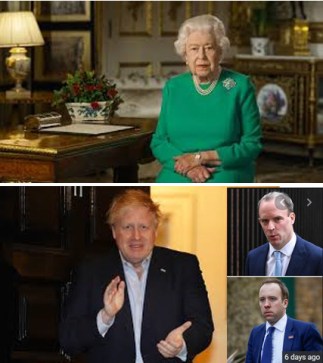
Those are not my narratives as I was brought up to try and treat everyone the same and to respect our Queen and the role she plays in our country and the mostly unseen support for our national institutions – not least through her weekly meeting with the Prime Minister. Whatever our personal view of the first-name-politician Boris, his part in the Conservative Party over issues like Brexit, his ambition to push others away in pursuit of being the leader, he is our elected Prime Minister with a substantial majority. He is easy to parody and characterise as a clown or buffoon, with that often repeated clip of him dangling from a high wire during the 2012 Olympics as Mayor of London. I do confess to sharing some of the ‘funny’ pictures and videos on social media. As Prime Minister he has a tough job and is facing something nobody expected to have to manage, and for which there is no real ‘play-book’.
Boris’s ‘friend’ US President Donald Trump increasingly looks like a man lost in the situation. Always over-promising the end of the crisis, trying to provide hope of ‘an amazing and beautiful economic recovery…’, not able to hold supporter rallies and probably worried about the November elections. I am waiting for the day he declares he has managed the virus so well, he is going to issue an Executive Order that gives him the job for a minimum of two more years.
In the earlier part of the last seven days President Trump, and other world leaders were sending ‘thoughts and prayers’ to our Prime Minister and their ‘friend’ Boris. Social media was full of messages from people from all parts of society expressing similar wishes. Easy words to say but I wonder how many people actually said that prayer. Our local churches in Holy Week hold times of daily reflection and I joined those each day at 7pm. We did actually pray for Boris and everyone else in hospital and those who had lost family members. Our minister has had several funerals and dealt with bereaved families who can’t attend the last moments of a loved one.
I have started to hear that phrase that comes out in times of a human or natural disaster, ‘how can God let this happen and why doesn’t he put an end to this…?’. I won’t hold my breath and wait for the time this is all over and people suggest we get together to thank that same God for bringing us through it.
We journeyed through Holy Week with Jesus and shared in his suffering. The Good Friday service is always a moving one and I always leave it in a low mood. On Sunday I shared in a live-stream service from Methodist Central Hall Westminster where we celebrated the Easter Day promise of new life overcoming death. For those who don’t share our view, signs of new life are all around. As we walk in the local area blossom is on the trees, birds singing loudly due to the lack of traffic, and there are green shoots in our gardens and parks.

Mention was made of ‘green shoots’ during one of the daily briefings looking at the trends in new infection rates. I will look more at this in next week’s blog.
What has become clear in the last week as we all get used to (some would say bored with) the daily government briefings, is the public and the press are starting to ask the ‘hard questions’, and not allowing ministers to avoid them. There is no doubt they are ‘managing expectations’ or we are being ‘spun’ in a way that governments always do. If the lock-down had started earlier and was announced as up to 12 weeks, there may well have been uproar and even civil disobedience. As we come to the end of the ‘first three weeks’ it seems like this will go on for much longer, and other European Countries like Italy and Spain, who are ahead of us, are not showing any signs of a fully formed exit strategy.
If there is anything other than ‘Coronavirus’ that is likely to make Word of the Year for 2020 it is surely the abbreviation PPE (Personal Protective Equipment). We hear minister after minister saying they have supplied ‘hundreds of millions of items’ to hospitals etc. I am sure there are a lot, but a small calculation can explain away this figure could be ‘misleading’;
There are about 1,250 hospitals, 7,500 GP surgeries and 10,500 pharmacies in the NHS. The numbers of doctors is about 105,000 and nurses 300,000. I suspect in giving us the numbers the following could be true;
A box of 100 pairs of latex gloves = 200 items
a pack of 100 pairs of lower sleeves = 200 items
a pack of 100 plastic aprons = 100 items
a pack of 5o disposable masks = 50 items
a pack of 50 paper hair coverings = 50 items
So if each doctor and nurse is given the above items to last a few days, as they need to change them between patients, that would be
(105,000 + 300,000) x (200+200+100+50+50) = 243 million items
If every surgery & pharmacy was sent the same order this would be another (10,500 +7,500) x 600 = 10.8 million items
So that allows politicians to claim ‘literally hundreds of millions of items’ have been provided. But this leaves care homes, paramedics, home carers etc out of the calculations. Despite reassurances we hear stories in the media every day, and this has been going on for several weeks. There is no doubt it is a huge issue, and getting the kit to the right places at the right time is a massive logistical challenge. But isn’t this is something the NHS supply chain does all the time? Can’t our politicians be honest with us? Some of the ‘lower ranking’ ministers that have been put up to take questions seem to have no empathy at all and simply repeat the same platitudes and ‘party line’.
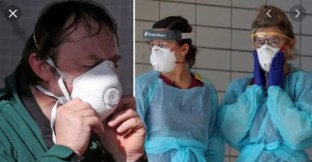 This week even Matt Hancock, Health Secretary (who is under great pressure and in my opinion seems to be leading well) resorted to apparently accusing NHS staff of ‘misusing PPE’. On Saturday the Priti Patel, Home Secretary gave a half-hearted apology when she said ‘I am sorry if people feel that way…’
On Thursday Dominic Raab, Foreign Secretary stood in for Boris at the briefing and answered a question about rewarding key workers after it was all over and said ‘this has certainly brought into focus who our key workers are’. He encouraged the country to join in the weekly ‘clap for carers’ at 8pm. Many of them are unskilled low paid carers, council workers and food delivery drivers. That same day 9th April the Home Office under Priti Patel released the next stage of the governments immigration policy to limit the numbers of ‘key workers’ coming into the UK. A document on the .Gov.uk website states;
Lower-skilled workers
There will not be an immigration route specifically for those who do not meet the skills or salary threshold for the skilled worker route
On Wednesday evening as the prime Minister left ICU and was reported to be getting better, it was left to BBC reporter Emily Maitlis at the start of a BBC 2 Newsnight report to say;
‘You do not survive the illness through fortitude and strength of character, whatever the prime minister’s colleagues will tell us. The disease is not a great leveller, the consequences of which everyone – rich or poor – suffers the same. This is a myth which needs debunking. Those on the front line right now – bus drivers and shelf stackers, nurses, care home workers, hospital staff and shop keepers – are disproportionately the lowest paid members of our workforce. They are more likely to catch the disease because they are more exposed.
Those who live in tower blocks and small flats will find the lockdown a lot tougher. Those who work in manual jobs will be unable to work from home. This is a health issue with huge ramifications for social welfare, and it is a welfare issue with huge ramifications for public health….
….As the World Trade Organisation warns that it might provoke the deepest economic downturn of our lifetimes, we ask what sort of social settlement might need to be put in place to stop the inequalities becoming even more stark.
One of the hardest things about dealing with graphs and numbers, statistics, targets and flattening or rising curves, is a propensity to forget the names and lives behind the growing death toll. Tonight we want to remember some of those who died while doing their job. They were not soldiers, they did not sign up to a career in which they pledged to give their lives. They would not see themselves as heroes, but as ordinary members of the public doing their work at a time when it required immense courage and kindness’
Among the increasing death toll and loss of around 30 front-line workers, doctors, nurses, pharmacists, physiotherapists, care home staff, teachers and bus drivers were some truly uplifting stories. I watched the tale of Hugh from Market Harborough who went into hospital on day 10 of his suffering straight to ICU where he was put on a ventilator. He described the awful time he went through but also the care of the doctors and nurses he got to know by first name. His father had died the day before he went in, and with his wife and daughter having to self-isolate due to his illness, they watched a video made by his sister from the graveside. Hugh recovered a week later and was applauded out of the hospital by the nurses. Standing in his garden with the sun shining and the birds singing, he looked the happiest man alive. He described the joy of being given a shave and a marmalade sandwich by a nurse as a treat. He could now walk 300 yards unaided. He paid tribute to the staff.
Albert a 99-year-old World War Two (WW 2) veteran who had survived three years in a prison camp and was applauded by nurses as he left hospital after coronavirus. ‘World War Two, done that, Coronavirus, done that too!’ was what Albert said to his nurses.
Then there is another 99-year-old WW2 veteran ‘Captain Tom’ who wanted to raise money for NHS charities by walking 100 times around his (not small) garden before he was 100. As I write his Just Giving page total is over £305,000. Go Tom!
The prime minister after leaving hospital on Sunday evening thanked many of the grades of workers who had looked after him. He named Jenny for New Zealand and Luis from Portugal who stood by his bedside for 48 hours. Perhaps he needs to have a quiet word with his Home Secretary about her new immigration system, to ensure the future Jennys and Luis’s can still come to work in the NHS.
Other news items this week.
I managed to find a few items related to the disruption caused by the virus that were not widely reported.
- Yemen – a country ravaged by conflict and bombed by a coalition of countries including Saudi Arabia armed by our own government, recorded its first cases of coronavirus. Large areas of the country are suffering famine, dire water shortages and lack of sanitation (no 20 second hand washing here). Almost half the hospitals have been destroyed or closed and people are living in makeshift camps. The Financial Times (FT) reported that there were only 205 ventilators in the country but the United Nations (UN) were sending another 420.
- Refugee Camps in Calais – Reporter Fergal Keane of the BBC did a report showing the overcrowded camps near Calais where lines of mainly men from The Balkans queued closely together to get food and water handouts.
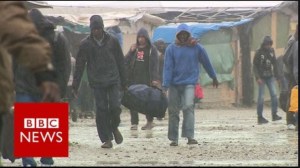
A French volunteer interviewed said he was ashamed that we treat people in such an inhuman way. Even if they get over to the UK refugees face discrimination, poor accommodation and access to food vouchers that they can’t use. - Dairy Farmers pouring milk down the drain – Given the queues at supermarkets and pictures on news channels of empty shelves, it seems odd that thousands of litres of good milk are being dumped. About half of the daily production was taken by a few larger processors and sold to restaurants, specialist bakers and coffee shops – all now closed. The demand from supermarkets is up 20% but the other part of the demand is down 70%. Cows are not industrial machines that can be ‘turned off’ and need to be milked. The dairies also aren’t collecting due to driver shortages and have reduced the price per litre the farmers get. So good milk is disposed of.
Thoughts at the end of week 3
We continue to be basically ok and able to find plenty of supplies and enjoy daily exercise, including a replacement form my weekly Parkrun with a course on my own locally.
We had several more ‘virtual coffee meetings’ with friends and family. We even had a couple of ‘virtual Easter cottage holiday’ gatherings and shared a pizza party with birthday cakes and candles, and a treasure hunt for the children.
I am extremely proud of Alyson, my wife, who has setup a WhatsApp group for some former work colleagues struggling with isolation and who had lost contact due to illness or losing jobs. After sharing a positive Easter message she had good feedback that it was helping a lot.
As the UK death toll passed 10,000 0n Sunday, we wonder whether the curve will flatten, whether the prime minister or his deputy and cabinet will review the lockdown in the coming week, and what the result might be.
I want to finish with a prayer we used this week in one of our daily sessions. It is by John Bell and part of a booklet from the Iona Community in Scotland examining the basis of our economy. I think it resonates even if you don’t have a specific faith.
May it not be long, Lord.
May it not be long
before there are no more beggars at the door
waiting for the crumbs from the tables of the rich.May it not be long
before the northern exploitation
of the southern economies
is a fact of history, not a fact of life.May it not be long
before poor economies
cease to be havens for sex tourism,
child labour and experimental genetic farming.May It not be long
before those nations we once evangelised
show us the larger Christ whom we,
too often, have forgotten .May it not be long Lord.
May it not belong
before the governments of our nations legislate
against commercial avarice and over-consumption which hurts the poor and indebts them.May it not be long
Before Christians in this land examine their economic priorities in the light of the Gospel rather than in
its shadow.May it not be long
before we respond out of love,
not out of guilt.May it not be long
before we find wells of hope
deeper than the shallow pools of optimism
in which we sometimes paddle.May it not be long
Before we feel as liberated and addressed by your word as those first folk did who heard you summon the oddest of people to fulfil the oddest of callings.
May it not be long, Lord. Amen
 Skat's Chat
Thank you Ian I found much food for thought, a sense of peace and agreement with all you said. God Bless M
LikeLike
Thanks Margaret and Easter blessings to you too.
Stay safe and ‘see you on the other side’.
LikeLike
Thanks for another week’s thoughtful summary
Margaret
>
LikeLike