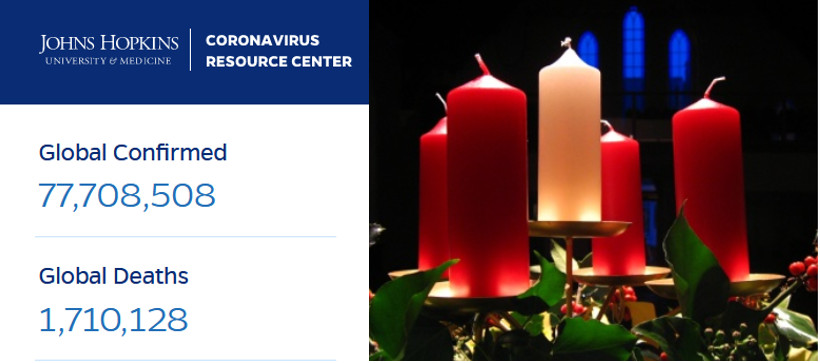
It is 20 weeks since I did my last blog, or ‘CoronaDiary’ as it was named for the Swansea University project that it became part of. It seems a long time ago but serves to show how time passes quickly after I decided that the time had come to stop, with things apparently starting to ‘slow down’, ‘getting under control’, ‘living with the new normal’ or any number of ways of describing life in late summer/early autumn. There was also a possible vaccine in development.
I started several times to write another instalment as events and key points in the story of this year were reached, but each time my enthusiasm to finish them waned. Due in part I suspect to not wanting to repeat the same themes I had visited before, but mainly due to the fact that we too were doing some of the things we hadn’t been able to. We were fortunate to be in a situation where we could take a week away to each of the Norfolk coast, Cornwall and North Yorkshire. In addition we enjoyed days out walking around the Cheshire countryside and Alyson managed some open water swimming at a nearby lake in Shropshire. The project I am working on with the accountancy practice in Sale was reaching the critical ‘go-live’ point, and Alyson was getting more NHS 111 home-based call centre shifts.
Deaths – a change of measure but still increasing quickly..
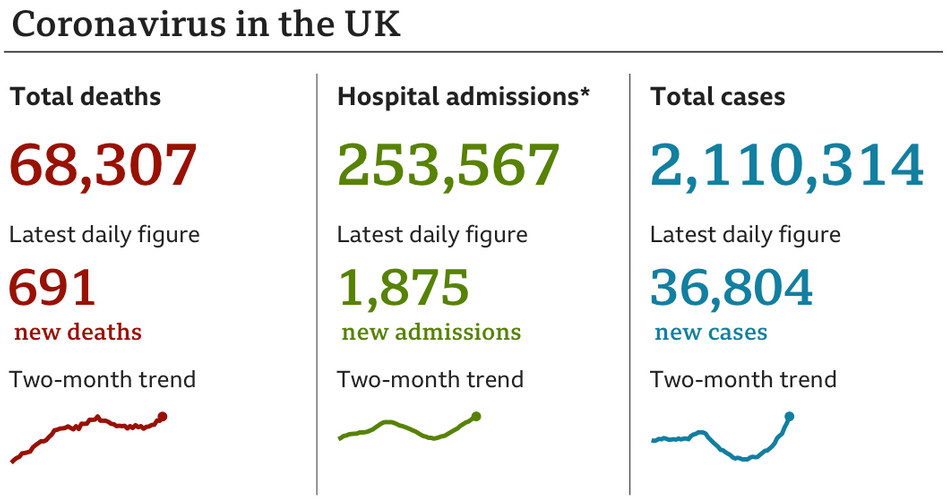
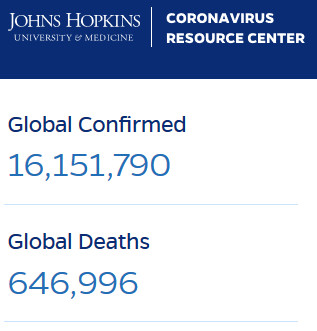
I had set myself the target of writing another blog when the official figures for the number of coronavirus deaths reached the level they were at my last blog, as the government reassessed them, just after I published it, in light of some ‘mis-recording’. On 12 August, the total fell by 5,000 overnight from 46,706 to 41,329. Until then a death was recorded for anyone who had tested positive for Covid-19 at any time, regardless of the cause. So someone who had died of a heart attack or in a car accident but had a positive test 10 weeks before was added to the virus statistics. It would take another 11 weeks to get back to 46,513 at the end of October – an average of 71 deaths per week. Just over 7 weeks later we have surpassed the grim figure of 60,000 to reach 68,307 – an average of 3,113 per week. The other measure of all deaths where coronavirus is mentioned on the certificate is likely to be over 80,000 by the end of the year.
Key events I could have written about…
There have been some major issues and milestones in the time since my last blog. Ones I have had strong feelings about are;
– The exam results ‘fiasco’
– The on-going story of migrants drowning whilst crossing the channel, and my idea of requisitioning unused cruise ships anchored off the south coast to give them decent accommodation.
– Introduction of the tiers system of restrictions
– My (and many others) perception that GPs are hiding away
– Schools and universities returning to full-time teaching
– A study I read on how the virus circulates indoor via ‘aerosol particles’
– ‘Circuit-breaker’ or second national lockdown
– President Trump catching Covid-19, US Election & refusal to accept the result
– Announcing the vaccination program earlier than planned on the day the report into the Home Secretary Priti Patel’s bullying behaviour was published.
– The seemingly endless Brexit negotiations/deadlines and extensions.
So why now…
The recent excitement over the new vaccines, the hope that brings of a ‘light at the end of the tunnel’, allied to planning for a small family Christmas get together was shattered by yesterday’s Government Briefing. Our Prime Minister, the only one in the World known mainly by his first name, Boris announced a new ‘Tier 4’ for London and the South East plus severe restrictions on ‘Christmas bubbles’ and the time they are allowed to meet. It seems like another one of the many ‘key points’ in the pandemic, coming as it does with the fact that a ‘new strain’ of the coronavirus that is much more effective at transmission is circulating and spreading rapidly through the population. The disease is called Covid-19 because it was in late December last year that the WHO office in China reported a ‘new type of pneumonia virus’ being reported in the area around the city of Wuhan. Whilst there is still some dispute about where it originated, the virus has been traced back to cases in mid-November. The first anniversary of the discovery of what we now call SARS-CoV-2 seems like a significant event to record in my blog.
For those with an interest in the science, the new variant is being referred to as SARS-CoV-2 VUI 202012/01 and the more detailed description of the mutation is as follows;
This variant has a mutation in the receptor binding domain (RBD) of the spike protein at position 501, where amino acid asparagine (N) has been replaced with tyrosine (Y). The shorthand for this mutation is N501Y, sometimes noted as S:N501Y to specify that it is in the spike protein. This variant carries many other mutations, including a double deletion (positions 69 and 70).
US Centers For Disease Control and Prevention, Emerging Variants Briefing December 2020.
It is this variation in the ‘spike protein’ that scientists think accounts for its ability for increased transmission by better binding to cells in people who get infected by the virus. It remains to be seen if the symptoms are more severe or if it is resistant to the vaccine, but the early signs are ‘hopeful’. What will certainly be the case is that the number of infections will rise and given the pattern up to now, many people will need some treatment in hospitals. This is the factor that may lead to ‘Lockdown v3.0’ and more damage to mental health and the economy.
In recent weeks I have been leading four sessions on the season of Advent with our church Bible study group and there are some themes which resonate with the current situation. As we approach the end of an extraordinary year and try to look forward to 2021 it seems an opportune moment to write down my personal thoughts and feelings. This blog has always been for my own reference, but I continue to be grateful for all the comments it attracts as each one is published.
Advent – the season of waiting – 2020 theme ‘Hope’….
It is only in the last few years, after 50+ years of being part the ‘Methodist Tradition’ through my church membership, that I have understood the ‘true meaning’ of Advent. For many it is ‘just the few weeks before Christmas’ but it is so much more than that. It is a time of ‘waiting’ and ‘anticipation’ during which we are called to lament/repent for all that has gone before and wait for the arrival of the long-promised ‘Light of the World’ to arrive in the form of a small child. Our fellow Christians in the Church of England, or ‘the Anglican Tradition’ recognise this in a more formal way. In the build up to Christmas they don’t sing ‘traditional carols’ and for them Christmas starts on the eve of the 25th December. It lasts for 12 days until Epiphany on the 6th January.
This year in the ‘real world’, the commercial one and the one that the church has hijacked from the original pagan ‘winter festival’, after all the upheaval of Covid and the challenges and illness and death, there has been a desire to ‘go early’. When I worked in retail pharmacy we would have started to plan for all the Christmas stock arrival earlier in the year. Indeed, during my time as Managing Director of our ‘Pharmacy Sundries’ subsidiary company, January would see me and the sales team attending trade fairs in the UK and Frankfurt in Germany, to meet suppliers from all over the globe to purchase, and in some cases ‘design’, the gifts our stores would sell during the ‘Christmas Season’. Stock would be ordered, shipped from China or India or wherever the suppliers were based, duty paid, containers received and unloaded at the warehouse, and delivered to the shops by a small fleet of vans ready to fill the shelves. There was always a tension between the warehouse wanting to get stock out (and our small company to invoice the larger one!) and the shops saying it was ‘too early’. In the end together with the retail marketing team for the shops we agreed a rough policy that, whilst stock could be delivered during September the, ‘big reveal’ would happen after the solemn celebration of Remembrance had taken place on November 11th. After that it was ‘all hands on deck’ to shift as much as we could. On a really good year our shops would be calling the warehouse in the second week of December pleading for us to send more – the items we had chosen that they were sceptical of selling were flying off the shelves. In the last week it might get to the point that shoppers were so desperate for a gift that even the stock we had left from previous years would look like the ideal gift for a family member!
It seems that a lot of people after the year they have had decided to ‘go early’. There was a rush to put up Christmas lights and decorations not just earlier but in bigger volumes than before. Around our estate there are so many whole garden displays and inflatable characters they can probably be seen from space! Goodness only knows what the electricity bills will be like in January. Shops have sold out and many Christmas tree growers have shut as all the stock has gone. There is an understandable desire from people wanting to celebrate and have something to look forward to. I confess to liking it, but it can get a bit wearing listening to hours of the old pop Christmas favourites from the 70s and 80s.
The theme for the Advent study we chose this year was ‘Hope’ which seemed appropriate for the year and is one aspect of the season along with joy, peace and love. As churches we have readings about John the Baptist and the Old Testament Prophets foretelling the arrival of The Messiah, the story of Mary and the journey towards Bethlehem. Many of us light four candles (and many ministers refer to the classic sketch on The Two Ronnies!) coloured red in an Advent wreath of holly, lighting the fifth white candle in the middle on Christmas day to represent Jesus. .
In many of our times of study we referenced the difficult times we have had during the pandemic. We would lament people we have lost, pray for support for those going through difficult times, missing friends and family contact, particularly those who know people in care homes or have not been able to attend the funeral of a family member. We have given thanks for the key workers helping us through difficult times. More recently we have given thanks for the God-given skills of the scientists for developing the vaccines, the hope that brings and the ability to start ‘looking forward’ in anticipation of a better 2021. Many of the Christmas cards we have received, had a handwritten note to reflect this hope too.
Watching Boris, Professor Chris Whitty, Chief Medical Officer and Sir Patrick Vallance, Government Chief Scientific Adviser on Saturday evening announcing the new ‘Tier 4’ measures, and limiting even more the Christmas travel and bubble arrangements, it would have been easy to find a new low of depression, and lack of optimism. Sunday morning’s news headlines on television and in the print media could be summed up as ‘Christmas Cancelled’. During the summer and into the early autumn with infection rates falling, deaths levelling-off to a figure that we could probably live with, health services opening, people going back to work and children to school, things appeared a little brighter. Despite having to take a lot of measures on our holiday in Norfolk and again when we went to the lodge in Great Ayton, North Yorkshire, and the early figures for the ‘second wave’ seeming not to be as high as the first, my optimism was still there.
It was whilst ‘attending’ (via You Tube) the live streamed service from Methodist Central Hall Westminster (MCHW) on Sunday morning that I decided to write this blog. MCHW of course is now in Tier 4 so the chances of a few people attending the church physically on Christmas Day has gone. The reading was about Mary and her willingness to carry the child that would become our Saviour. We sang Joy To The World and O Come All Ye Faithful and accepted the challenge from Rev Gordon to take up whatever challenges we will face in the coming months. Both Gordon and Rev Tony who leads the service said that although we were in lockdown, Christmas itself wasn’t cancelled. Tony said he had received a humorous text about there being ‘only 370 more sleeps to Christmas’ but he wanted to state that wasn’t true. I posted the image below on my Facebook page on Monday and it attracted many likes…
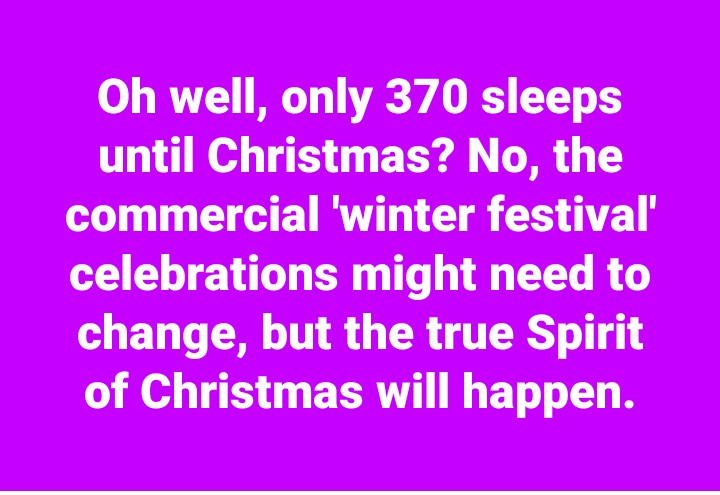
The commercial ‘winter festival’ may have been curtailed and many would not be able to see family and friends, but nothing is going to stop Christmas being Christmas for Christians. It brought to mind this tweet from earlier in the week reminding us that other religions had their celebrations ‘cancelled’ at even shorter notice – in some cases the evening before the big family gatherings.
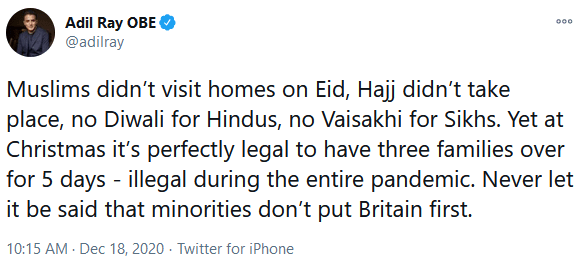
Admittedly, some replies pointed out that Easter was ‘cancelled’ at the start of lockdown and, as happens on social media these days, there were plenty of racist comments, but the point was the same one I had made the night before Eid. ‘Imagine the uproar if they cancelled Christmas…’
The most striking interview I saw on Sunday morning was with Rev Justin Welby, Archbishop of Canterbury on the BBC’s Andrew Marr Show. It appeared to me that the leader of our national church was shaken by the events of Saturday and, like many of us, struggling with an inner voice that was saying to him ‘I am really not sure that my faith is strong enough for this…’. But he found another inner voice and rallied to assure us that Christmas would indeed happen on the appointed day. He also talked movingly about the ‘hole in the celebration’ left by those who can’t be with us, either because they have died or are alone in a place we can’t travel to. He encouraged us all to celebrate the great festival by remembering those who have died, talking about them, and for those who are isolated to pick up the phone and speak to them. He encouraged the vulnerable not to attend church but to call one of the many phone numbers with services, carols or prayers being broadcast.
Some of the many people with a spare place at the table are the family of our school friend Clare who died in November aged just 61 from motor neurone disease diagnosed five years ago. Clare is the first of our contemporaries that we have kept in touch with for over 50 years to go. It is as much a sobering reminder of our own mortality as it is sad. It was also our first (and probably not last) ‘virtual funeral’, we watched the live stream whilst listening to the music chosen by Clare herself on You Tube.
As I sang along watching the service from Westminster to O Come All You Faithful I remembered the Christmas of 2016 when my dad died. We were celebrating at a cottage on the North York Moors with Alyson’s family. Dad was on end-of-life care in a nursing home nearby, and died the day we were leaving the cottage. You can read about that in the blog that I wrote at the time . I asked the minister if we could sing the hymn at dad’s funeral as he was a long-time member of the church choir and hadn’t managed to sing it that year. Rev Ruth said that it was a great idea and all we needed to change was the last verse usually sung on Christmas Day from ‘Yea we greet thee born this happy morning’ to …that happy morning..’. Alyson’s dad who was 90 and not in good health gave a short speech during Christmas Day lunch suggesting that this might be the last one he had with us. He died later that year in October.
So we had two Christmases in a row with spare places at the table. Such is the ‘circle of life’, we have lost Alyson’s mum since, but this year we have two small boys born to our nieces since. They represent the joy, love and hope of the Advent season.
Final thoughts and looking to the future…
There will be three households with us on Christmas Day, but only four people – Alyson and I, and our two sons who are single-person households. We will social distance as much as we can and maybe even eat outside. Other than that we have several ‘Zoom’ catch-ups planned with other family members and friends. We had one last weekend with my brothers and cousins (my older brother lives in San Jose California, 6 miles from the global Zoom HQ so was supporting one of his ‘local businesses’!). We have had one ‘virtual Christmas party’ with the head injury charity I am a member and trustee of. Ready-made meals were delivered along with a box of crackers, hats and gifts. We played charades, told jokes from the crackers and even tried to sing some carols. A great time was had by all who attended.
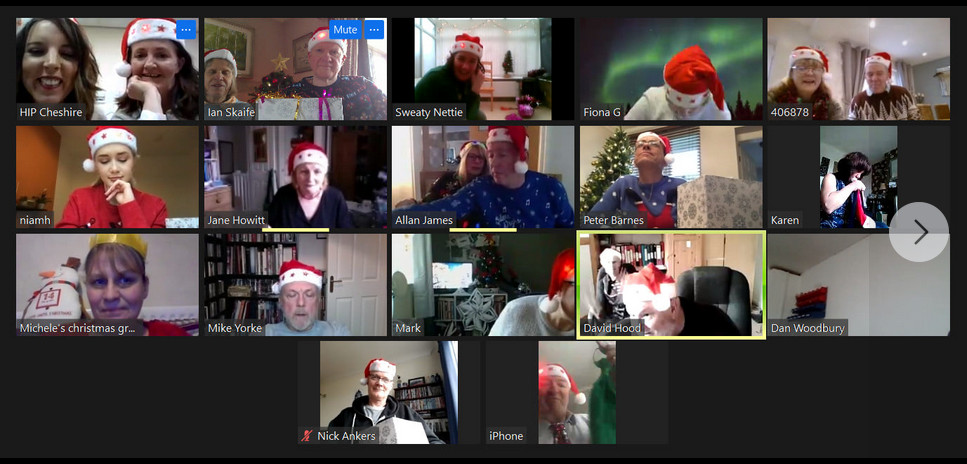
I heard from another friend that the company he works at had a ‘Zoom office party’ that started at 8pm and for some people went on until 6am. Apparently, the ability to drink and not have to drive home led to some problems with people saying and doing things that they would regret when reading the ‘chat’ the next day. So it seems a virtual party can be as good or bad as a real-world one!
I like to think I have always been generally an optimistic person, trying to see the positive in both situations and in people I meet. Alyson thinks I am a bit too laid back and even naive, and reminds me that earlier in the year I was still hoping that we would be able to get a sunny holiday overseas and was one of those who said it would be all over by Christmas. I try to find hope in the vaccination program but recognise that our governments record for ‘ramping up’ the testing capacity could induce pessimism that our ability to vaccinate the estimated 16.5 million people aged over 60. To get this done before Easter, considering the five weeks to achieve full immunity, will require an average of two million vaccinations each week. There have been half a million people vaccinated in the two weeks since 90-year-old Margaret Keenan became the first person on 8 December. We need an eight-fold increase in that rate if we are to reach the Easter target.
As I reflect on the end of a very strange and difficult year, my faith is strong, and my optimism remains at a high level. The hours of daylight are increasing from today, and I am looking forward to 2021
 Skat's Chat