Coronavirus week 19 – That didn’t last long…second wave starting

A short heatwave but signs of another wave of infection.

According to one of the weather forecasters I heard, to qualify as a heatwave there needs to be a period of three days of higher than average temperatures, but ours this week was only one day. It was 20-21 degrees on Thursday and reasonably sunny, by Friday afternoon it was 35 but by the evening it was cloudy muggy and raining and on Saturday it was back to 21 with a cool wind and some showers.

At the end of my last blog I suggested that I may not do another for a few weeks as things appeared to have reached a ‘steady state’, with falling numbers of deaths and a ‘levelling off’ in the number of infections. That idea didn’t even last for 24 hours. It wasn’t that a couple of people were kind enough to comment on my Facebook post saying that they enjoyed reading them; it was watching Channel 4 News on Monday evening.  It’s a way of getting updated on current events that I get the most from. All day ‘rolling news’ is a great thing, something we never had in ‘the good old days’ when there were only three or four terrestrial television channels. The problem is that even  BBC News 24, whose coverage I also enjoy, only touch the surface of a story. I don’t want to sound like a ‘grumpy old man’, but programme makers appear to think we are incapable of listening for more than 90 seconds, or in ITV’s case, that we also need the chance to win a £150,000 prize of gifts we probably don’t need.

Anyway, it was watching the news on Monday evening that there were so many items I wanted to write about, many of them linked to each other or to coronavirus. Hence this blog with all the topics originating with the items on that edition.

Holidaymakers returning from mainland Spain complaining that there were more cases of the virus on one caravan park in Shropshire, than the whole of the Balearic Islands, and they felt safer in a country where everyone was obeying the rules on social distancing and hygiene. By the evening, the islands had been included. Transport minister Grant Shapps went to Spain but had to isolate when he came back on Wednesday. I admit to thinking that I would go if insured, and suffer two weeks quarantine or extend the holiday as I was sure there would be extra capacity. By the end of the week, however, as local lockdown was declared for large parts of Greater Manchester, Lancashire, and West Yorkshire, like others I suspect, I was more doubtful.  I listened to arguments about having to declare whole countries as giving a simpler message than trying to exclude certain areas, and had to agree. Whilst the Canaries are further from mainland Spain than Venice is from London, it would not be difficult to get around the rules by taking a flight from the mainland to the islands and return from there. There is also the danger of catching the virus and having to be in hospital in a foreign country possibly for a long time where the care may be excellent, but my Spanish is almost non-existent.

Despite early criticism there appeared to be more acceptance later in the week when the rates of infection in Belgium (which had one of the highest rates in Europe in the earlier part of the pandemic), and Luxembourg, were rising very quickly. It seems a ‘second wave’ is starting to spread across Europe.

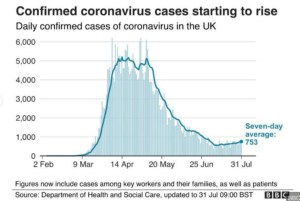
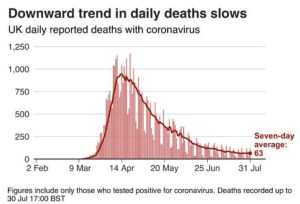
In the UK cases were definitely rising with average daily cases approaching 800 at the end of the week. The fact that average daily deaths was still falling to about 60 at the end of the week, could point to two things; that the lag between cases and serious illness is not showing yet, or that it is mainly younger people getting infections and they don’t generally suffer with the more life-threatening symptoms.
Boris says ‘get on your bike’…

Boris encouraged us (like Norman Tebbit in 1981) to ‘get on our bikes’, but this time not to look for work, but in an effort to fight obesity. The web site handing out free £50 vouchers to get bikes repaired crashed due to demand. Not surprising for £2.5million of untargeted benefits. Many would be snapped up by those who could well afford to repair the bicycle that had lain neglected in the garage for years. It all seemed a bit of a headline-grabbing gimmick. Boris has previous on this topic. As Mayor of London he encouraged people to use a Transport for London (TfL) scheme for hiring simple bicycles parked in many areas in the city to travel to other areas. Registered users could take any of the 5,000 cycles from any of the 315 docking stations in central London to any other for a relatively small fee. This was in 2010 and proved successful. The original bikes were sponsored by Barclays bank with a blue highlight. The scheme was transferred to Santander bank with the current ones mainly red and there are now 11,000 bikes and 800 ‘stations’ spread across 40 square miles of London. 

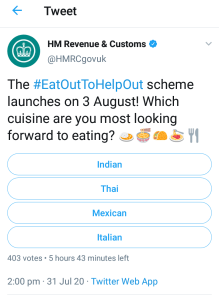
In a week of mixed messages I had one alert from GOV.UK announcing a ban on buy one get one free offers on unhealthy food, and the next one reminded me that I could go to the pub or restaurant and taxpayers will give me 50% off any meal. This is for as many times as I like. So presumably I could get a first course with chips, followed by a chocolate brownie/ice cream / sticky toffee pudding (with extra chocolate sauce) for 12 days (it’s only Monday-Wednesday) from 3rd to 31st August. All washed down with a nice glass of wine or beer – but don’t worry the discount is not off those and they don’t contain many calories. Even HMRC were putting out Tweets about the offer – even if they couldn’t bring themselves to think people might want other European or even British menus…?
The idea of making it a requirement to put calories on all restaurant menus is a good one, but many pubs and fast-food sites do that now. The problem appears to be the ‘education’ needed to allow us to make the healthier choices.

Channel 4 News had an interview with chef Jamie Oliver (who also has years of campaigning for us to make more healthy choices. He made the point that the good quality food is more expensive, and those with less money can only afford the ‘less good’. Rather than taxing sugar, he suggested that perhaps we should be subsidising healthier food.

It could be that this approach to obesity, exercise and healthy eating was related to Boris’s own experience of Covid-19 and the realisation that his own health may have meant not seeing his fiancee and young child? There are many in the Conservative Party who decry the so-called ‘Nanny State’ (itself a posh expression), but a government that claims to have been ‘following the science and experts’ appears in the past to have paid more attention to the food and drink industry lobbyists than ‘health experts’ when deciding policies. Like tobacco before it, the ‘curse of sugar’ needs mass cultural and social change if it is to be effective.

What it doesn’t need is ‘fat-shaming’ and judging people by their apparent excess weight. The majority of our population have some problems maintaining a healthy diet. No one wakes up one day and finds themselves several stones overweight.  The busyness of our lives and availability of cheap food make it hard to change. I have the luxury of a good income, the space to own an exercise bike, and a pleasant area go out for a run. In my case I have made a conscious decision to change, and am currently about a stone less in weight than I was at the start of March. I also know it will be a struggle to keep this way once we get back to eating out again on a regular basis.  I often wonder how people in poverty-stricken countries who have to walk miles to get clean water or a meagre amount of food to take back to a house with no electricity, would make of our kitchen cupboards and American-style double refrigerators. As if that wasn’t enough for them to take in, imagine trying to explain that we then pay a membership of £360 a year for the privilege of driving, three or more times a week ,to a large warehouse full of bicycles that don’t move and treadmills. All in an effort to lose the excess body mass we have!

The next item of news last Monday was one on rehabilitation from the after effects of having Covid-19, or one of its variants dubbed ‘Long Covid’, as the fatigue and memory issues and muscle weakness can last for months (maybe even years, we don’t know yet). The item showed a group using a gym closed due to lockdown, and sharing experiences with people who have been through the same thing.  This is just like my journey after brain injury, when I found the charity that brings together people from all parts of society and background to share with each other. Access to physio and rehab services across the country is patchy at best, but so vital. All of this should have happened years ago. There is a small charity that works with people who have been in intensive care for long periods of time. Patients may be physically well, but the mental effects can last a very long time.  If this step of physio is missing or not done thoroughly, there is more of a cost to the country in terms of lost working days and productivity, as well as actual treatment, medicines, and care in old age. It makes no sense health wise or economically, not having these services readily available for everyone.

The final two articles on the Monday evening news was one that US president Trump’s security advisor had tested positive, after a trip to Florida ,where there is a rise in cases of Covid-19.  Then that Brazil’s president Bolsanaro has been reported to the International Criminal Court, by an umbrella group representing health worker unions and social care organisations, for ignoring and mishandling the crisis. Their claim of crimes against humanity amounting to genocide are unlikely to be taken on by the ICC but demonstrate the strong feelings in the country.  There was an interview (on BBC news!) with a doctor in a hospital in Sao Paulo stating that they had people turn up at hospital still claiming it was all false and a hoax – but when they ended up in intensive care they say ‘doctor don’t let me die and tell my family to take care!’ 

Other news last week.

  • We watched Jimmy McGovern’s powerful drama imagining the life Anthony Walker a young black man killed aged just 18 in 2005. He wanted to become a barrister. His mum asked the writer to show him qualifying against all the odds, marrying his (white) girlfriend at the time of his death, having a child and saving his best man from a life of crime by taking him to live with his family after becoming destitute. It brought me to tears. 
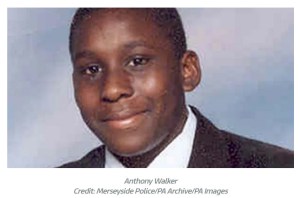
    Anthony’s mother, Gee Walker, has setup a trust in his name and as a Christian she believed this was part of Anthony’s legacy.  This will be something that is hard for those without a faith to accept. But I believe, as his mother hopes, that despite not becoming a civil rights lawyer and going to America, Anthony’s legacy through the work his mum does, and the effect of this drama, means more people could be touched. Some small comfort to his brave mum.
  • Late Thursday evening health secretary Matt Hancock announced that Greater Manchester, East Lancashire and parts of West Yorkshire were told to go into a ‘local lockdown’. This was due to a ‘spike in cases’ from people going into each other’s homes. There was some confusion and a great deal of contention from the Muslim population as it was the eve of Eid one of the major feasts of Islam. One leader likened it to cancelling the Christmas Day at 9 o’clock on Christmas Eve, although another did acknowledge that when the original lockdown was imposed many Christians had to miss Easter Day celebrations.
    Writing as someone who is doing project work for a company in Sale, there was concern that some members of the team who had only returned to work because their parents could look after the children again, may have to go back on furlough until the lockdown was over.
  • Another member of the team at the company developed some symptoms and was relieved when their test came back negative – but they had to wait over 3 days for the result.
  • One report from Manchester showed a street where many of the rainbow posters drawn to put in windows to celebrate the NHS Heroes were faded and torn….perhaps a sign of how quickly we forget?
  • One of the most worrying statements last week was from Professor Chris Whitty as he stood next to Boris Johnson at a Downing Street press conference on Friday announcing that the opening of face to face beauty treatments and bowling alleys was to be delayed for a further two weeks at least. He said

“I think what we’re seeing from the data from ONS, and other data, is that we have probably reached near the limit or the limits of what we can do in terms of opening up society.

“So what that means potentially is that if we wish to do more things in the future, we may have to do less of some other things.”

He expanded to say that if we are to get children back to school in September we may need to close some other places (pubs perhaps?) or put new limits on what people can do and who they can meet.

It really does feel this week that we are not in a ‘steady state’ anymore….!

How was week 19 for us?

After weeks of training and struggling with IT and ‘HR’ Alyson finally managed to book a few shifts on NHS 111 service…but only as reserve. She responded ‘I don’t want to be a reserve I want to be on the first team!’ Her wish came true on Friday when she was given just 20 minutes notice that she was working an 8-hour shift. This was due to late cancellations by two other people on the shifts. The deal is that people are supposed to get 24 hours’ notice. So, she managed to cancel one and worked 4-8pm. It was a tough shift, not only with the types of call, but using the systems for the first time. Reflecting afterwards Alyson felt that she had helped people at a difficult time, and knew that the next shift(s) would be better.

We both signed up as volunteers for vaccine trial in conjunction with the NHS and a pharmaceutical company. Unlike last week’s attempt we both passed the age & health requirements.

After the very warm day of Friday we went to Coventry for a ‘socially distanced picnic’ in a large park to meet up with Alyson’s sister and brother and their families in  Coventry. It was good to see everyone again including our two boys and our nieces. There were three generations and one of our nieces is expecting her first child in October  – she works in a hospital so was concerned about getting too close to us, but I think she enjoyed the day. The only member of the family who couldn’t come was our nephew who returned from the Spanish Balearic Island of Majorca so was self-isolating in his London flat.

On Sunday I attended my now weekly Zoom service at Westminster Central Hall Methodist Church. It was great to be part of a ‘congregation’ of over 1,100 people sharing in worship. Rev Howard Mellor gave an amazing sermon on the ‘original picnic’, the feeding of the 5,000, a miracle told in exactly the same way in all four gospels. Howard pointed out a small word that I had not noticed before – grass! Despite the disciples only having meagre rations of five loaves and two fishes, and thinking that was not enough to feed the crowd, Jesus managed to make it sufficient for all the people (more than 5,000 when including the women and children) and ‘still there were 12 baskets left over’. All this in an area which, because of the grass, was clearly a place of abundance where crops could grow. Howard’s message to those of us hoping to be modern day ‘good disciples’ was however little (in terms of skills and gifts) we think we have, if we give it to Jesus, he can help us achieve so much more than we ever believed.

Stay safe and let’s see if there is enough for another blog next week!
Coronavirus weeks 16 & 17 – will it all be over by Christmas?

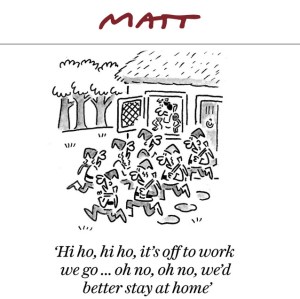
Hi ho, hi ho, it’s off to work we go..

I couldn’t decide whether to title this blog ‘it will be all over by Christmas’ or the one I settled on. Unlike Boris Johnson and his government, on balance I decided to ‘trust the scientists’.  There are still too many unknowns to be sure. I acknowledge that the recent announcements were a ‘hope’ rather than an assertion, and one role of government is to ‘get the economy going’ in order to raise the funds needed to do all the spending needed, and there will be harm to health if there is mass unemployment and economic hardship.

The dilemma was summed up by Matt Pritchett’s cartoon in The Telegraph newspaper on Saturday.

Alyson asked me how I felt about the announcement and I replied honestly that I was conflicted. On the day when the statistics on deaths and new cases were also thrown into confusion (or to be precise more confusion), this added to my uncertainty. I have looked at statistics in an earlier blog, and whilst the figure for ‘excess deaths’ produced by the ONS is a more reliable figure, I have stated the daily announced figures from the government briefings in each blog. I am no longer able to do that as they are no longer being declared. It seems that we have been counting as a ‘daily death’ in England if someone dies of any cause but had been tested positive in the last few months. The example used was somebody having a positive test in March and then dying from a heart attack in June. The effects of any ‘error’ in these figures may be a few thousand, and acknowledging that every death is tragic, but in the overall view it will make little difference.

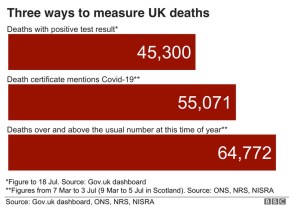
The best estimate we can manage is that the 7-day rolling average death toll is currently around 69 per day, slightly down on previous weeks. Average new cases have steadied off but are now rising slightly again to 621 per day.  The government has three ways of measuring total deaths with differing time periods as below.

The other change recently, and one that is probably the way forward, is looking at much more localised figures, along with giving local authorities and public health managers the ability to put in effective measures – the idea of ‘local lockdowns’. I wrote a few weeks ago that local systems had been dismantled and now they will have more of a role to play. This is the current data on ‘areas of concern’.
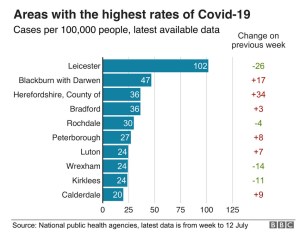
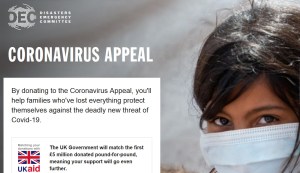

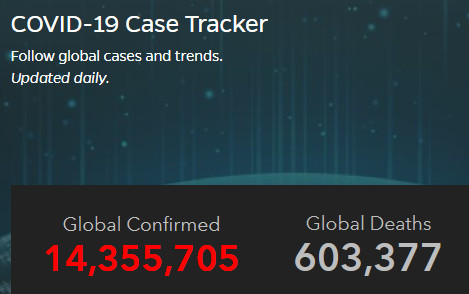
Before leaving statistics for this week, as I write the levels of coronavirus globally are still rising and the number of daily infections is the highest recorded so far with the WHO putting it at 259,848 with 7,360 more deaths. So while the situation in our country is levelling off, this still remains a global pandemic – a fact that we all need constantly reminding of. The Disasters Emergency Committee (DEC) appeal to help those around the world where Covid-19 is adding to poverty, famine, war and poor health provision is one example of people trying to help others in a practical way. It is good to see UKAid matching the donations as well.

New ways of working and a new economy.

Anecdotally, there is a reluctance to return to ‘normal work’ and particularly in office situations. This may be due to safety concerns, childcare or possibly that people are learning that there is more to life than commuting in crowded public transport, or sitting in a traffic queue. Whatever the reasons I do think there will be, to use a phrase from my last blog, ‘a reorientation’ of the world of work. People do want to spend more quality time with family, taking exercise outdoors, working remotely, and spending less on ‘stuff’ we accumulate. Endless ‘consuming’ of the world’s resources and damaging our environment are topics that will be higher on the agenda. These are complex and interrelated issues and some initial questions that need exploring and debating politically are;

  • Economically can we come up with a new model where value is derived from providing more ‘services’ and ‘experiences’ than from manufacturing things?
  • How will money flow from those providing such things and those paying for them?
  • Will there be sufficient tax income to enable government/society to provide essential services such as education, health and social care, and a ‘safety net’ for those unable to take part due to disability, health or social conditions?
  • Who will be the people/organisations willing to invest in these new ways of working/supplying?

I worry that it is all too easy for employers to simply ask people to work from home without providing the necessary environment for that to happen effectively.  Those, like us, who are lucky enough to have a large house with two rooms we can dedicate to be ‘offices’,  with good connectivity and equipment will be able to do more effective work. However, imagine being in a shared flat in the centre of a city where four or more 18-35 year-olds are trying to sit on a bed with a laptop for hours on end, not having enough bandwidth to download data or stream video, having to be ‘available’ for your ‘boss/supervisor’ whenever they choose. Possibly you will need to be close enough to travel into the office once a week/twice a month for face to face group meetings or to talk to clients/customers. You will be stuck in a no-win situation of neither being able to move to less expensive places to get on the property ladder, or having little time to take advantage of the social interactions needed to build up any sort of ‘team / business’ culture that separates good organisations from the merely satisfactory.

There could be upsides to this if planned effectively. If there is a collapse in the commercial property sector with large office blocks being freed up, then these could be re-purposed for affordable city living, and shops on deserted high streets in smaller towns could be converted to ‘work hubs’ where people could travel short distances to ‘hot-desk’ in comfortable offices with good connectivity, shared meeting spaces and good facilities. This would allow the separation of home from work that many desire, but still leave time to spend on leisure/social activities with friends and family. If I was a larger company wondering where my market was going, this is what I would be investing in.

Why the virus will be dangerous for a long time

The other aspect of the current situation that we need to resolve in this country is the suggestion (or is it a fact?) that the ‘virus is going to be with us for a long time’. Given there are countries across the world who have been through a very hot summer and also ones where there have been winters, it seems the virus is not affected by either. There were two snippets of news that I heard, but have not been able to research much at the time of writing, which are potentially worrying.

  1.  The virus is mutating (as all viruses like the flu one do) and the ‘second’ virus which mutated from the one originating in Wuhan is now the ‘dominant’ one and causing the current pandemic.
  2. Having antibodies from an infection of coronavirus is not a guarantee that you will be able to resist a second bout of infection – the antibodies are not ‘long-lasting’.

The two issues are interrelated, and both make it hard to produce an effective vaccine. There is no evidence that the mutation makes the virus more transmissible which is the other worry. We have been lucky in one regard that although the current version of the coronavirus is quite easy to catch, it only appears to seriously affect certain sections of the population, with many getting mild symptoms.

If we had taken more notice and put in systems and plans after previous outbreaks of MERS, SARS and Swine Flu, outcomes may have been better. We have had plenty of warnings. It is vital that we learn lessons as the real ‘doomsday scenario’ is that the next virus might be all of the following;

  • Very easily transmissible via contact or being airborne.
  • Able to last for a long time on many surfaces and in many environmental conditions.
  • Affect almost everyone who gets it in an extremely serious or deadly way.

The nearest we came to this was SARS which was quite hard to catch and cross borders, but spread to 26 countries and killed almost 10% of those who caught it . It was contained in a relatively small area of the world, and this is why wearing masks and contact tracing is more accepted in south Asia than in Europe or The Americas.  MERS was relatively short-lived and contained but with a death rate of around 35%. Both of them killed between 700-900 each. Swine flu in 2009 is thought to have killed between 123,000 and 200,000 globally, spreading to 214 countries in a year, but being a variant of the ‘flu’ virus many older people already had some immunity to it.

The so-called ‘second wave’ in the coming winter in  the UK will be due to a combination of a new variant of seasonal flu, added to coronavirus, and no effective vaccine for either.  In the good weather of the summer and autumn people are willing to meet outside or queue to get into shops, but imagine the effect of cold and wet conditions on our willingness to do those things. This is the reason leading members of the SAGE group continue to push hygiene measures and social distancing as effective measures ‘for many months ahead’.

Other news in the past two weeks.

  • A support package for performing arts and venues was announced and welcomed, but there are still many who will not survive and thousands of performers and technicians who rely on seasonal income are outside the scheme.
  • The environmental damage caused by careless disposal of billions of pieces of PPE that contain ‘single use plastics’ had added to the amount of micro-plastics in our oceans and on land. Much of the PPE should be classed as ‘clinical waste’ and incinerated but personal masks and gloves are being thrown away much like other litter. The increasing use of takeaway food from restaurants has added to this.
  • Wearing of face coverings in shops is to be compulsory from 24th July, but the police are not willing (quite rightly in my opinion) to enforce the new law which is more than guidance.
  • There doesn’t appear to have been a steep increase in new cases as a result of opening of pubs and restaurants and other shops.
  • There has definitely been an increase in traffic as junctions 16-19 of the M6 motorway near to us are back on the travel news with queues and accidents.
  • Gyms, swimming pools and beauty parlours can re-open.
  • Another example of ‘police brutality’ appeared on social media in England with a young white policeman kneeling on the neck of a black man. There were examples of young black couples being stopped and aggressively searched for driving in a new expensive Mercedes, and in another case for parking outside their house in a mainly white residential area.

How were weeks 16 and 17 for us?

Our main news from the past fortnight and the reason there wasn’t a separate blog for week 16 is that we have been on one of the holidays we booked last year.  A five-hour drive to a small National Trust cottage on the north Norfolk coast next to a disused windmill. It was very pleasant and great to be in a different and new place. Being self-catering and just the two of us it felt ‘normal’. Even for July the caravan park we were in was very quiet. We were not able to book a place to eat as the pubs were all booked up, and we did have to queue outside the small deli and convenience shop in the village. We walked miles of coastal path, went for two 6k runs and managed to keep social distances. We had a couple of ice creams, and ate pizza outside from a manor house with outside tables, we walked to one evening.
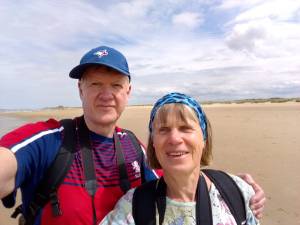
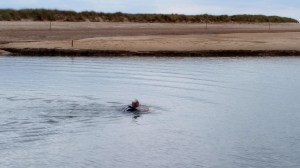
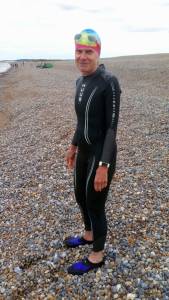
We visited several beaches which were busy with car parking but large enough to keep a decent distance and had clean and available toilet facilities. Alyson even managed to christen her new wetsuit with two swims in the sea, and on one of them she was joined by two grey seals sharing the same inlet.

Apart from having to plan stops on the way there and back – at a supermarket in Grantham on the way there and a farm cafe on the way back, our journeys were relatively straightforward. We noticed the extra traffic on the roads on our journey home last Friday as the official school holidays have started so it may be a different picture in the next few weeks.


I went to a meeting in the accountant’s office in Sale for a face to face project meeting on Wednesday 8th, and it felt strange but there were only nine of the usual 20+ people in so it was all very safe, and we managed to keep social distancing. It was much easier than holding a planning meeting via Zoom and sharing screens.

That evening I attended a church meeting via Zoom with 12 of us from across our district to look at grant funding applications. We decided that it worked so well, we would continue meeting this way in the future. It saves many of our group travelling for over an hour to an office so is ‘greener’, and we can get more people attending. It will be more pleasant than driving the narrow roads in Cheshire and Staffordshire on cold wet winter evenings.

David tried wearing his mask in a shop but declared himself feeling very claustrophobic so decided he would go shopping just once a week.

Michael has managed a few days in The Lake District in a remote cottage on his own and enjoyed early morning walks.

Stay safe everyone. 

Life & Death – Coronavirus week 4 – ‘Squashing the sombrero’

Care homes and the elderly – a hidden crisis revealed?

This week’s main headlines have been dominated by two main issues. The first was around how many people have died from the effects of Covid-19 in care homes and the community. This has put a spotlight on how much this area of our health and social care system appears to have been forgotten, with an extra 4,000 deaths to be added to the total which stands at 16,060 at the end of the week.

I do think after this is all over it will be an issue of collective shame that ‘we’ didn’t bring the care sector into the national effort sooner. Perhaps we assumed that these people were already ‘shielded’ by being in a closed environment; or did we subconsciously think that as they were older, with some nearing the end of their lives, it would be sad, but not so disastrous if that end came sooner.

The other main issue of the week was the review of the lockdown that under the emergency powers the government has taken, needs to be looked at every three weeks. There were calls from the new Labour leader, Keir Starmer, for the government to layout the plans for how the restrictions may be eased. This was echoed by the end of the week when Conservative Ian Duncan Smith MP, a former Work & Pensions Secretary called for ministers to treat the country as grown-ups and not children who couldn’t understand.

We were told that any talk of lifting the lockdown in a few weeks might be giving ‘mixed messages, and lead to us not carrying on with the strict regime. I do begin to understand this, but my analogy would be that when you go on a package holiday and the rep tells you to be at the airport in three weeks for your return flight, I don’t think many people turn up for the flight the next day. They are two quite simple messages. It was good to hear that there is a group of experts looking at what other countries are doing, and data is being collected on the effectiveness of softening each measure.

The discussions are happening anyway, and it seems logical to ‘reverse’ the measures we put in place. This means children (or at least some year groups) going back to school, perhaps after the original end of May Bank Holiday half-term. Then opening some health care settings like dentists, opticians, chiropodists etc (with of course relevant safety measures in place). This could be followed by garden centres and DIY stores so that people can carry on with projects at home and give those businesses for who this season is a large part of their turnover, some much needed cash and return of profit. Many people who are working from home could continue to do so. I hear anecdotally  that many of them like the new way with not having to commute. I imagine those who have been furloughed on 80% (particularly those who are being paid the extra 20%) are enjoying their ‘sabbatical’ and if the good weather continues would be more than happy to carry on.

The government briefings continue to push the message of carrying on until we see a change in the data, and that the peak of infections/hospital admissions has not yet been reached. It came as no surprise that on Thursday it was announced that current measures will be in place until at least the 7th of May. As that is the start of the VE Day (Victory in Europe) Bank Holiday weekend, my own view is that they will be in place until that is over.

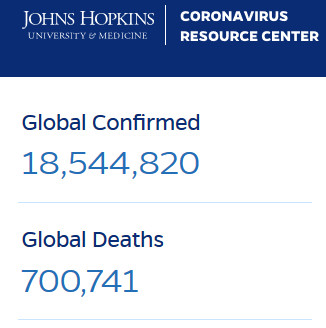
As the figures in the main image show, the death toll across the world keeps rising.  I admit to spending a lot of time looking at graphs trying to interpret ‘trends’.  However, without some deep grounding in statistical methods and how data is reported, some graphs can be ‘misleading’. I have even seen ‘logarithmic scales’ used for the vertical axis of ‘number of deaths’ which flattens the curve and lessens the steepness of the rise. Education is so important in these matters, but some of our journalists appear to think that cramming a few minutes of research via a search engine on epidemiology allows them to ask ‘searching questions’ of the health and science experts. One even got antibody (to see if someone has had the virus in the past and developed some immunity) and antigen tests (finding if someone has the infection now) mixed up.

The figures in this article come from Johns (notice the extra ‘s’) Hopkins University web site. They have a useful set of visual tools that display the data on Covid-19 from all over the world, updated daily.

You need to understand what a ‘normal distribution curve’ is to know what the line and the space under it mean. The graphs below appear to give some hope that the ‘curve is flattening’ and, as Boris put it so colourfully in an early press conference, we are ‘squashing the sombrero’.   These are today’s curves of reported cases.

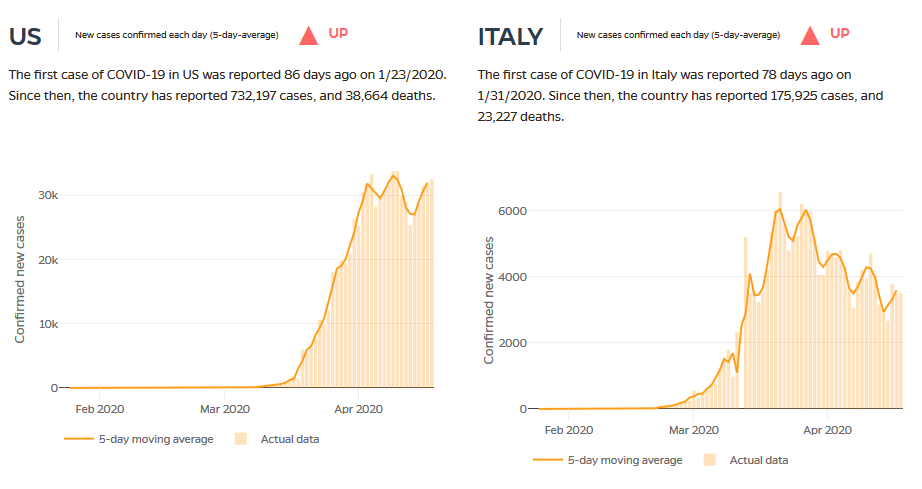
Coronavirus Cases US & Italy 19 April

Even these diagrams have very different vertical axes with some in thousands and some tens of thousands. They are useful to see overall trends in the number of cases, but this is dependent upon the same testing regime being in place in a country for the period reported, and even more so when comparing different countries.

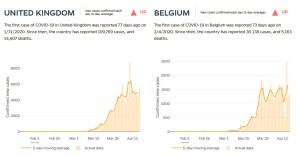
This is the one that compares the UK and Belgium.

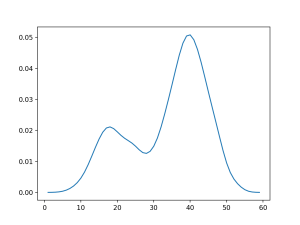
The danger of trying to read trends in these curves is that they could be a small part of an even larger curve or the start of several ‘small peaks’ that go on and on. Looking at the curve below for example, in the data above, we might not quite be at point 20 on the horizontal axis.

The important thing to understand, should this be true, is that the area under the curve represents the total number of deaths. I heard one epedemiologist modelling the outbreak estimate that if we added the extra care home and community deaths, which could be as high as 50%, then even if there is a single ‘normal curve’ we need to double the total deaths currently, resulting in a figure in excess of 40,000.

To add some more ‘worrying’ numbers into the mix if, as some experts are saying, only 15% of the population have had the virus, then to get to the 60% required for the original plan of ‘herd immunity’ would require a total of four such curves and associated lockdowns. It does seem that the crisis will continue in some extended form for many more months.

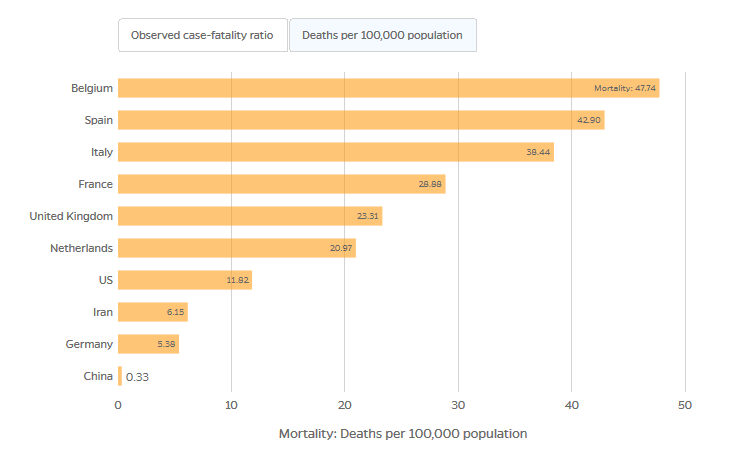
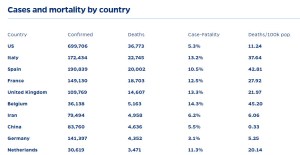
Population numbers and density in a country are important factors that allow another way of looking at the figures. Consider the graphic below showing the number of deaths per 100,000 of the population. with a table below it showing some numbers.

Coronavirus Worldwide Mortality Rate April 2020

These figures are from a few days ago and some countries are at different stages of their outbreak.  There have been questions over the reporting in China where it is alleged that some of the administrators at a state level could be underreporting  numbers for fear of upsetting the central Communist Party. The figures were amended this week on the day China announced a negative Gross Domestic Product (GDP) rate for the first time in nearly 40 years.

Other news items this week.

  • ‘Captain Tom’ who I mentioned last week has now raised over £26 million and promised to keep walking as long as people keep giving.
  • In many countries with more ‘authoritarian’ regimes, there have been examples of extra surveillance via mobile phone location data, and extreme violence by police under the guise of enforcing the measures.
  • Protests have taken place in the USA and Brazil against the lockdowns showing that individuals are rebelling against the situation. In our country, apart from a few examples people have been generally compliant. No one wants to think about us getting the stage of extreme disorder and looting that has been part of the ‘Hollywood narrative’ in the disaster/survival movie genres.
  • President Trump continues to make headlines after declaring himself the only person who could decide when states release lockdown. This is not the legal situation as each of the states has a separate ‘government’ in their federal system. The next day he announced his decision….that each governor could decide when and how to lift their lockdown!

Thoughts at the end of week 4.

The virus has come closer to us after a member of my head injury charity, monthly coffee morning group, died of Covid-19 on Thursday. Blythe had some underlying issues but she was doing well at home after a spell in a care home before Christmas. Another person I know is in hospital with the virus but fortunately not in ICU.

The mother of the partner of one of our nieces died 13 days ago, not of the virus, but his father couldn’t visit her in the nursing home, and the family had the problem of organising a funeral under the new regulations . In addition our niece was furloughed and her partner told to take a 30% pay cut, at a time when his company wanted him to work from home and do even longer hours.

We are still managing to get some daily exercise and no problems with food or other supplies. We have had many Zoom coffee meet-ups with family and friends. I helped lead a Zoom Bible study group on Wednesday evening. We are ready for another extended period of lockdown and the forecast good weather is a real bonus. Alyson is missing trips to see wildlife away from our suburban estate, but is making the most of walks along a stream in woodland nearby.

We are doing more reading, watching films and recorded ‘live musicals’ shows on the Internet. Attending a live-streamed church service from Methodist Central Hall in London is now part of my Sunday routine.

Stay safe and, God-willing, there will be another blog next week.

Theology Everywhere

Discuss theology today to transform tomorrow

verbalising

ruminations on life at fifty ... or so ...

Discover WordPress

A daily selection of the best content published on WordPress, collected for you by humans who love to read.

The Daily Post

The Art and Craft of Blogging

WordPress.com News

The latest news on WordPress.com and the WordPress community.