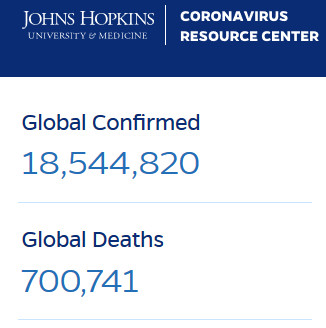
A short heatwave but signs of another wave of infection.
According to one of the weather forecasters I heard, to qualify as a heatwave there needs to be a period of three days of higher than average temperatures, but ours this week was only one day. It was 20-21 degrees on Thursday and reasonably sunny, by Friday afternoon it was 35 but by the evening it was cloudy muggy and raining and on Saturday it was back to 21 with a cool wind and some showers.
At the end of my last blog I suggested that I may not do another for a few weeks as things appeared to have reached a ‘steady state’, with falling numbers of deaths and a ‘levelling off’ in the number of infections. That idea didn’t even last for 24 hours. It wasn’t that a couple of people were kind enough to comment on my Facebook post saying that they enjoyed reading them; it was watching Channel 4 News on Monday evening. It’s a way of getting updated on current events that I get the most from. All day ‘rolling news’ is a great thing, something we never had in ‘the good old days’ when there were only three or four terrestrial television channels. The problem is that even BBC News 24, whose coverage I also enjoy, only touch the surface of a story. I don’t want to sound like a ‘grumpy old man’, but programme makers appear to think we are incapable of listening for more than 90 seconds, or in ITV’s case, that we also need the chance to win a £150,000 prize of gifts we probably don’t need.
Anyway, it was watching the news on Monday evening that there were so many items I wanted to write about, many of them linked to each other or to coronavirus. Hence this blog with all the topics originating with the items on that edition.
Holidaymakers returning from mainland Spain complaining that there were more cases of the virus on one caravan park in Shropshire, than the whole of the Balearic Islands, and they felt safer in a country where everyone was obeying the rules on social distancing and hygiene. By the evening, the islands had been included. Transport minister Grant Shapps went to Spain but had to isolate when he came back on Wednesday. I admit to thinking that I would go if insured, and suffer two weeks quarantine or extend the holiday as I was sure there would be extra capacity. By the end of the week, however, as local lockdown was declared for large parts of Greater Manchester, Lancashire, and West Yorkshire, like others I suspect, I was more doubtful. I listened to arguments about having to declare whole countries as giving a simpler message than trying to exclude certain areas, and had to agree. Whilst the Canaries are further from mainland Spain than Venice is from London, it would not be difficult to get around the rules by taking a flight from the mainland to the islands and return from there. There is also the danger of catching the virus and having to be in hospital in a foreign country possibly for a long time where the care may be excellent, but my Spanish is almost non-existent.
Despite early criticism there appeared to be more acceptance later in the week when the rates of infection in Belgium (which had one of the highest rates in Europe in the earlier part of the pandemic), and Luxembourg, were rising very quickly. It seems a ‘second wave’ is starting to spread across Europe.
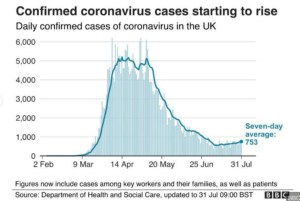
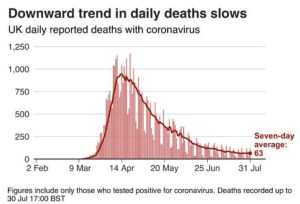
In the UK cases were definitely rising with average daily cases approaching 800 at the end of the week. The fact that average daily deaths was still falling to about 60 at the end of the week, could point to two things; that the lag between cases and serious illness is not showing yet, or that it is mainly younger people getting infections and they don’t generally suffer with the more life-threatening symptoms.
Boris says ‘get on your bike’…
Boris encouraged us (like Norman Tebbit in 1981) to ‘get on our bikes’, but this time not to look for work, but in an effort to fight obesity. The web site handing out free £50 vouchers to get bikes repaired crashed due to demand. Not surprising for £2.5million of untargeted benefits. Many would be snapped up by those who could well afford to repair the bicycle that had lain neglected in the garage for years. It all seemed a bit of a headline-grabbing gimmick. Boris has previous on this topic. As Mayor of London he encouraged people to use a Transport for London (TfL) scheme for hiring simple bicycles parked in many areas in the city to travel to other areas. Registered users could take any of the 5,000 cycles from any of the 315 docking stations in central London to any other for a relatively small fee. This was in 2010 and proved successful. The original bikes were sponsored by Barclays bank with a blue highlight. The scheme was transferred to Santander bank with the current ones mainly red and there are now 11,000 bikes and 800 ‘stations’ spread across 40 square miles of London.
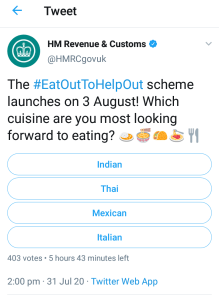
In a week of mixed messages I had one alert from GOV.UK announcing a ban on buy one get one free offers on unhealthy food, and the next one reminded me that I could go to the pub or restaurant and taxpayers will give me 50% off any meal. This is for as many times as I like. So presumably I could get a first course with chips, followed by a chocolate brownie/ice cream / sticky toffee pudding (with extra chocolate sauce) for 12 days (it’s only Monday-Wednesday) from 3rd to 31st August. All washed down with a nice glass of wine or beer – but don’t worry the discount is not off those and they don’t contain many calories. Even HMRC were putting out Tweets about the offer – even if they couldn’t bring themselves to think people might want other European or even British menus…?
The idea of making it a requirement to put calories on all restaurant menus is a good one, but many pubs and fast-food sites do that now. The problem appears to be the ‘education’ needed to allow us to make the healthier choices.
Channel 4 News had an interview with chef Jamie Oliver (who also has years of campaigning for us to make more healthy choices. He made the point that the good quality food is more expensive, and those with less money can only afford the ‘less good’. Rather than taxing sugar, he suggested that perhaps we should be subsidising healthier food.
It could be that this approach to obesity, exercise and healthy eating was related to Boris’s own experience of Covid-19 and the realisation that his own health may have meant not seeing his fiancee and young child? There are many in the Conservative Party who decry the so-called ‘Nanny State’ (itself a posh expression), but a government that claims to have been ‘following the science and experts’ appears in the past to have paid more attention to the food and drink industry lobbyists than ‘health experts’ when deciding policies. Like tobacco before it, the ‘curse of sugar’ needs mass cultural and social change if it is to be effective.
What it doesn’t need is ‘fat-shaming’ and judging people by their apparent excess weight. The majority of our population have some problems maintaining a healthy diet. No one wakes up one day and finds themselves several stones overweight. The busyness of our lives and availability of cheap food make it hard to change. I have the luxury of a good income, the space to own an exercise bike, and a pleasant area go out for a run. In my case I have made a conscious decision to change, and am currently about a stone less in weight than I was at the start of March. I also know it will be a struggle to keep this way once we get back to eating out again on a regular basis. I often wonder how people in poverty-stricken countries who have to walk miles to get clean water or a meagre amount of food to take back to a house with no electricity, would make of our kitchen cupboards and American-style double refrigerators. As if that wasn’t enough for them to take in, imagine trying to explain that we then pay a membership of £360 a year for the privilege of driving, three or more times a week ,to a large warehouse full of bicycles that don’t move and treadmills. All in an effort to lose the excess body mass we have!
The next item of news last Monday was one on rehabilitation from the after effects of having Covid-19, or one of its variants dubbed ‘Long Covid’, as the fatigue and memory issues and muscle weakness can last for months (maybe even years, we don’t know yet). The item showed a group using a gym closed due to lockdown, and sharing experiences with people who have been through the same thing. This is just like my journey after brain injury, when I found the charity that brings together people from all parts of society and background to share with each other. Access to physio and rehab services across the country is patchy at best, but so vital. All of this should have happened years ago. There is a small charity that works with people who have been in intensive care for long periods of time. Patients may be physically well, but the mental effects can last a very long time. If this step of physio is missing or not done thoroughly, there is more of a cost to the country in terms of lost working days and productivity, as well as actual treatment, medicines, and care in old age. It makes no sense health wise or economically, not having these services readily available for everyone.
The final two articles on the Monday evening news was one that US president Trump’s security advisor had tested positive, after a trip to Florida ,where there is a rise in cases of Covid-19. Then that Brazil’s president Bolsanaro has been reported to the International Criminal Court, by an umbrella group representing health worker unions and social care organisations, for ignoring and mishandling the crisis. Their claim of crimes against humanity amounting to genocide are unlikely to be taken on by the ICC but demonstrate the strong feelings in the country. There was an interview (on BBC news!) with a doctor in a hospital in Sao Paulo stating that they had people turn up at hospital still claiming it was all false and a hoax – but when they ended up in intensive care they say ‘doctor don’t let me die and tell my family to take care!’
Other news last week.
- We watched Jimmy McGovern’s powerful drama imagining the life Anthony Walker a young black man killed aged just 18 in 2005. He wanted to become a barrister. His mum asked the writer to show him qualifying against all the odds, marrying his (white) girlfriend at the time of his death, having a child and saving his best man from a life of crime by taking him to live with his family after becoming destitute. It brought me to tears.
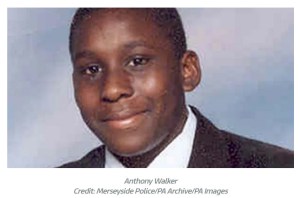 Anthony’s mother, Gee Walker, has setup a trust in his name and as a Christian she believed this was part of Anthony’s legacy. This will be something that is hard for those without a faith to accept. But I believe, as his mother hopes, that despite not becoming a civil rights lawyer and going to America, Anthony’s legacy through the work his mum does, and the effect of this drama, means more people could be touched. Some small comfort to his brave mum.
 - Late Thursday evening health secretary Matt Hancock announced that Greater Manchester, East Lancashire and parts of West Yorkshire were told to go into a ‘local lockdown’. This was due to a ‘spike in cases’ from people going into each other’s homes. There was some confusion and a great deal of contention from the Muslim population as it was the eve of Eid one of the major feasts of Islam. One leader likened it to cancelling the Christmas Day at 9 o’clock on Christmas Eve, although another did acknowledge that when the original lockdown was imposed many Christians had to miss Easter Day celebrations.
Writing as someone who is doing project work for a company in Sale, there was concern that some members of the team who had only returned to work because their parents could look after the children again, may have to go back on furlough until the lockdown was over. - Another member of the team at the company developed some symptoms and was relieved when their test came back negative – but they had to wait over 3 days for the result.
- One report from Manchester showed a street where many of the rainbow posters drawn to put in windows to celebrate the NHS Heroes were faded and torn….perhaps a sign of how quickly we forget?
- One of the most worrying statements last week was from Professor Chris Whitty as he stood next to Boris Johnson at a Downing Street press conference on Friday announcing that the opening of face to face beauty treatments and bowling alleys was to be delayed for a further two weeks at least. He said
“I think what we’re seeing from the data from ONS, and other data, is that we have probably reached near the limit or the limits of what we can do in terms of opening up society.
“So what that means potentially is that if we wish to do more things in the future, we may have to do less of some other things.”
He expanded to say that if we are to get children back to school in September we may need to close some other places (pubs perhaps?) or put new limits on what people can do and who they can meet.
It really does feel this week that we are not in a ‘steady state’ anymore….!
How was week 19 for us?
After weeks of training and struggling with IT and ‘HR’ Alyson finally managed to book a few shifts on NHS 111 service…but only as reserve. She responded ‘I don’t want to be a reserve I want to be on the first team!’ Her wish came true on Friday when she was given just 20 minutes notice that she was working an 8-hour shift. This was due to late cancellations by two other people on the shifts. The deal is that people are supposed to get 24 hours’ notice. So, she managed to cancel one and worked 4-8pm. It was a tough shift, not only with the types of call, but using the systems for the first time. Reflecting afterwards Alyson felt that she had helped people at a difficult time, and knew that the next shift(s) would be better.
We both signed up as volunteers for vaccine trial in conjunction with the NHS and a pharmaceutical company. Unlike last week’s attempt we both passed the age & health requirements.
After the very warm day of Friday we went to Coventry for a ‘socially distanced picnic’ in a large park to meet up with Alyson’s sister and brother and their families in Coventry. It was good to see everyone again including our two boys and our nieces. There were three generations and one of our nieces is expecting her first child in October – she works in a hospital so was concerned about getting too close to us, but I think she enjoyed the day. The only member of the family who couldn’t come was our nephew who returned from the Spanish Balearic Island of Majorca so was self-isolating in his London flat.
On Sunday I attended my now weekly Zoom service at Westminster Central Hall Methodist Church. It was great to be part of a ‘congregation’ of over 1,100 people sharing in worship. Rev Howard Mellor gave an amazing sermon on the ‘original picnic’, the feeding of the 5,000, a miracle told in exactly the same way in all four gospels. Howard pointed out a small word that I had not noticed before – grass! Despite the disciples only having meagre rations of five loaves and two fishes, and thinking that was not enough to feed the crowd, Jesus managed to make it sufficient for all the people (more than 5,000 when including the women and children) and ‘still there were 12 baskets left over’. All this in an area which, because of the grass, was clearly a place of abundance where crops could grow. Howard’s message to those of us hoping to be modern day ‘good disciples’ was however little (in terms of skills and gifts) we think we have, if we give it to Jesus, he can help us achieve so much more than we ever believed.
Stay safe and let’s see if there is enough for another blog next week!
 Skat's Chat