Hi ho, hi ho, it’s off to work we go..
I couldn’t decide whether to title this blog ‘it will be all over by Christmas’ or the one I settled on. Unlike Boris Johnson and his government, on balance I decided to ‘trust the scientists’. There are still too many unknowns to be sure. I acknowledge that the recent announcements were a ‘hope’ rather than an assertion, and one role of government is to ‘get the economy going’ in order to raise the funds needed to do all the spending needed, and there will be harm to health if there is mass unemployment and economic hardship.
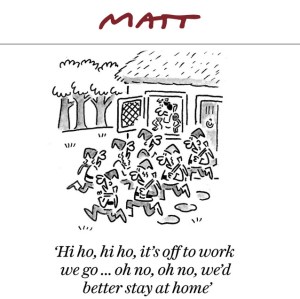
The dilemma was summed up by Matt Pritchett’s cartoon in The Telegraph newspaper on Saturday.
Alyson asked me how I felt about the announcement and I replied honestly that I was conflicted. On the day when the statistics on deaths and new cases were also thrown into confusion (or to be precise more confusion), this added to my uncertainty. I have looked at statistics in an earlier blog, and whilst the figure for ‘excess deaths’ produced by the ONS is a more reliable figure, I have stated the daily announced figures from the government briefings in each blog. I am no longer able to do that as they are no longer being declared. It seems that we have been counting as a ‘daily death’ in England if someone dies of any cause but had been tested positive in the last few months. The example used was somebody having a positive test in March and then dying from a heart attack in June. The effects of any ‘error’ in these figures may be a few thousand, and acknowledging that every death is tragic, but in the overall view it will make little difference.
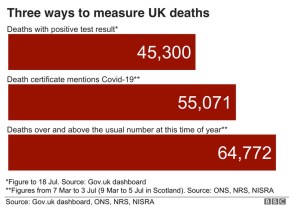
The best estimate we can manage is that the 7-day rolling average death toll is currently around 69 per day, slightly down on previous weeks. Average new cases have steadied off but are now rising slightly again to 621 per day. The government has three ways of measuring total deaths with differing time periods as below.
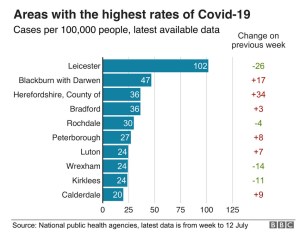
 The other change recently, and one that is probably the way forward, is looking at much more localised figures, along with giving local authorities and public health managers the ability to put in effective measures – the idea of ‘local lockdowns’. I wrote a few weeks ago that local systems had been dismantled and now they will have more of a role to play. This is the current data on ‘areas of concern’.
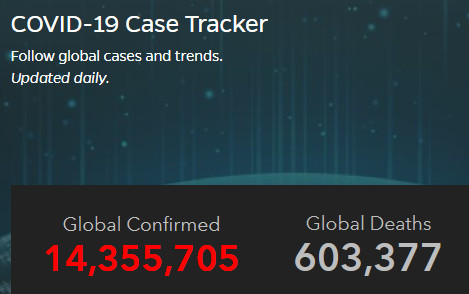
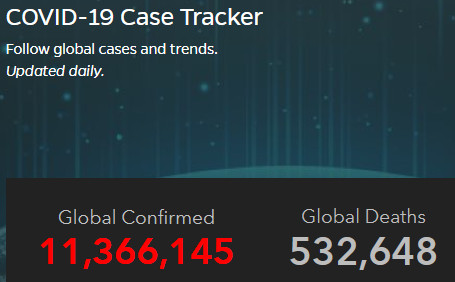
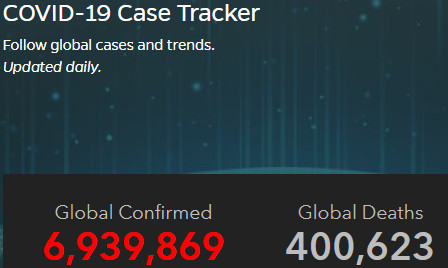
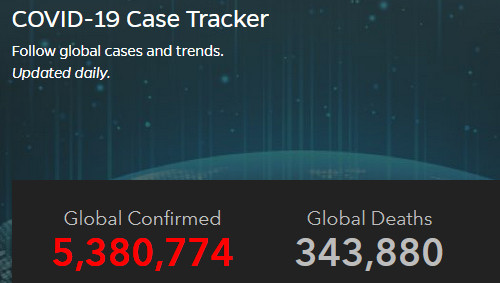
Before leaving statistics for this week, as I write the levels of coronavirus globally are still rising and the number of daily infections is the highest recorded so far with the WHO putting it at 259,848 with 7,360 more deaths. So while the situation in our country is levelling off, this still remains a global pandemic – a fact that we all need constantly reminding of. The Disasters Emergency Committee (DEC) appeal to help those around the world where Covid-19 is adding to poverty, famine, war and poor health provision is one example of people trying to help others in a practical way. It is good to see UKAid matching the donations as well.
New ways of working and a new economy.
Anecdotally, there is a reluctance to return to ‘normal work’ and particularly in office situations. This may be due to safety concerns, childcare or possibly that people are learning that there is more to life than commuting in crowded public transport, or sitting in a traffic queue. Whatever the reasons I do think there will be, to use a phrase from my last blog, ‘a reorientation’ of the world of work. People do want to spend more quality time with family, taking exercise outdoors, working remotely, and spending less on ‘stuff’ we accumulate. Endless ‘consuming’ of the world’s resources and damaging our environment are topics that will be higher on the agenda. These are complex and interrelated issues and some initial questions that need exploring and debating politically are;
- Economically can we come up with a new model where value is derived from providing more ‘services’ and ‘experiences’ than from manufacturing things?
- How will money flow from those providing such things and those paying for them?
- Will there be sufficient tax income to enable government/society to provide essential services such as education, health and social care, and a ‘safety net’ for those unable to take part due to disability, health or social conditions?
- Who will be the people/organisations willing to invest in these new ways of working/supplying?
I worry that it is all too easy for employers to simply ask people to work from home without providing the necessary environment for that to happen effectively. Those, like us, who are lucky enough to have a large house with two rooms we can dedicate to be ‘offices’, with good connectivity and equipment will be able to do more effective work. However, imagine being in a shared flat in the centre of a city where four or more 18-35 year-olds are trying to sit on a bed with a laptop for hours on end, not having enough bandwidth to download data or stream video, having to be ‘available’ for your ‘boss/supervisor’ whenever they choose. Possibly you will need to be close enough to travel into the office once a week/twice a month for face to face group meetings or to talk to clients/customers. You will be stuck in a no-win situation of neither being able to move to less expensive places to get on the property ladder, or having little time to take advantage of the social interactions needed to build up any sort of ‘team / business’ culture that separates good organisations from the merely satisfactory.
There could be upsides to this if planned effectively. If there is a collapse in the commercial property sector with large office blocks being freed up, then these could be re-purposed for affordable city living, and shops on deserted high streets in smaller towns could be converted to ‘work hubs’ where people could travel short distances to ‘hot-desk’ in comfortable offices with good connectivity, shared meeting spaces and good facilities. This would allow the separation of home from work that many desire, but still leave time to spend on leisure/social activities with friends and family. If I was a larger company wondering where my market was going, this is what I would be investing in.
Why the virus will be dangerous for a long time
The other aspect of the current situation that we need to resolve in this country is the suggestion (or is it a fact?) that the ‘virus is going to be with us for a long time’. Given there are countries across the world who have been through a very hot summer and also ones where there have been winters, it seems the virus is not affected by either. There were two snippets of news that I heard, but have not been able to research much at the time of writing, which are potentially worrying.
- The virus is mutating (as all viruses like the flu one do) and the ‘second’ virus which mutated from the one originating in Wuhan is now the ‘dominant’ one and causing the current pandemic.
- Having antibodies from an infection of coronavirus is not a guarantee that you will be able to resist a second bout of infection – the antibodies are not ‘long-lasting’.
The two issues are interrelated, and both make it hard to produce an effective vaccine. There is no evidence that the mutation makes the virus more transmissible which is the other worry. We have been lucky in one regard that although the current version of the coronavirus is quite easy to catch, it only appears to seriously affect certain sections of the population, with many getting mild symptoms.
If we had taken more notice and put in systems and plans after previous outbreaks of MERS, SARS and Swine Flu, outcomes may have been better. We have had plenty of warnings. It is vital that we learn lessons as the real ‘doomsday scenario’ is that the next virus might be all of the following;
- Very easily transmissible via contact or being airborne.
- Able to last for a long time on many surfaces and in many environmental conditions.
- Affect almost everyone who gets it in an extremely serious or deadly way.
The nearest we came to this was SARS which was quite hard to catch and cross borders, but spread to 26 countries and killed almost 10% of those who caught it . It was contained in a relatively small area of the world, and this is why wearing masks and contact tracing is more accepted in south Asia than in Europe or The Americas. MERS was relatively short-lived and contained but with a death rate of around 35%. Both of them killed between 700-900 each. Swine flu in 2009 is thought to have killed between 123,000 and 200,000 globally, spreading to 214 countries in a year, but being a variant of the ‘flu’ virus many older people already had some immunity to it.
The so-called ‘second wave’ in the coming winter in the UK will be due to a combination of a new variant of seasonal flu, added to coronavirus, and no effective vaccine for either. In the good weather of the summer and autumn people are willing to meet outside or queue to get into shops, but imagine the effect of cold and wet conditions on our willingness to do those things. This is the reason leading members of the SAGE group continue to push hygiene measures and social distancing as effective measures ‘for many months ahead’.
Other news in the past two weeks.
- A support package for performing arts and venues was announced and welcomed, but there are still many who will not survive and thousands of performers and technicians who rely on seasonal income are outside the scheme.
- The environmental damage caused by careless disposal of billions of pieces of PPE that contain ‘single use plastics’ had added to the amount of micro-plastics in our oceans and on land. Much of the PPE should be classed as ‘clinical waste’ and incinerated but personal masks and gloves are being thrown away much like other litter. The increasing use of takeaway food from restaurants has added to this.
- Wearing of face coverings in shops is to be compulsory from 24th July, but the police are not willing (quite rightly in my opinion) to enforce the new law which is more than guidance.
- There doesn’t appear to have been a steep increase in new cases as a result of opening of pubs and restaurants and other shops.
- There has definitely been an increase in traffic as junctions 16-19 of the M6 motorway near to us are back on the travel news with queues and accidents.
- Gyms, swimming pools and beauty parlours can re-open.
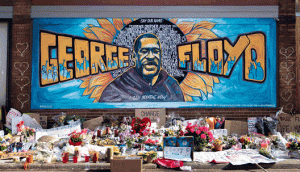
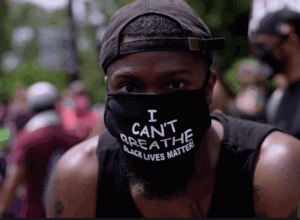
- Another example of ‘police brutality’ appeared on social media in England with a young white policeman kneeling on the neck of a black man. There were examples of young black couples being stopped and aggressively searched for driving in a new expensive Mercedes, and in another case for parking outside their house in a mainly white residential area.
How were weeks 16 and 17 for us?
Our main news from the past fortnight and the reason there wasn’t a separate blog for week 16 is that we have been on one of the holidays we booked last year. A five-hour drive to a small National Trust cottage on the north Norfolk coast next to a disused windmill.  It was very pleasant and great to be in a different and new place. Being self-catering and just the two of us it felt ‘normal’. Even for July the caravan park we were in was very quiet. We were not able to book a place to eat as the pubs were all booked up, and we did have to queue outside the small deli and convenience shop in the village. We walked miles of coastal path, went for two 6k runs and managed to keep social distances. We had a couple of ice creams, and ate pizza outside from a manor house with outside tables, we walked to one evening.
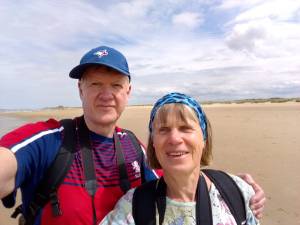
We visited several beaches which were busy with car parking but large enough to keep a decent distance and had clean and available toilet facilities. 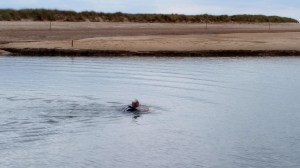
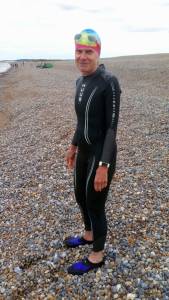 Alyson even managed to christen her new wetsuit with two swims in the sea, and on one of them she was joined by two grey seals sharing the same inlet.
Apart from having to plan stops on the way there and back – at a supermarket in Grantham on the way there and a farm cafe on the way back, our journeys were relatively straightforward. We noticed the extra traffic on the roads on our journey home last Friday as the official school holidays have started so it may be a different picture in the next few weeks.
I went to a meeting in the accountant’s office in Sale for a face to face project meeting on Wednesday 8th, and it felt strange but there were only nine of the usual 20+ people in so it was all very safe, and we managed to keep social distancing. It was much easier than holding a planning meeting via Zoom and sharing screens.
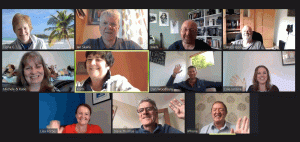
That evening I attended a church meeting via Zoom with 12 of us from across our district to look at grant funding applications. We decided that it worked so well, we would continue meeting this way in the future. It saves many of our group travelling for over an hour to an office so is ‘greener’, and we can get more people attending. It will be more pleasant than driving the narrow roads in Cheshire and Staffordshire on cold wet winter evenings.
David tried wearing his mask in a shop but declared himself feeling very claustrophobic so decided he would go shopping just once a week.
Michael has managed a few days in The Lake District in a remote cottage on his own and enjoyed early morning walks.
Stay safe everyone.


 More worrying than President Trump’s personal medication was a warning from the White House’s coronavirus taskforce member Dr Anthony Fauci that new localized outbreaks were “inevitable” as mitigation measures are relaxed, leading to the need to put in place a further lockdown. Given the dependence of the world’s economy on that of the US, however much we wish it didn’t, the decisions of the administration are vital to the rest of us.
 Skat's Chat