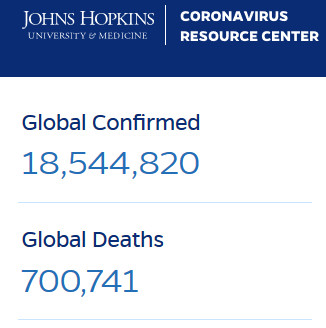
Coronavirus week 19 – That didn’t last long…second wave starting

A short heatwave but signs of another wave of infection.

According to one of the weather forecasters I heard, to qualify as a heatwave there needs to be a period of three days of higher than average temperatures, but ours this week was only one day. It was 20-21 degrees on Thursday and reasonably sunny, by Friday afternoon it was 35 but by the evening it was cloudy muggy and raining and on Saturday it was back to 21 with a cool wind and some showers.

At the end of my last blog I suggested that I may not do another for a few weeks as things appeared to have reached a ‘steady state’, with falling numbers of deaths and a ‘levelling off’ in the number of infections. That idea didn’t even last for 24 hours. It wasn’t that a couple of people were kind enough to comment on my Facebook post saying that they enjoyed reading them; it was watching Channel 4 News on Monday evening.  It’s a way of getting updated on current events that I get the most from. All day ‘rolling news’ is a great thing, something we never had in ‘the good old days’ when there were only three or four terrestrial television channels. The problem is that even  BBC News 24, whose coverage I also enjoy, only touch the surface of a story. I don’t want to sound like a ‘grumpy old man’, but programme makers appear to think we are incapable of listening for more than 90 seconds, or in ITV’s case, that we also need the chance to win a £150,000 prize of gifts we probably don’t need.

Anyway, it was watching the news on Monday evening that there were so many items I wanted to write about, many of them linked to each other or to coronavirus. Hence this blog with all the topics originating with the items on that edition.

Holidaymakers returning from mainland Spain complaining that there were more cases of the virus on one caravan park in Shropshire, than the whole of the Balearic Islands, and they felt safer in a country where everyone was obeying the rules on social distancing and hygiene. By the evening, the islands had been included. Transport minister Grant Shapps went to Spain but had to isolate when he came back on Wednesday. I admit to thinking that I would go if insured, and suffer two weeks quarantine or extend the holiday as I was sure there would be extra capacity. By the end of the week, however, as local lockdown was declared for large parts of Greater Manchester, Lancashire, and West Yorkshire, like others I suspect, I was more doubtful.  I listened to arguments about having to declare whole countries as giving a simpler message than trying to exclude certain areas, and had to agree. Whilst the Canaries are further from mainland Spain than Venice is from London, it would not be difficult to get around the rules by taking a flight from the mainland to the islands and return from there. There is also the danger of catching the virus and having to be in hospital in a foreign country possibly for a long time where the care may be excellent, but my Spanish is almost non-existent.

Despite early criticism there appeared to be more acceptance later in the week when the rates of infection in Belgium (which had one of the highest rates in Europe in the earlier part of the pandemic), and Luxembourg, were rising very quickly. It seems a ‘second wave’ is starting to spread across Europe.

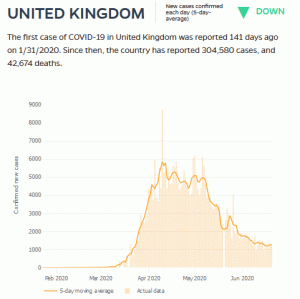
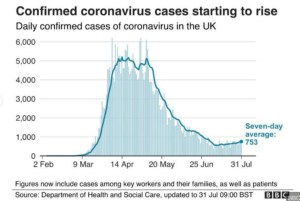
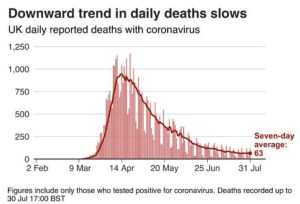
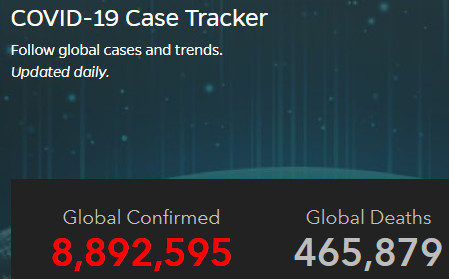
In the UK cases were definitely rising with average daily cases approaching 800 at the end of the week. The fact that average daily deaths was still falling to about 60 at the end of the week, could point to two things; that the lag between cases and serious illness is not showing yet, or that it is mainly younger people getting infections and they don’t generally suffer with the more life-threatening symptoms.
Boris says ‘get on your bike’…

Boris encouraged us (like Norman Tebbit in 1981) to ‘get on our bikes’, but this time not to look for work, but in an effort to fight obesity. The web site handing out free £50 vouchers to get bikes repaired crashed due to demand. Not surprising for £2.5million of untargeted benefits. Many would be snapped up by those who could well afford to repair the bicycle that had lain neglected in the garage for years. It all seemed a bit of a headline-grabbing gimmick. Boris has previous on this topic. As Mayor of London he encouraged people to use a Transport for London (TfL) scheme for hiring simple bicycles parked in many areas in the city to travel to other areas. Registered users could take any of the 5,000 cycles from any of the 315 docking stations in central London to any other for a relatively small fee. This was in 2010 and proved successful. The original bikes were sponsored by Barclays bank with a blue highlight. The scheme was transferred to Santander bank with the current ones mainly red and there are now 11,000 bikes and 800 ‘stations’ spread across 40 square miles of London. 

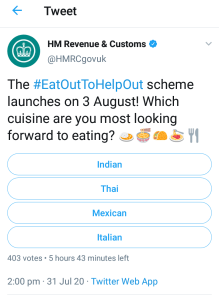
In a week of mixed messages I had one alert from GOV.UK announcing a ban on buy one get one free offers on unhealthy food, and the next one reminded me that I could go to the pub or restaurant and taxpayers will give me 50% off any meal. This is for as many times as I like. So presumably I could get a first course with chips, followed by a chocolate brownie/ice cream / sticky toffee pudding (with extra chocolate sauce) for 12 days (it’s only Monday-Wednesday) from 3rd to 31st August. All washed down with a nice glass of wine or beer – but don’t worry the discount is not off those and they don’t contain many calories. Even HMRC were putting out Tweets about the offer – even if they couldn’t bring themselves to think people might want other European or even British menus…?
The idea of making it a requirement to put calories on all restaurant menus is a good one, but many pubs and fast-food sites do that now. The problem appears to be the ‘education’ needed to allow us to make the healthier choices.

Channel 4 News had an interview with chef Jamie Oliver (who also has years of campaigning for us to make more healthy choices. He made the point that the good quality food is more expensive, and those with less money can only afford the ‘less good’. Rather than taxing sugar, he suggested that perhaps we should be subsidising healthier food.

It could be that this approach to obesity, exercise and healthy eating was related to Boris’s own experience of Covid-19 and the realisation that his own health may have meant not seeing his fiancee and young child? There are many in the Conservative Party who decry the so-called ‘Nanny State’ (itself a posh expression), but a government that claims to have been ‘following the science and experts’ appears in the past to have paid more attention to the food and drink industry lobbyists than ‘health experts’ when deciding policies. Like tobacco before it, the ‘curse of sugar’ needs mass cultural and social change if it is to be effective.

What it doesn’t need is ‘fat-shaming’ and judging people by their apparent excess weight. The majority of our population have some problems maintaining a healthy diet. No one wakes up one day and finds themselves several stones overweight.  The busyness of our lives and availability of cheap food make it hard to change. I have the luxury of a good income, the space to own an exercise bike, and a pleasant area go out for a run. In my case I have made a conscious decision to change, and am currently about a stone less in weight than I was at the start of March. I also know it will be a struggle to keep this way once we get back to eating out again on a regular basis.  I often wonder how people in poverty-stricken countries who have to walk miles to get clean water or a meagre amount of food to take back to a house with no electricity, would make of our kitchen cupboards and American-style double refrigerators. As if that wasn’t enough for them to take in, imagine trying to explain that we then pay a membership of £360 a year for the privilege of driving, three or more times a week ,to a large warehouse full of bicycles that don’t move and treadmills. All in an effort to lose the excess body mass we have!

The next item of news last Monday was one on rehabilitation from the after effects of having Covid-19, or one of its variants dubbed ‘Long Covid’, as the fatigue and memory issues and muscle weakness can last for months (maybe even years, we don’t know yet). The item showed a group using a gym closed due to lockdown, and sharing experiences with people who have been through the same thing.  This is just like my journey after brain injury, when I found the charity that brings together people from all parts of society and background to share with each other. Access to physio and rehab services across the country is patchy at best, but so vital. All of this should have happened years ago. There is a small charity that works with people who have been in intensive care for long periods of time. Patients may be physically well, but the mental effects can last a very long time.  If this step of physio is missing or not done thoroughly, there is more of a cost to the country in terms of lost working days and productivity, as well as actual treatment, medicines, and care in old age. It makes no sense health wise or economically, not having these services readily available for everyone.

The final two articles on the Monday evening news was one that US president Trump’s security advisor had tested positive, after a trip to Florida ,where there is a rise in cases of Covid-19.  Then that Brazil’s president Bolsanaro has been reported to the International Criminal Court, by an umbrella group representing health worker unions and social care organisations, for ignoring and mishandling the crisis. Their claim of crimes against humanity amounting to genocide are unlikely to be taken on by the ICC but demonstrate the strong feelings in the country.  There was an interview (on BBC news!) with a doctor in a hospital in Sao Paulo stating that they had people turn up at hospital still claiming it was all false and a hoax – but when they ended up in intensive care they say ‘doctor don’t let me die and tell my family to take care!’ 

Other news last week.

  • We watched Jimmy McGovern’s powerful drama imagining the life Anthony Walker a young black man killed aged just 18 in 2005. He wanted to become a barrister. His mum asked the writer to show him qualifying against all the odds, marrying his (white) girlfriend at the time of his death, having a child and saving his best man from a life of crime by taking him to live with his family after becoming destitute. It brought me to tears. 
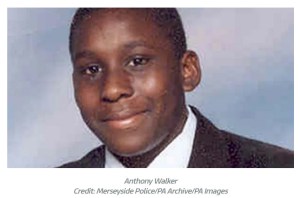
    Anthony’s mother, Gee Walker, has setup a trust in his name and as a Christian she believed this was part of Anthony’s legacy.  This will be something that is hard for those without a faith to accept. But I believe, as his mother hopes, that despite not becoming a civil rights lawyer and going to America, Anthony’s legacy through the work his mum does, and the effect of this drama, means more people could be touched. Some small comfort to his brave mum.
  • Late Thursday evening health secretary Matt Hancock announced that Greater Manchester, East Lancashire and parts of West Yorkshire were told to go into a ‘local lockdown’. This was due to a ‘spike in cases’ from people going into each other’s homes. There was some confusion and a great deal of contention from the Muslim population as it was the eve of Eid one of the major feasts of Islam. One leader likened it to cancelling the Christmas Day at 9 o’clock on Christmas Eve, although another did acknowledge that when the original lockdown was imposed many Christians had to miss Easter Day celebrations.
    Writing as someone who is doing project work for a company in Sale, there was concern that some members of the team who had only returned to work because their parents could look after the children again, may have to go back on furlough until the lockdown was over.
  • Another member of the team at the company developed some symptoms and was relieved when their test came back negative – but they had to wait over 3 days for the result.
  • One report from Manchester showed a street where many of the rainbow posters drawn to put in windows to celebrate the NHS Heroes were faded and torn….perhaps a sign of how quickly we forget?
  • One of the most worrying statements last week was from Professor Chris Whitty as he stood next to Boris Johnson at a Downing Street press conference on Friday announcing that the opening of face to face beauty treatments and bowling alleys was to be delayed for a further two weeks at least. He said

“I think what we’re seeing from the data from ONS, and other data, is that we have probably reached near the limit or the limits of what we can do in terms of opening up society.

“So what that means potentially is that if we wish to do more things in the future, we may have to do less of some other things.”

He expanded to say that if we are to get children back to school in September we may need to close some other places (pubs perhaps?) or put new limits on what people can do and who they can meet.

It really does feel this week that we are not in a ‘steady state’ anymore….!

How was week 19 for us?

After weeks of training and struggling with IT and ‘HR’ Alyson finally managed to book a few shifts on NHS 111 service…but only as reserve. She responded ‘I don’t want to be a reserve I want to be on the first team!’ Her wish came true on Friday when she was given just 20 minutes notice that she was working an 8-hour shift. This was due to late cancellations by two other people on the shifts. The deal is that people are supposed to get 24 hours’ notice. So, she managed to cancel one and worked 4-8pm. It was a tough shift, not only with the types of call, but using the systems for the first time. Reflecting afterwards Alyson felt that she had helped people at a difficult time, and knew that the next shift(s) would be better.

We both signed up as volunteers for vaccine trial in conjunction with the NHS and a pharmaceutical company. Unlike last week’s attempt we both passed the age & health requirements.

After the very warm day of Friday we went to Coventry for a ‘socially distanced picnic’ in a large park to meet up with Alyson’s sister and brother and their families in  Coventry. It was good to see everyone again including our two boys and our nieces. There were three generations and one of our nieces is expecting her first child in October  – she works in a hospital so was concerned about getting too close to us, but I think she enjoyed the day. The only member of the family who couldn’t come was our nephew who returned from the Spanish Balearic Island of Majorca so was self-isolating in his London flat.

On Sunday I attended my now weekly Zoom service at Westminster Central Hall Methodist Church. It was great to be part of a ‘congregation’ of over 1,100 people sharing in worship. Rev Howard Mellor gave an amazing sermon on the ‘original picnic’, the feeding of the 5,000, a miracle told in exactly the same way in all four gospels. Howard pointed out a small word that I had not noticed before – grass! Despite the disciples only having meagre rations of five loaves and two fishes, and thinking that was not enough to feed the crowd, Jesus managed to make it sufficient for all the people (more than 5,000 when including the women and children) and ‘still there were 12 baskets left over’. All this in an area which, because of the grass, was clearly a place of abundance where crops could grow. Howard’s message to those of us hoping to be modern day ‘good disciples’ was however little (in terms of skills and gifts) we think we have, if we give it to Jesus, he can help us achieve so much more than we ever believed.

Stay safe and let’s see if there is enough for another blog next week!
Coronavirus week 13 – The best and worst of the NHS – the old normal is back…

C22H29FO5 – the wonder drug

As it is nearly 40 years since I was awarded a BA(Hons) in Chemistry, I think I can be forgiven for not being able to give the modern name for dexamethasone. This is the drug announced this week used to treat patients with Covid-19 resulting in reduced deaths for those receiving oxygen or on mechanical ventilators.

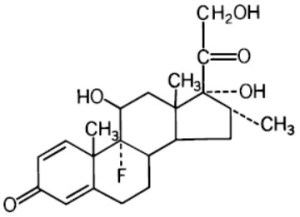
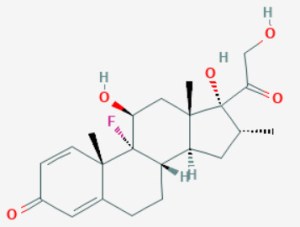
Nomenclature has changed since I taught chemistry for five years in the mid-80s. Looking back at the literature of the time it was called 9α-fluoro-16α-methylprednisolone or 6α-methyl-9α-fluoroprednisolone, but either way even having done a biochemistry module I am not sure I would have known it was a steroid derivative of the well-known drug hydrocortisone. One of the main topics I enjoyed was organic chemistry, that of carbon compounds. Looking through the 1,280 pages of Hendrickson, Cram and Hammond’s textbook from 1977 there is no mention of it, despite being used in a clinical way since 1961. To complete the confusion that people often express when I tell them I used to teach chemistry, it is always good to have a chemical structure to describe the compound. Here are two for this drug.

The slightly more modern version on the right shows the different elements hydrogen, oxygen and fluorine as different colours and the methyl (CH3-) structures as a dark triangle. My pharmacy consultant (and wife) Alyson tells me that I was on dexamethasone for a short time in 2012. I was in hospital for 12 weeks (the time we have been locked down now) with a brain abscess, and was given it to reduce the resultant swelling of my brain.

The research on dexamethasone done in British hospitals, with volunteer patients involved in the clinical trials, has been hailed as ground-breaking. The drug has potential to save tens of thousands of lives worldwide. It must be devastating for those who have lost loved ones who may have benefited from it. This and the amazing dedication of the care staff, cleaners, physios, pharmacists, therapists, doctors, nurses, and administrators demonstrate the best of our NHS. As a country and tax payers we need to fund them to the level required. We will have a thorough review and ‘learn the lessons’, but I fear that once ‘real life’ takes over and self-interest resumes its ‘normal life’, we will forget those weeks early on when as one voice we said ‘this can’t be allowed to happen again’.

The whole system needs a thorough rethink. There have been many reviews and reorganisations over the years, and it would be natural for those who work in it to think ‘oh no not again’.  The NHS needs rebuilding from the ground up, and possibly renaming. Before Covid-19 I think most people thought of the NHS mainly as the hospitals and local surgeries. In latter years, and certainly during the crisis, there have been concerns that care homes, mental health services, and some social care is linked to the NHS. Many people comment on ‘private business’ not getting involved in our health system as a bad thing. Well I have news for them, much of what we think of are ‘private businesses’. Community pharmacies which I worked in for over 20 years and Alyson has worked in for 40 now, are private limited companies owned mostly by pharmacists but some by medical wholesalers. The same is true of almost every doctor’s surgery who are businesses of doctors setup as a partnership of lead GPs who employ other GPs to help them. These private businesses operate as ‘contractors’ and are paid by Department for Health and Social Care (DHSC), itself only renamed in January 2018.  They are paid a rate for their services, whether that’s seeing patients, running clinics or dispensing prescription or carrying out medicine use reviews that is negotiated by their professional bodies with DHSC. It should not be a surprise that negotiating with what is in effect a ‘monopoly’ supplier is not one that leads to mass riches. What does surprise those doctors who visit pharmacies or chat to owners is unlike their partnerships, DHSC pays nothing towards premises or staffing costs of pharmacy businesses, or pay for the holding of large amounts of drug stocks. And don’t even get me on the subject of Dispensing Doctor practices – people who can write a prescription if they have too much stock of a particular drug, or choose the one that’s best for their business rather than the patient.

‘Business’ and the idea of accountability and competition has been part of the health service for many years, and now we have ‘Trusts’ who are independent organisations running services at a local or regional level. They contract to suppliers and surgeries, pharmacies and ‘buy in’ other services from blood and organ donation services, laboratory services and a host of other clinical ones. There are companies who contract for IT projects, finance, property building and maintenance, catering, cleaning etc. This started when I was still in pharmacy 20 years ago and even then I could see the problems of having local GPs on trusts. As with teachers and risk assessments I wrote about in an earlier blog, most GPs are not businesspeople and they can’t be blamed for conflicts of interest between their business and that of patients and other contractors.

Many governments have presided over reforms but the last major one by the coalition government in 2010 and overseen by Andrew Lansley has proven to be disastrous. Even before starting it drew criticism from a lot of areas. The idea of giving even more power to GPs and frontline staff and increased ‘competition’ on one level might seem like a good one, but in reality it led to a mix of systems and lack of any central accountability. The devolving of the social care and public health issues to local government foundered as the secretary of state for health, Jeremy Hunt, cut the budgets under the guise of ‘austerity measures’. The well-publicised ‘scandals’ with Mid Staffordshire NHS Trust and others in care homes can be laid at the lack of oversight on patient safety.  The organisation Public Health England (PHE) was formed as a result of abolishing Strategic Health Authorities (SHAs), and at the time several directors warned that this would compromise our ability to ‘fight any future pandemic’. SHA’s would have been able to lead on organising the local response and would have people on the ground able to conduct a ‘track and trace’ system. Andrew Lansley stepped down from government in 2015 and was rewarded for his efforts with a seat in the House of Lords.

Jeremy Hunt was the secretary of health who ignored the results of ‘Operation Cygnus’ in  October 2016 used to check the resilience of the NHS to respond to a pandemic (albeit one of influenza). As widely reported at the start of this pandemic, this led to a failure to replenish our stockpiles of PPE, antiviral drugs and ventilators. It is shocking to see him in recent weeks, as the now chair of the parliamentary health and social care select committee, taking the government to task over their failure on issues he was responsible for. When he was elected by MPs to this role in January there was a feeling that this conflict of interest might stop him questioning too much. It’s extraordinary to see the exact opposite happening, but his ability to wipe clean his own responsibility is equally unbelievable.

Andrew Lansley promised a ‘bottom up’ review but ended up with more ‘top down’ structures in place and setting up a whole series of ‘independent bodies’ to monitor things.

Several people have expressed surprise that hospices receive so little funding from DHSC and other government bodies that they have to rely on local fundraising and charitable status to continue. This was put in the spotlight early in the current crisis when fundraising stopped and no provision was forthcoming to help with PPE. If a national health service is supposed to cater for us from ‘cradle to grave’, what has gone so wrong that patients and their families who are facing the real end of the health system are left to donations and sales from charity shops for the provision of care to their loved ones. Another part of the health service that I have experience of, and which has been neglected are rehabilitation units. It seems Covid-19 is an illness that takes a terrible toll on survivors, with months of aftercare needed to even walk again. Many weeks on a ventilator in a medically-induced coma leads to mental health issues as well as physical weakness.

NHS IT provision, which I had some experience of when trying to implement the Electronic Prescription Service (EPS) in our pharmacy branches in 2005/6 was one riven with problems. With the help of our wholesalers and investment in NHS broadband we got all 50 branches setup just as we were sold to the Co-op. Alyson continued working in branch and even now, 14 years on, the system is not fully implemented and looks unlikely to be any time soon. Only recently can pharmacists see a very small amount of information held nationally on any patient who comes into their branchwhen they are away from the place they live. I know from personal experience that my local hospital, 15 miles from the one in another county and a separate trust where I was treated for my brain injury, can’t access any of my scans or records. This is why I have a lever arch folder with all my records and several CDs of my scans/x-rays that I can take in should it happen again.

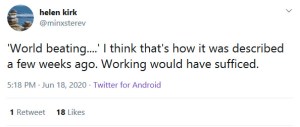
As predicted by my sons in a blog six weeks ago NHS IT, or NHSX as it is now called, was criticised this week for the failure to deliver the NHS Test & Trace app, and are considering reverting to the Google/Apple model. As my chair of district tweeted;

In all the ‘clap for carers’ and accolades given to those in the health and care systems, we shouldn’t fall into the trap of thinking everyone is working for the common good. In an organisation of about 1.5 million people there will be some ‘bad apples’ and strong management and administration supported by decent pay and training is needed.

Our National Health service should be as much about prevention and encouragement to live a healthy lifestyle as it is about treating us when we fall ill. The effects of obesity, diabetes, heart disease and respiratory conditions on the death rate from coronavirus demonstrates this need. The savings made from prevention should outweigh the costs of later treatment.  Education, as in many things, is vital for health outcomes as is reducing poverty.

Let’s hope the next review takes all of the factors into account and, as I wrote last week, as a country we can fund the necessary changes. Our National Health Service has become a ‘Reactive Illness Programme’ (RIP), and needs to change, and quickly.

Other news this week

  • The ‘old normal’ resurfaced in our area this week when 6,000 people attended raves in two separate areas of Manchester on Monday. Several people were stabbed, one girl allegedly raped and local people had to clear up the mess after everyone had left.
  • Crime seems to be on the increase (or at least being more reported) and terror is back on our streets with the stabbings in Reading this weekend.
  • There is more talk of reducing the social distancing requirements to one metre to get hospitality and self-catering holiday accommodation open.
  • Dame Vera Lynn died this week at the age of 103. She was called the ‘forces sweetheart’ during World War Two and had shared her thoughts during the current crisis and her song was echoed in the address to the nation by our Queen when she said ‘we will meet again’.
  • The Labour Party review on the reasons for disastrous results in December’s general election was published. It didn’t make comfortable reading for members of the party like me. We must work for Labour to produce policies which chime with the need to do things differently in relation to funding the new health and social care system, tackling poverty, improving education and closing the gap between the wealthy and poorer in society.
  • The daily death announced totals continue to fall with the Monday-Friday total this week being 853 down from 1,065 last week (a fall of 20%). The total of deaths at the end of the week was 42,632.
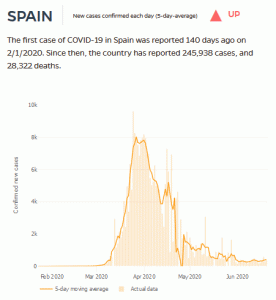
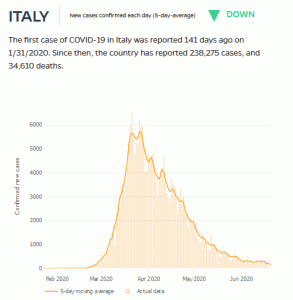
  • With numbers seemingly under control in European countries despite some local outbreaks in Germany, I looked again at the statistics on Johns Hopkins site and there are some awful looking graphs in other areas of the world. Here are the graphs for cases in Europe;


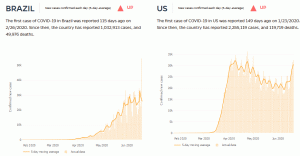
    These show that we are over the (first?) peak of infections. The story in two countries with presidents who think it is nothing to worry about, and are trying to get their country’s open again is not so hopeful…

    and note that the scales on these are tens of thousands rather than the thousands in Europe.
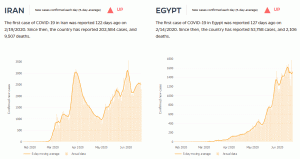
    The middle and far east countries are also showing curves which are concerning, with a ‘double peak’ for Iran. The cases are in hundreds but show no signs of decreasing.

  • We need to start looking overseas again now that we are getting the UK cases down. There is concern from aid charities that helping less well-off countries will be harder now that the department for international development (DFID) and the UKAid agency has been subsumed into the Foreign Office. A move criticised by three recent former prime ministers from both Conservative and Labour.
  • The debate and protests around racism and the ‘Black Lives Matter’ movement continued across the world.
  • I was going to write that the demonstrations and actions of climate protestors, similar to the ones for Black Lives Matters with marches and ‘direct action’ had not resurfaced, when yesterday I saw an interview with Greta Thunberg saying that she was looking forward to going back to school in Sweden, and vowing to carry on campaigning.
  • Greta’s target for criticism president Donald J Trump was back on the campaign trail with a ‘huge rally’ in Tulsa, Oklahoma where only 6,000 of a possible 19,000 seats were occupied despite over a million applications for tickets. For those who did attend there was little sign of masks or social distancing, and six of the organisers caught the virus. At the time of writing there are reports that Mr Trumps rally had been ‘turned over’ by teens and young people responding to campaigns on the Tik-Tok and K-Pop social media platforms applying for tickets then not turning up. Mr Trump said earlier in the week that a million supporters would come.

How has week 13 been for us?

Unfortunately we have another example of the ‘worst of the NHS’ in our household. Five weeks after Alyson applied to help out NHS 111 with taking phone calls from people who need to speak to a pharmacist, and after three polite chasing emails and responses from the HR team doing the ‘on-boarding’ stating that she will hear ‘in a few days’, there is still no sign of her contract or training plans. She has played her part by taking two more calls on the SOS NHS volunteering app.

We haven’t ventured to ‘non-essential shops’ yet and the crush at the Nike store in London and the lady interviewed in the Primark queue in Manchester who stated that she ‘felt like I’ve won the lottery’ didn’t pursuade us. We did go for another walk in Delamere Forest and had a picnic which was pleasant. The weather meant another postponement of meeting with friends in our garden, but we have a walk planned in a park further afield this week.

I have watched a couple of the Premier League football matches now live on ‘free tv’ and have been surprised how realistic the ‘virtual crowd noise’ is to make them seem more ‘normal’ despite empty stadiums. The  online radio commentary I heard for my team Middlesbrough was a sign of the ‘new normal’ being much like the old – we lost 3-0 and are looking at relegation again.

I had my first international Zoom with a call to our subcontractors’ office in India with the person who helps on the IT project I am doing. We have had training sessions with the team from our district who are attending the Methodist Conference in a week’s time. With over 300 representatives, Zoom will be in the form of a webinar where we can only see the person presenting and another speaker who wants to add to the debate. Voting will by the raising of a virtual hand or completing a poll on the screen, so the feedback on numbers should be much quicker than the usual manual count of raised hands in the conference hall.  I will write more about this next week. The conference service on Sunday will be at my now ‘virtual home church’ of Methodist Central Hall, Westminster in London.

Keep safe and let’s hope there is a safe further easing of lockdown in the coming week.


Coronavirus week 12 – what I have (not) done…

Looking to a more just society…

Even though lockdown has been eased and we are allowed to do more things than before, my week has been dominated by planned activities that I have not done.

Alyson gave me a lovely thoughtful present to surprise me on my birthday in April. It was something that she knows I had looked at, but dismissed as probably too expensive and not fitting in with our plans at the time. This weekend should have been the ‘London Series’ of Major League Baseball (MLB) where teams from the US play a two-game series at the ex-Olympic Stadium, now the London Stadium and home to Premier League team West Ham United. The two teams due to play were the St Louis Cardinals and the Chicago Cubs, who play in the Central Division of the National League(NL) so it would be one game in a long-standing rivalry.

The 2019 series, the first one to showcase MLB overseas by playing in the UK, was another rivalry between the New York Yankees and the Boston Red Sox of the American League (AL) East Division. Some readers may know that I have been a supporter of another AL East team the Toronto Blue Jays since I first saw them in the early 80’s and have been to matches each time we have been to Toronto since, including last September. So, it would have been great to see a live game in London, but the virus put a stop to that.

I am sure more people would have been looking forward to the next thing I have (not) done this week – the Euro 2020 football championships. Friday would have been the first match in Rome where Turkey would have taken on Italy at 10pm UK time. Saturday would have seen Wales play and today England would have played Croatia at Wembley. I had put all the matches into the calendar on my computer which I do months before each major tournament in case people try to arrange church or charity meetings. Not that I wouldn’t go if they did, I just want to be able to inform them, and to have the chance not to do so!

The third activity I have (not) done this week like the 11 weeks before is my regular Saturday morning Parkrun at 9am in Delamere Forest. I have written about Parkrun before if you look back at posts, starting in April 2016 when I did my first run and first post, to February 2018 when I did my 50th, and last October when I did a sponsored 10k the week after completing my 100th. I really miss the run, the team of volunteers and other runners. During lockdown I have done a 5k run on Wednesday and a longer 6.1k on Saturday morning. The great thing is that I have come first every time, and today was my second fastest time of the 12 weeks.

However, the one thing I have (not) done and want to write about the most is an event I chose not to go to on Tuesday, despite being successful in my application to attend. We met up with Alyson’s sister and husband in Cannock Chase Forest park for a lovely walk and a ‘socially distanced picnic’ sitting either end of a felled tree. There were a lot of people around, but it was easy to keep a safe distance on the miles of paths. There was a takeout service from the cafe and there were plenty of Portaloo facilities which were clean and had plenty of hand sanitiser.

The event I chose not to go to was a Zoom conference with the Shadow Work and Pensions Secretary Jonathan Reynolds and other MPs and Labour Party members. It was to discuss policies that feed into the National Policy Forum consultation taking place this summer. The agenda looked an extensive one;

This policy discussion is on the subject of the future of social security after coronavirus and we would like to hear your thoughts and ideas on the questions below: 

  1. What has the crisis taught us about the role of social security in protecting the most vulnerable in society and the gaps in the current system?
  2. To what extent has the crisis changed public perceptions of social security? How can we build on any changes to ensure wider public support for the system?
  3. To what extent should social security be a universal entitlement available to all?
  4. How can social security support self-employed workers?
  5. What role can social security play in addressing inequalities and poverty in society?

Many of these were topics I wanted to write about when I started this blog and if you look back to the first one on the 5th April there is a section on Economics where I ask

  • How we use our wealth to best effect for what both main political parties agree should be ‘for the many not the few’.
  • How corporations, public bodies, small and medium businesses, wealthy individuals, and every individual supports each other.
  • Do we need a fundamental rethink and ‘reordering’ of past conventions?

So it would have been extremely interesting to have been in the session and one of the ‘breakout room’ where we would have had the opportunity to discuss in smaller groups with other MPs acting as leaders and Johnathan popping in to listen and answer questions.

The brief paper that we needed to read before attending the forum set out the problems with the current system, many of which were there before the crisis, but have been highlighted in recent weeks. It acknowledged the steps the present government has taken in the furlough, business rates, business loan and help for the self-employed, which have been unprecedented in recent times. The paper also pointed out the issues that need a fundamental rethink.

I admit to having no formal economic training and acknowledge that the taxation and benefits system for any ‘developed’ country is complex. A balance between ‘fairness’, ‘equality’, ‘incentive’, ‘reward’, ‘ethics’, ‘environment’, the fast-moving needs of the ‘labour market’ and dealing with factors arising from being an interconnected world and ‘globalisation’. But you don’t need to be any sort of expert to know that the present system is failing. It fails not just those in real poverty and need, but large numbers of working people who are claiming benefits and slipping into poverty as housing  and other costs rise at a time when wages are rising slowly.

To pick up on the current mood, the effects of the virus and ‘Black Lives Matter’, the present system already discriminates against the BAME community, those who we now call ‘heroes’ in low-paid but vital jobs, many of who are women, the disabled, young people coming out of education trying to get employment and into a home of their own. After the virus, these impacts will only increase.

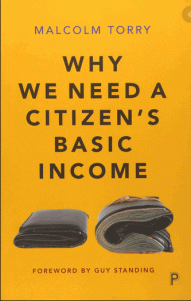
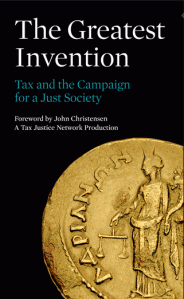
In mid-February I ordered the book below, prompted by a discussion we were having in one of our church study groups with Richard who worked at the local Credit Union. I had been reading the second one for the last year. Both have something to add to the conversation we would have had at the forum and for a policy fit for the 21st century.


Richard’s statement about what we could do to help those who he sees at the Credit Union was simple. ‘As one of the richest countries in the world, it’s time we paid everybody in the country a basic income’. The other book explains how our current taxation system is exploited by global corporations and wealthy individuals, using tax-havens and false reporting of money flows to avoid paying a fair share to support society. This can be to the point of criminality by those who setup the money markets to manipulate it in ways that even governments don’t understand, and for which there is little transparency. Radical change is needed considering the ideas in both books to reform the economy.

A Basic Citizen’s Income

There is not enough room to explain all the ideas around this and I suspect most people’s reaction would be ‘well it is a nice idea, but it will never work’.   The details need to be worked out after a full debate and explanation. The amount needs to be considered but the ‘simplicity’ of it, in my opinion, is unarguable.

Every citizen who reaches working age will receive a basic income for them to use as they wish.  It is unconditional and nonwithdrawable (with higher amounts for older people and smaller amounts for children). It will be paid by the government directly into people’s bank account on a regular basis with no means testing at all. This immediately cuts out whole swathes of bureaucracy or ‘red tape’ so disliked by many politicians, it allows citizens who live in the present world characterised as a ‘precariat’ of uncertain income and changing jobs frequently, quickly slipping into needing help. There would be no need for Universal Benefit as everyone would have some income and could build a ‘reserve’ to see them through short periods of unemployment or sickness (or lack of income caused by a situation like the present virus). It could, over time, replace the need to pay a state pension. It will give the ability to those who want to pursue higher education the means to subsidise that, those who want to setup a small business to do so, and those in work to help others less fortunate or to pool ‘unneeded income’ to give a hand up to other family members. All such income would be taxable.

It needs bringing in with another pillar of a fair society – education. I can already hear people suggesting that it is a recipe for ‘scroungers and wasters’. Children and families will be taught basic money management and the way the economy works. Banks would have to change their model to help people manage their money well, and stop them from getting into debt through bad choices.

There is not enough room in this blog to explain it all, but I hope the chapter titles in Malcolm Torry’s book will prompt you to think about it more;

  1. Imagine….
  2. How did we get to where we are now?
  3. The economy. work and employment
  4. Individuals and their families
  5. Administrative efficiency
  6. Reducing poverty and inequality
  7. Is it feasible?
  8. Options for implementation
  9. Pilot projects and experiments
  10. Objections
  11. Alternatives to a Citizen’s Basic Income

Tax and the Campaign for a Just Society

This is the subtitle of the second book I read a review in The Methodist Recorder and asked for it as a Christmas present. I have not read it all but the parts I have made me realise that the reason a universal basic income might not happen, is the people who setup our complex financial structures are also those who control and exploit it.  Although not formally setup until March 2003 the Tax Justice Network (TJN) has its roots in the almost total lack of research as to what lead to extreme poverty in Africa, South-East Asia and Latin America as money flowed out from these countries under the guise of ‘aid’ to the financial centres in Geneva, New York and London via a complex network of offshore companies and trusts located in secrecy jurisdictions. They exploited the fact that many of the countries they were ‘helping’ had poor governance and taxation systems and officials willing to be corrupted by the promise of wealth such people could only dream of.  One of the writers of the book has worked ‘on the inside’ and struggled with what he saw in terms of ‘transfer pricing’, tax havens and ‘illicit financial flows’ as part of a team working for accountants Deloitte Touche and as Economic Advisor to the States of Jersey and alongside the Organisation for Economic Cooperation and Development (OECD). He witnesses what he calls the ‘dark arts of tax havenry’ and relations with Hong Kong, Jersey, London, and Singapore. Every time he questioned something with senior people, lecturers for his degree or powerful people in government, it was side-stepped and he realised he had wandered into an ‘economic blind spot’. TJN is now an established organisation working with partners in the charity sector and other likeminded organisation to campaign for transparency and information and changes to the global economic system. Not easy when you have the full weight of large financial institutions funding lobbyists and vested interests.

Again, there is not enough space here to write in full, but the book is in the form of individual articles/papers written by a variety of authors. I urge you to read some of them and here is a selection;

  • What is necessary is possible
  • Pinstripe Outlaws
  • The Africa Question: Where Do All the Profits Go?
  • Tax Justice and the Oil Industry
  • Tax Competition: A case of Winner Takes All?
  • Revealed: How Multinational Companies Avoid the Taxman
  • Making the Link:  Tax, Governance and Civil Society
  • The City of London: A State Within a State
  • Harnessing Land Value as a Green Tax
  • How Much Should the Rich Pay in Taxes
  • Didn’t they notice?
  • Human Rights and Just Taxation
  • Public Duty, Private Gain: Professional Ethics and Tax

The one highlighted in red I found the most shocking as it exposes the City of London as the largest enablers of tax havens in the world. In four short pages written 11 years ago it explains why it is unlikely that any UK Government will agree to such a radical policy as transparency in tax avoidance, and how the narrative against a citizens income could be stopped in its tracks by ‘those who have the real power’.

Other news this week

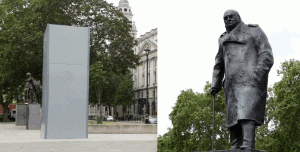
  • The Black Lives Matters protests continued and after the toppling of Edward Colston’s statue last week and the graffiti daubed on Winston Churchill’s in Parliament Square, a debate started on which others should be removed. This, like most topics I have written about, is why education is so important. The historical context of our ‘famous’ people and the benefit to society needs to be explained and the flaws of whatever size or nature drawn out. In some cases this could lead to public statues being placed into museums and others to have information that gives both sides of the stories. None of this should take focus away from what we need to do now and in the future to change society for the better.
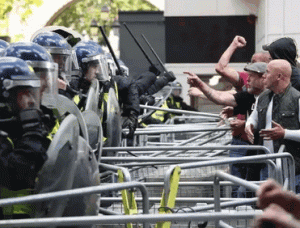
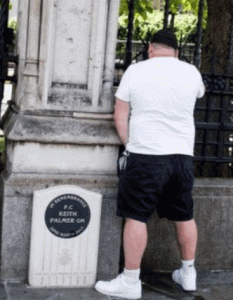
    There is no doubt that the violence on Saturday by so called ‘protectors of the statues’ was nothing more than extremist thuggery and anarchists and aggression towards the police. Many of the young men involved are clearly missing the chance to fight other football hooligans in the (not) Euro 2020 Championships.

  • I admit to being taken aback when one of my ‘local heroes’ Captain James Cook’s statue in Whitby as well as those in Australia. In the several books I have read of Cook’s life story it is clear that he is an example of someone from Middlesbrough born to a labourer who worked his way up from farmhand, to shop assistant, to junior sailor in the merchant navy, and became a senior captain in the Admiralty and who led surveys of large parts of the then ‘undiscovered continents’ and routes between them. These were ‘different times’ but Cook was known to treat his crews ‘relatively well’ and never lost one from the diseases of the time.  He is honoured in his hometown with schools and the major hospital named after him. The other parkrun I sometimes do when I am in the north east starts just outside the Captain Cook Birthplace Museum in a park in Marton next to the place where he was born in what was at the time little more than a shack and is no longer there. The cottage the family is supposed to have lived in when they moved to Great Ayton was moved to Melbourne in Australia in 1934.
    I completely understand the objection by indigenous first nation Australians that James Cook ‘discovered Australia’ and the suggestion by them that 26th January the ‘Australia Day’ national holiday should be renamed ‘Invasion Day’/ ‘National Day of Mourning’ / ‘Survival Day’ and the colonial nature of the planting of the flag on Australian soil by Co0k’s fleet that day should be set in historical context.

    But as far as being involved in the slave trade, there is nothing of that in Cook’s story that I have read, but it is true that he killed Maori warriors on arrival in New Zealand and proceeded to subdue the then self-governing people, misunderstanding their initial ‘welcome’ as one of a threat to his ship and crew. Similarly an incident of kidnapping a king on Hawaii that lead ultimately to Cook’s death was a tragic episode.
  • The protests in the US continued and another unarmed black man was shot  by a white policeman. Another name added to the ever growing list.
  • Education has been to the fore again this week. A government that put a lot of energy into the building of new hospitals and getting retired medical staff to return, appears unwilling to do a similar thing for our schools. There is no sign of building temporary classrooms or taking over unused public buildings or exhibition centres to setup places to help the generation that is missing out on six months of formal education, particularly those with no facilities at home. A straw poll of retired teachers I know shows that some might be willing to go back and help in the short term with classes to make up for lost time. As someone who left teaching 34 years ago I am not sure my ‘skills’ are up to the job or my subject knowledge of Chemistry and Mathematics!
  • The official number of total deaths announced at the daily briefings continued to fall gradually as measured by the 7-day average. The figures for Wednesday to Saturday were 151, 202, 181, 36 and on Sunday the total stood at 41,698.
  • The 14-day quarantine for people arriving at airports was introduced but other than airlines complaining there was little news on the effectiveness and no numbers on how many people had been followed up or fined.
  • In the coming week ‘non-essential’ shops who have put social distancing measures and are self-declared ‘Covid Secure’ can re-open.
  • As I write Boris Johnson, pushed by some Conservative MPs are looking to reduce the social distancing from two metres. It seems ironic that many who were in favour of ‘taking back control’ from the EU are now quoting many countries from who are using shorter distances than we are. It would be interesting to know if their views would be the same if a declaration by the EU that all member states should adopt a distance of one metre had been given when we were still part of the bloc and operating a ‘different standard? I am not sure how those retailers who have already spent millions of pounds (much of it grants from local government) on reorganising layouts and putting signage in, will feel when the advice changes again in three weeks as hospitality starts opening.
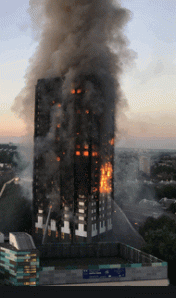
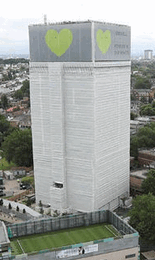
  • Today is also the third anniversary of the Grenfell Tower disaster. We saw the tower covered in screening as we drove through London last August. It was a larger example of the covered statues this weekend. At the time there was much talk about how the lower paid and largely ethnic minority key workers who live there had been forgotten by the wealthy borough next door. Three years on this seems to have been dropped from the agenda. Sound familiar? This and the violence in the centre of London makes me less optimistic that we will ‘learn the lessons’ and start being kinder to each other. 

So how has week 12 been for us?

Apart from our walk in Cannock Chase Forest, Alyson has continued daily walks and I joined her for one on Friday which was also the anniversary of her mum’s death 12 months ago. We walked on a footpath through fields of corn and stopped between the showers to listen to the sounds of birds singing. The sadness of the anniversary was tempered by feelings of gratitude that this time last year we didn’t have to cope with a pandemic, and the associated issues of visiting care homes, organising the funeral, and sorting the sale of the family house in the north east.

Alyson took another trip to the garden centre to buy a yellow rose to plant as a reminder of her mum who loved roses and the colour yellow. The garden is starting to look a blaze of colours as other plants flower and grow.

The birdlife in our garden continues to become more varied and this week as Alyson was exercising on the bike in our conservatory she saw a buzzard land briefly, and today a green woodpecker visited. The buzzard probably explained the headless body and scattered feathers from a blackbird we found on Monday.

With the announcement of ‘household bubbles’ where single person households can pair with others without social distancing and even stay overnight, we asked our son David if he wanted to travel from Bath to see us. He declared himself ‘happy in his own bubble’! He has managed to go for an open water swim and some more rowing.

Zoom coffees have continued and I attended my weekly streamed service from Methodist Central Hall, thankfully not affected by the violence just outside in Parliament Square. I am not sure that any statues of our founder John Wesley are on the ‘hitlist’ of those for removal, but like all of us his life was not without flaws. There is a statue in what was a British Colony of Georgia in the southern states of America. In 1736 John and his brother Charles travelled to the newly formed parish Savannah, as Anglican High churchmen with the primary aim of evangelising to the Native Americans. This was not successful and an incident with a young lady who he had a failed relationship with, and then banned from taking communion did not go down well.

Nevertheless, John Wesley went on to found a movement that, as as I written before, was a reforming one with social principles and members who were key in the Trade Unions and Labour Party. I try to live by his rules on wealth which sparked my interest in the two books in this blog. Those rules were;

Gain all you can. Save all you can. Give all you can.

Stay safe and let’s see what the next seven days brings. Two things are certain;

  • we will (not) be rushing to join the queues in the shops that are opening.
  • Alyson will definitely (not) be watching the restart of live sport in the form of Premier League and Championship football!


Coronavirus week 11 – ‘I can’t breathe…’ not because of Covid-19

How many pandemics can we have at once?

When I started to draft this week’s blog the other day, the first lines were about other news breaking in, and that for the first time in weeks it wasn’t part of the first headline. I suggested that even the Daily Briefings are getting ‘bored with themselves’, with just slides and questions rather than new announcements. By Friday Matt Hancock was on his own with no scientists. I thought that by next weekend they will be finished or once a week.  It turns out that they are going to be only on weekdays, so none this weekend. The statistics were still produced by the Department of Health and Social Care and they showed that on Saturday 204 deaths were announced and on Sunday 77 bringing the total to 40,542.

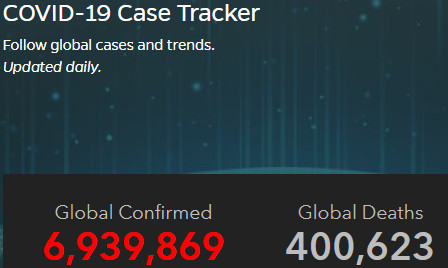
As the number of official deaths passed 40,000 it felt like a grim milestone, and the Office for National Statistics (ONS) figures of all deaths mentioning Covid-19 is over 60,000. This week worldwide deaths passed 400,000.

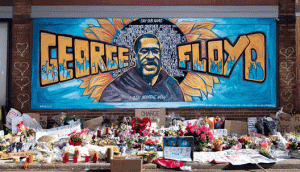
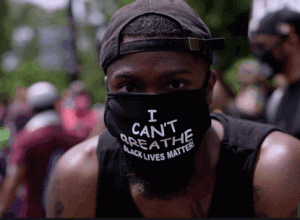
The news that pushed Coronavirus off the front pages of newspapers and further down the television bulletins were protests in the US and other countries about the death of George Floyd.  George was a black American killed by a white policeman by kneeling on his neck for 8 minutes 46 seconds, while George repeatedly said ‘I can’t breathe’. At first the Minneapolis Police Department denied there was anything untoward, but after mobile phone footage of the incident was broadcast, that was shown not to be true.  This triggered several days of protests in many of the larger cities across the US, several of which were used as cover for looting of shops and burning of public buildings.

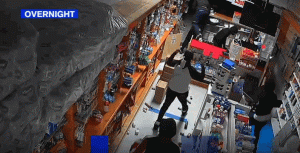
I was particularly shocked by footage from a security camera of tens of people stripping a small family-run pharmacy in the Bronx area of New York of all of its stock including prescriptions made up waiting for patients to collect them.

The irony of many of them wearing masks to protect them from coronavirus was lost among interviews with the devastated owners, as it had taken them 14 years to build the business up in a relatively poor neighbourhood. The Rodriguez family are themselves members of a minority community.

As the protests spread out to Atlanta, Chicago, Los Angeles and Philadelphia under the banner of ‘Black Lives Matter’ the long-standing issue of racism that has been part of American society back to the Civil War and the Civil Rights cases in the 1960’s, was high up the political agenda once more. Protesters and some policemen went down on one knee in a reminder of the act of the policeman in Milwaukee, and an echo of the protests by black players from the National Football League (NFL) a couple of years ago. President Trump had called for them to be sacked at the time. Now he sent the National Guard to clear protestors in Washington who had gathered outside a church, and then he posed in front of the church with Bible in hand, much to the indignation of the local ministers.

The Floyd family have the services of Ben Crump an attorney who takes on high profile cases for those who need representation in the areas of unlawful death and civil rights. At the memorial service in Minneapolis he said

..it was not the coronavirus pandemic that killed George Floyd. It was that other pandemic, the pandemic of racism and discrimination.

Rev Al Sharpton, a veteran of civil rights cases alongside Rev Jesse Jackson in his eulogy said it was time to stand up and say “get your knee off our necks”.

In the social media furore around the riots an interview with a former  police chief of Milwaukee appeared to show him ranting about the fact that people know the names of the last three people killed because they are black, but not the names of the last 300 killed by criminals using guns. He said there are a lot of bad policemen, but there are also a lot of unlicensed guns and he was on his way to reports of a five-year-old girl accidentally shot through the head.  The video was from 2014. The President’s son Donald Trump Jr used it to divert attention away from the race issue. The fact that the police chief was speaking after attending a meeting about the shooting of another black man Dontre Hamilton, was not mentioned.  The white officer involved was fired as he had stopped and frisked the man for no apparent reason.

Given that a record 2 million extra handguns were sold in March, many to first time gun owners, it could be that the number of Americans dying in the future from the ‘pandemic of gun ownership’, will be a high figure.

Despite the home secretary Priti Patel and Australian prime minister Scott Morrison appealing for demonstrations not to happen due to the virus this weekend, large numbers turned out in London and Sydney. Masks and gloves were handed out, but as numbers grew social distancing became an issue. This type of protests needs to be done ‘in the moment’, but it could affect the spread of the virus. So I understand those who criticise. We shouldn’t forget that in the UK we have had our own problems with ‘stop and search’ tactics of policing, and claims of ‘institutional racism’. And these things are not only apparent in police and government, but in business and housing. The scenes of disturbances around Downing Street and violence directed towards the police were shocking. During the demonstrations earlier in the week some people had defaced memorials around the Cenotaph on Whitehall.  The next morning a group of young people were filmed cleaning the graffiti off and being berated by a protestor who said ‘could you not leave it for just one day’. It turns out the ‘young people’ were cadet trainees at the Household Cavalry from barracks nearby. On Sunday in Bristol a statue of the ‘slave master’ Edward Colston was pulled down and one of the demonstrators knelt on his neck. The city is built on the wealth of the slave trade and even though Colston gave much of his wealth to charitable causes, setup schools and hospitals, there are some who think the record of their former MP was ‘sanitised’ and rewritten before the statue was erected.

On the news pictures I saw, however, most of the demonstrations were peaceful and did their best to maintain social distancing (if not the regulations about more than six people meeting). Overhead shots of demonstrations in Chicago, Philadelphia and Washington in the US and Manchester in our area of the UK showed a great deal of good distancing and masks.

Australia, like America has had problems with police brutality and race and this was the focus of the protests. in 2016 David Dungay Jr an indigenous Australian man was killed whilst being restrained by police in a hospital saying those same words ‘I can’t breathe’. We saw the pictures of people talking about their frustration that yet again something happens and again nothing happens.

The last word goes to an academic on a video my cousin Janet’s husband Chris posted on Facebook. I don’t know the name of the person or anything of their background, and it was from an organisation called ‘Atheist Republic’ and appeared to be cut together from a longer one. None of that matters as it struck a chord with its simple message . The question was put ‘why do we hate’?

We hate because we are taught to hate. We hate because we are ignorant….We have been taught that there are four or five different races…there are not…there is only one race on this earth which we are all part of, and that’s the human race. But we have separated ourselves into different races so that some of us can see ourselves as superior to others….It hasn’t worked, and it is bad for everyone. It’s time to get over this business. There is no gene for racism, no gene for bigotry, you’re not born a bigot, you need to learn to be a bigot. Anything you learn you can unlearn, it’s time to unlearn bigotry. It’s time to get over this thing…and pretty soon. I am an educator…and it’s my business to lead people out of ignorance, the ignorance that you are better or worse than someone because of the amount of a pigment you have in your skin. Pigmentation of your skin has nothing to do with intelligence or your worth as a human being. It’s time to get over that.

We are struggling to find a vaccine for the coronavirus pandemic and are worried that it may take a year rather than a few months. It seems that we have been unable to find a vaccine for the pandemics of racism and gun control, or the other pandemics of hunger, poverty, and inequality which have been with us for centuries. After the coronavirus pandemic is over there could be a pandemic of unemployment, a pandemic of economic uncertainty and a pandemic of growing debt. Can we do things to ‘unlearn’ the behaviours that make them happen.

As a representative to the Methodist Conference at the end of the month (see note later on about our week), I have been asked to complete some training on ‘unconscious’ bias as part of the church’s Equality Diversity Inclusion (EDI) policies. I commit to doing so as a small step to understanding my own behaviours and to check if I need to ‘unlearn’ some attitudes.

Other news this week

  • The news that pushed coronavirus down to third place on the television bulletins was that of the German police identifying a suspect for the abduction of Madeleine McCann in 2007 and declared it a murder inquiry.  It is a story that was horrible the first time around and doesn’t get any easier each time it crops up again. I hope that the family get some certainty soon.
  • We live in an area, the north west, where the number of infections is not decreasing, and the R-number is on the unsafe value of almost 1.  The north west as defined by the government is a large area stretching from where we live in Crewe to Kendal 110 miles away on the edge of the Lake District. However, the detailed statistical tables show that in our local hospital there was only one death on Wednesday, Friday and Sunday this week, compared to deaths every day and a total of 15 the week before.
  • Crewe is a town which is dependent on the ‘health’ of one of its largest employers Bentley Motors.  Admittedly, not as dependent as it was when we moved here 40 years ago and along with the Railway Works, Rolls Royce Bentley as it was then were the main employers in the town. The announcement on Friday that nearly 25% of the 4,200 workforce were under the threat of redundancy is a blow to the local economy. This wasn’t due entirely to coronavirus but adjustments for social distancing has cut production by half in recent weeks.
  • With the government declaring two weeks quarantine on travellers coming in through airports, there was talk of  ‘air bridges’ that would allow those from some countries with lower infections not to have to do so. The airline owners are against the quarantines and some countries will not allow UK citizens to have an ‘air bridge’ with them as we are a country with a high infection rate.
  • Track, test, and trace continued to be a point of contention with Boris Johnson challenged at Prime Ministers Questions about the lack of statistics and details around this topic.
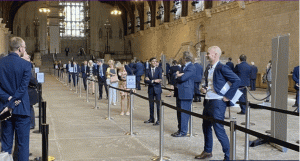
  • MPs returned to parliament and there was much discontent about having to vote by forming a queue which was over a kilometre long to walk past the Speaker to say which way they were voting. The irony was that the motion was about the type of voting that could be used if they remain away from the House of Commons due to the virus. One said it was like ‘doing the Mogg conga queuing for a ride at Alton Towers that turned out to be a little bit sh*t.’

How was week 11 for us?

Alyson took advantage of the new ‘freedoms’ to go to a garden centre 8 miles away but came back disappointed by the choice of plants and the lack of atmosphere as the main centre and shops were not open.

Alyson was delighted, however, that as we watched another week of BBC’s Springwatch we had a version going on in our garden. Visitors to the feeders included, bullfinch, greenfinch, goldfinch, long-tailed tits, and a mother blue tit feeding three tiny fledglings as they lined up on one of the supports.

I was elected as one of seven representatives from our District to go to the Methodist Conference in Telford at the end of June, but that has been cancelled in its usual form. We usually meet as a group to discuss the topics and format of the 5 days, and we did so this year but via Zoom, as we will with 300+ others this year. The Conference will not have the debate and resolution of the report we discussed last year on our understanding of relationships. This could have paved the way to same sex marriage taking place in our churches, but it has been held over to next year. It was felt that if we couldn’t give the time needed, meet in smaller groups face to face, and share on the fringes of the Conference, it could be challenged. This won’t stop us looking at more reports and ‘business’ to move our witness and evangelism forward.

Wednesday was Global Running Day, but I wasn’t aware of that as I set out in the rain for my early morning 5k run. It was only when I got back and Alyson told me that she heard it on the radio and I found out that I had joined with over a million people in 170 countries to celebrate a simple sport that those like me with little natural ability can participate in.

During my weekly virtual coffee later that morning with David, a friend from church, we reflected on the ways we need to change personally and as a church in how things are done, and lessons learned during the pandemic. My evening Bible study with 10 others via Zoom is one such example that we will continue with. There really is little point splitting us into two groups and travelling to each other’s houses, especially on cold wet winter evenings.

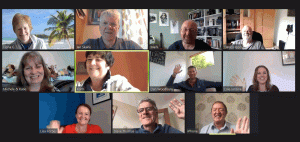
The cold and damp weather that started on Wednesday led to Alyson cancelling the get together with three former work colleagues in our garden on Thursday morning. The beauty of a ‘virtual coffee morning’ like the one I hosted for our head injury charity, is that the weather will not stop it taking place. There were 11 of us and I used a feature in Zoom that allowed all of us to be put in two separate ‘rooms’. One for the group that would normally meet in Crewe and the other at Ellesmere Port. It worked well and the smaller numbers meant that those who didn’t want to speak in the larger gathering chatted to members that they were used to meeting.

HIP Charity – Cheshire-wide coffee group members

We had ‘virtual Friday night drinks’ with Alyson’s brother and sister and then on Saturday night we had a Zoom quiz with my cousins and family. Alyson and I came second out of ten teams after 100 questions using an app on my phone called ‘Kahoot’.

Sunday brought my now weekly trip via YouTube to the service at Methodist Central Hall in London. We restated our belief in the sanctity of all human life, knelt in solidarity with those who are victims of discrimination, and prayed for the family of George Floyd. It brought to mind one of the modern songs we sing that challenges us to act for the wider good. These are three of the verses. They seem appropriate given the news this week.

Will you use your voice; will you not sit down
when the multitudes are silent?
Will you make a choice to stand your ground
when the crowds are turning violent?

In your city streets will you be God’s heart?
Will you listen to the voiceless?
Will you stop and eat, and when friendships start,
will you share your faith with the faithless?

Will you watch the news with the eyes of faith
and believe it could be different?
Will you share your views using words of grace?
Will you leave a thoughtful imprint?

Stay safe and I hope to post another instalment next week.


Theology Everywhere

Discuss theology today to transform tomorrow

verbalising

ruminations on life at fifty ... or so ...

Discover WordPress

A daily selection of the best content published on WordPress, collected for you by humans who love to read.

The Daily Post

The Art and Craft of Blogging

WordPress.com News

The latest news on WordPress.com and the WordPress community.