Coronavirus week 39 – Advent hope or Christmas cancelled?

It is 20 weeks since I did my last blog, or ‘CoronaDiary’ as it was named for the Swansea University project that it became part of. It seems a long time ago but serves to show how time passes quickly after I decided that the time had come to stop, with things apparently starting to ‘slow down’, ‘getting under control’, ‘living with the new normal’ or any number of ways of describing life in late summer/early autumn. There was also a possible vaccine in development.

I started several times to write another instalment as events and key points in the story of this year were reached, but each time my enthusiasm to finish them waned. Due in part I suspect to not wanting to repeat the same themes I had visited before, but mainly due to the fact that we too were doing some of the things we hadn’t been able to. We were fortunate to be in a situation where we could take a week away to each of the Norfolk coast, Cornwall and North Yorkshire. In addition we enjoyed days out walking around the Cheshire countryside and Alyson managed some open water swimming at a nearby lake in Shropshire. The project I am working on with the accountancy practice in Sale was reaching the critical ‘go-live’ point, and Alyson was getting more NHS 111 home-based call centre shifts.

Deaths – a change of measure but still increasing quickly..

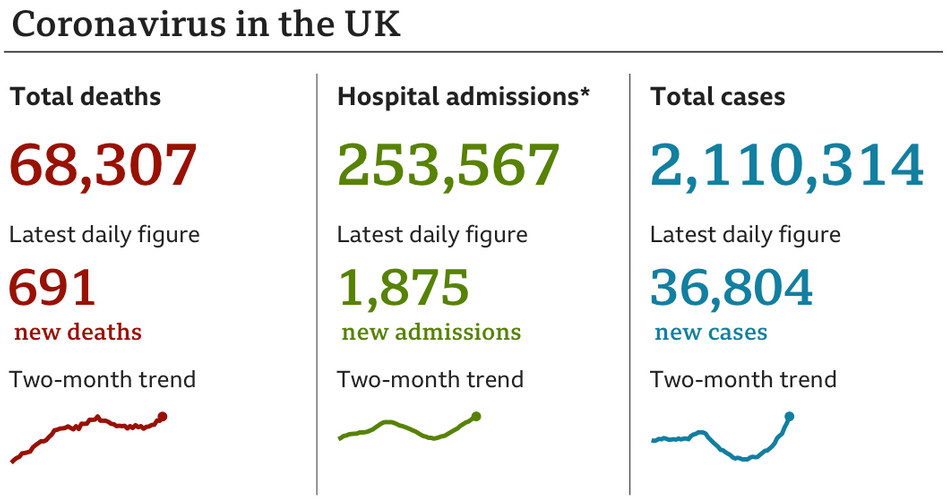
I had set myself the target of writing another blog when the official figures for the number of coronavirus deaths reached the level they were at my last blog, as the government reassessed them, just after I published it, in light of some ‘mis-recording’. On 12 August, the total fell by 5,000 overnight from 46,706 to 41,329. Until then a death was recorded for anyone who had tested positive for Covid-19 at any time, regardless of the cause. So someone who had died of a heart attack or in a car accident but had a positive test 10 weeks before was added to the virus statistics. It would take another 11 weeks to get back to 46,513 at the end of October – an average of 71 deaths per week. Just over 7 weeks later we have surpassed the grim figure of 60,000 to reach 68,307 – an average of 3,113 per week. The other measure of all deaths where coronavirus is mentioned on the certificate is likely to be over 80,000 by the end of the year.
Key events I could have written about…

There have been some major issues and milestones in the time since my last blog. Ones I have had strong feelings about are;
– The exam results ‘fiasco’
– The on-going story of migrants drowning whilst crossing the channel, and my idea of requisitioning unused cruise ships anchored off the south coast to give them decent accommodation.
– Introduction of the tiers system of restrictions
– My (and many others) perception that GPs are hiding away
– Schools and universities returning to full-time teaching
– A study I read on how the virus circulates indoor via ‘aerosol particles’
– ‘Circuit-breaker’ or second national lockdown
– President Trump catching Covid-19, US Election & refusal to accept the result
– Announcing the vaccination program earlier than planned on the day the report into the Home Secretary Priti Patel’s bullying behaviour was published.
– The seemingly endless Brexit negotiations/deadlines and extensions.

So why now…

The recent excitement over the new vaccines, the hope that brings of a ‘light at the end of the tunnel’, allied to planning for a small family Christmas get together was shattered by yesterday’s Government Briefing. Our Prime Minister, the only one in the World known mainly by his first name, Boris announced a new ‘Tier 4’ for London and the South East plus severe restrictions on ‘Christmas bubbles’ and the time they are allowed to meet. It seems like another one of the many ‘key points’ in the pandemic, coming as it does with the fact that a ‘new strain’ of the coronavirus that is much more effective at transmission is circulating and spreading rapidly through the population. The disease is called Covid-19 because it was in late December last year that the WHO office in China reported a ‘new type of pneumonia virus’ being reported in the area around the city of Wuhan. Whilst there is still some dispute about where it originated, the virus has been traced back to cases in mid-November. The first anniversary of the discovery of what we now call SARS-CoV-2 seems like a significant event to record in my blog.

For those with an interest in the science, the new variant is being referred to as SARS-CoV-2 VUI 202012/01 and the more detailed description of the mutation is as follows;

This variant has a mutation in the receptor binding domain (RBD) of the spike protein at position 501, where amino acid asparagine (N) has been replaced with tyrosine (Y). The shorthand for this mutation is N501Y, sometimes noted as S:N501Y to specify that it is in the spike protein. This variant carries many other mutations, including a double deletion (positions 69 and 70).

US Centers For Disease Control and Prevention, Emerging Variants Briefing December 2020.

It is this variation in the ‘spike protein’ that scientists think accounts for its ability for increased transmission by better binding to cells in people who get infected by the virus. It remains to be seen if the symptoms are more severe or if it is resistant to the vaccine, but the early signs are ‘hopeful’. What will certainly be the case is that the number of infections will rise and given the pattern up to now, many people will need some treatment in hospitals. This is the factor that may lead to ‘Lockdown v3.0’ and more damage to mental health and the economy.

In recent weeks I have been leading four sessions on the season of Advent with our church Bible study group and there are some themes which resonate with the current situation. As we approach the end of an extraordinary year and try to look forward to 2021 it seems an opportune moment to write down my personal thoughts and feelings. This blog has always been for my own reference, but I continue to be grateful for all the comments it attracts as each one is published.

Advent – the season of waiting – 2020 theme ‘Hope’….

It is only in the last few years, after 50+ years of being part the ‘Methodist Tradition’ through my church membership, that I have understood the ‘true meaning’ of Advent. For many it is ‘just the few weeks before Christmas’ but it is so much more than that. It is a time of ‘waiting’ and ‘anticipation’ during which we are called to lament/repent for all that has gone before and wait for the arrival of the long-promised ‘Light of the World’ to arrive in the form of a small child. Our fellow Christians in the Church of England, or ‘the Anglican Tradition’ recognise this in a more formal way. In the build up to Christmas they don’t sing ‘traditional carols’ and for them Christmas starts on the eve of the 25th December. It lasts for 12 days until Epiphany on the 6th January.

This year in the ‘real world’, the commercial one and the one that the church has hijacked from the original pagan ‘winter festival’, after all the upheaval of Covid and the challenges and illness and death, there has been a desire to ‘go early’. When I worked in retail pharmacy we would have started to plan for all the Christmas stock arrival earlier in the year. Indeed, during my time as Managing Director of our ‘Pharmacy Sundries’ subsidiary company, January would see me and the sales team attending trade fairs in the UK and Frankfurt in Germany, to meet suppliers from all over the globe to purchase, and in some cases ‘design’, the gifts our stores would sell during the ‘Christmas Season’. Stock would be ordered, shipped from China or India or wherever the suppliers were based, duty paid, containers received and unloaded at the warehouse, and delivered to the shops by a small fleet of vans ready to fill the shelves. There was always a tension between the warehouse wanting to get stock out (and our small company to invoice the larger one!) and the shops saying it was ‘too early’. In the end together with the retail marketing team for the shops we agreed a rough policy that, whilst stock could be delivered during September the, ‘big reveal’ would happen after the solemn celebration of Remembrance had taken place on November 11th. After that it was ‘all hands on deck’ to shift as much as we could. On a really good year our shops would be calling the warehouse in the second week of December pleading for us to send more – the items we had chosen that they were sceptical of selling were flying off the shelves. In the last week it might get to the point that shoppers were so desperate for a gift that even the stock we had left from previous years would look like the ideal gift for a family member!

It seems that a lot of people after the year they have had decided to ‘go early’. There was a rush to put up Christmas lights and decorations not just earlier but in bigger volumes than before. Around our estate there are so many whole garden displays and inflatable characters they can probably be seen from space! Goodness only knows what the electricity bills will be like in January. Shops have sold out and many Christmas tree growers have shut as all the stock has gone. There is an understandable desire from people wanting to celebrate and have something to look forward to. I confess to liking it, but it can get a bit wearing listening to hours of the old pop Christmas favourites from the 70s and 80s.

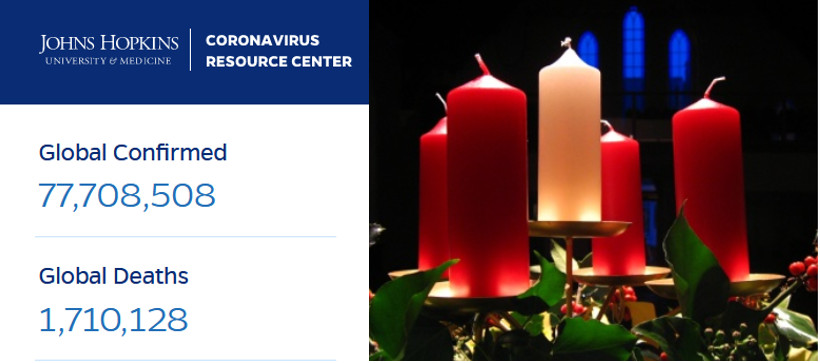
The theme for the Advent study we chose this year was ‘Hope’ which seemed appropriate for the year and is one aspect of the season along with joy, peace and love. As churches we have readings about John the Baptist and the Old Testament Prophets foretelling the arrival of The Messiah, the story of Mary and the journey towards Bethlehem. Many of us light four candles (and many ministers refer to the classic sketch on The Two Ronnies!) coloured red in an Advent wreath of holly, lighting the fifth white candle in the middle on Christmas day to represent Jesus. .

In many of our times of study we referenced the difficult times we have had during the pandemic. We would lament people we have lost, pray for support for those going through difficult times, missing friends and family contact, particularly those who know people in care homes or have not been able to attend the funeral of a family member. We have given thanks for the key workers helping us through difficult times. More recently we have given thanks for the God-given skills of the scientists for developing the vaccines, the hope that brings and the ability to start ‘looking forward’ in anticipation of a better 2021. Many of the Christmas cards we have received, had a handwritten note to reflect this hope too.

Watching Boris, Professor Chris Whitty, Chief Medical Officer and Sir Patrick Vallance, Government Chief Scientific Adviser on Saturday evening announcing the new ‘Tier 4’ measures, and limiting even more the Christmas travel and bubble arrangements, it would have been easy to find a new low of depression, and lack of optimism. Sunday morning’s news headlines on television and in the print media could be summed up as ‘Christmas Cancelled’. During the summer and into the early autumn with infection rates falling, deaths levelling-off to a figure that we could probably live with, health services opening, people going back to work and children to school, things appeared a little brighter. Despite having to take a lot of measures on our holiday in Norfolk and again when we went to the lodge in Great Ayton, North Yorkshire, and the early figures for the ‘second wave’ seeming not to be as high as the first, my optimism was still there.

It was whilst ‘attending’ (via You Tube) the live streamed service from Methodist Central Hall Westminster (MCHW) on Sunday morning that I decided to write this blog. MCHW of course is now in Tier 4 so the chances of a few people attending the church physically on Christmas Day has gone. The reading was about Mary and her willingness to carry the child that would become our Saviour. We sang Joy To The World and O Come All Ye Faithful and accepted the challenge from Rev Gordon to take up whatever challenges we will face in the coming months. Both Gordon and Rev Tony who leads the service said that although we were in lockdown, Christmas itself wasn’t cancelled. Tony said he had received a humorous text about there being ‘only 370 more sleeps to Christmas’ but he wanted to state that wasn’t true. I posted the image below on my Facebook page on Monday and it attracted many likes…
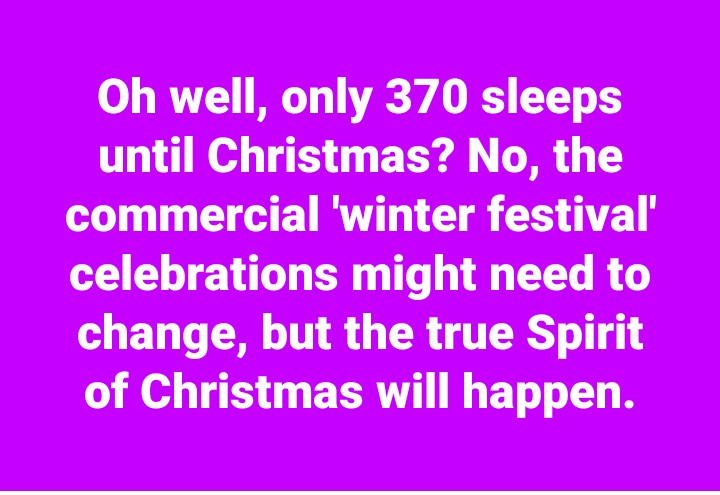
The commercial ‘winter festival’ may have been curtailed and many would not be able to see family and friends, but nothing is going to stop Christmas being Christmas for Christians. It brought to mind this tweet from earlier in the week reminding us that other religions had their celebrations ‘cancelled’ at even shorter notice – in some cases the evening before the big family gatherings.
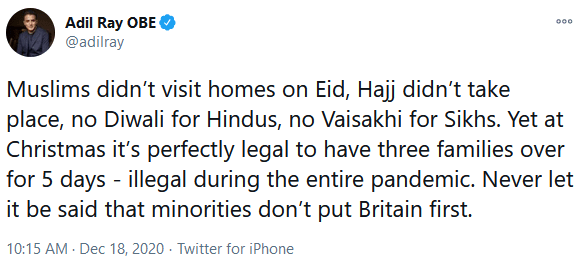
Admittedly, some replies pointed out that Easter was ‘cancelled’ at the start of lockdown and, as happens on social media these days, there were plenty of racist comments, but the point was the same one I had made the night before Eid. ‘Imagine the uproar if they cancelled Christmas…’

The most striking interview I saw on Sunday morning was with Rev Justin Welby, Archbishop of Canterbury on the BBC’s Andrew Marr Show. It appeared to me that the leader of our national church was shaken by the events of Saturday and, like many of us, struggling with an inner voice that was saying to him ‘I am really not sure that my faith is strong enough for this…’. But he found another inner voice and rallied to assure us that Christmas would indeed happen on the appointed day. He also talked movingly about the ‘hole in the celebration’ left by those who can’t be with us, either because they have died or are alone in a place we can’t travel to. He encouraged us all to celebrate the great festival by remembering those who have died, talking about them, and for those who are isolated to pick up the phone and speak to them. He encouraged the vulnerable not to attend church but to call one of the many phone numbers with services, carols or prayers being broadcast.

Some of the many people with a spare place at the table are the family of our school friend Clare who died in November aged just 61 from motor neurone disease diagnosed five years ago. Clare is the first of our contemporaries that we have kept in touch with for over 50 years to go. It is as much a sobering reminder of our own mortality as it is sad. It was also our first (and probably not last) ‘virtual funeral’, we watched the live stream whilst listening to the music chosen by Clare herself on You Tube.

As I sang along watching the service from Westminster to O Come All You Faithful I remembered the Christmas of 2016 when my dad died. We were celebrating at a cottage on the North York Moors with Alyson’s family. Dad was on end-of-life care in a nursing home nearby, and died the day we were leaving the cottage. You can read about that in the blog that I wrote at the time . I asked the minister if we could sing the hymn at dad’s funeral as he was a long-time member of the church choir and hadn’t managed to sing it that year. Rev Ruth said that it was a great idea and all we needed to change was the last verse usually sung on Christmas Day from ‘Yea we greet thee born this happy morning’ to …that happy morning..’. Alyson’s dad who was 90 and not in good health gave a short speech during Christmas Day lunch suggesting that this might be the last one he had with us. He died later that year in October.

So we had two Christmases in a row with spare places at the table. Such is the ‘circle of life’, we have lost Alyson’s mum since, but this year we have two small boys born to our nieces since. They represent the joy, love and hope of the Advent season.

Final thoughts and looking to the future…

There will be three households with us on Christmas Day, but only four people – Alyson and I, and our two sons who are single-person households. We will social distance as much as we can and maybe even eat outside. Other than that we have several ‘Zoom’ catch-ups planned with other family members and friends. We had one last weekend with my brothers and cousins (my older brother lives in San Jose California, 6 miles from the global Zoom HQ so was supporting one of his ‘local businesses’!). We have had one ‘virtual Christmas party’ with the head injury charity I am a member and trustee of. Ready-made meals were delivered along with a box of crackers, hats and gifts. We played charades, told jokes from the crackers and even tried to sing some carols. A great time was had by all who attended.
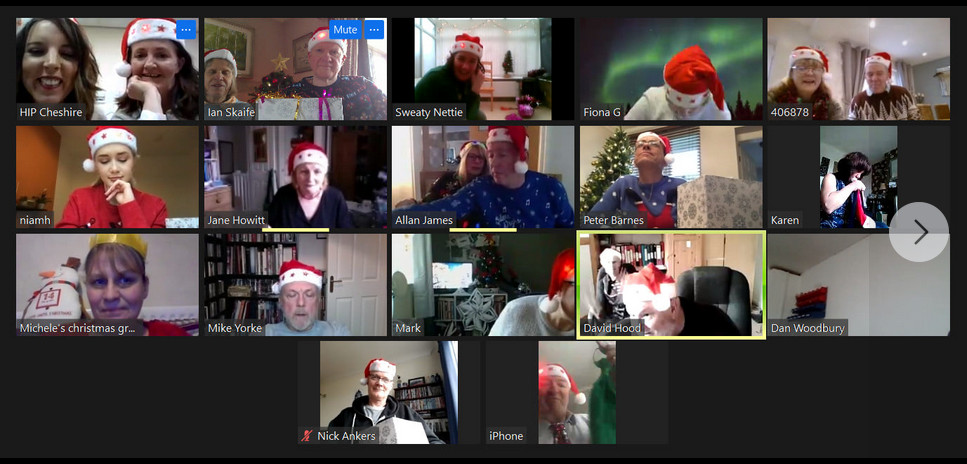
I heard from another friend that the company he works at had a ‘Zoom office party’ that started at 8pm and for some people went on until 6am. Apparently, the ability to drink and not have to drive home led to some problems with people saying and doing things that they would regret when reading the ‘chat’ the next day. So it seems a virtual party can be as good or bad as a real-world one!

I like to think I have always been generally an optimistic person, trying to see the positive in both situations and in people I meet. Alyson thinks I am a bit too laid back and even naive, and reminds me that earlier in the year I was still hoping that we would be able to get a sunny holiday overseas and was one of those who said it would be all over by Christmas. I try to find hope in the vaccination program but recognise that our governments record for ‘ramping up’ the testing capacity could induce pessimism that our ability to vaccinate the estimated 16.5 million people aged over 60. To get this done before Easter, considering the five weeks to achieve full immunity, will require an average of two million vaccinations each week. There have been half a million people vaccinated in the two weeks since 90-year-old Margaret Keenan became the first person on 8 December. We need an eight-fold increase in that rate if we are to reach the Easter target.

As I reflect on the end of a very strange and difficult year, my faith is strong, and my optimism remains at a high level. The hours of daylight are increasing from today, and I am looking forward to 2021


Coronavirus week 19 – That didn’t last long…second wave starting

A short heatwave but signs of another wave of infection.

According to one of the weather forecasters I heard, to qualify as a heatwave there needs to be a period of three days of higher than average temperatures, but ours this week was only one day. It was 20-21 degrees on Thursday and reasonably sunny, by Friday afternoon it was 35 but by the evening it was cloudy muggy and raining and on Saturday it was back to 21 with a cool wind and some showers.

At the end of my last blog I suggested that I may not do another for a few weeks as things appeared to have reached a ‘steady state’, with falling numbers of deaths and a ‘levelling off’ in the number of infections. That idea didn’t even last for 24 hours. It wasn’t that a couple of people were kind enough to comment on my Facebook post saying that they enjoyed reading them; it was watching Channel 4 News on Monday evening.  It’s a way of getting updated on current events that I get the most from. All day ‘rolling news’ is a great thing, something we never had in ‘the good old days’ when there were only three or four terrestrial television channels. The problem is that even  BBC News 24, whose coverage I also enjoy, only touch the surface of a story. I don’t want to sound like a ‘grumpy old man’, but programme makers appear to think we are incapable of listening for more than 90 seconds, or in ITV’s case, that we also need the chance to win a £150,000 prize of gifts we probably don’t need.

Anyway, it was watching the news on Monday evening that there were so many items I wanted to write about, many of them linked to each other or to coronavirus. Hence this blog with all the topics originating with the items on that edition.

Holidaymakers returning from mainland Spain complaining that there were more cases of the virus on one caravan park in Shropshire, than the whole of the Balearic Islands, and they felt safer in a country where everyone was obeying the rules on social distancing and hygiene. By the evening, the islands had been included. Transport minister Grant Shapps went to Spain but had to isolate when he came back on Wednesday. I admit to thinking that I would go if insured, and suffer two weeks quarantine or extend the holiday as I was sure there would be extra capacity. By the end of the week, however, as local lockdown was declared for large parts of Greater Manchester, Lancashire, and West Yorkshire, like others I suspect, I was more doubtful.  I listened to arguments about having to declare whole countries as giving a simpler message than trying to exclude certain areas, and had to agree. Whilst the Canaries are further from mainland Spain than Venice is from London, it would not be difficult to get around the rules by taking a flight from the mainland to the islands and return from there. There is also the danger of catching the virus and having to be in hospital in a foreign country possibly for a long time where the care may be excellent, but my Spanish is almost non-existent.

Despite early criticism there appeared to be more acceptance later in the week when the rates of infection in Belgium (which had one of the highest rates in Europe in the earlier part of the pandemic), and Luxembourg, were rising very quickly. It seems a ‘second wave’ is starting to spread across Europe.

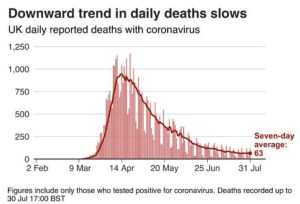
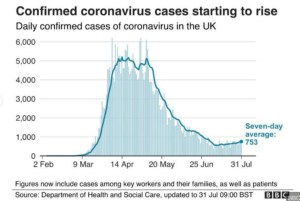
In the UK cases were definitely rising with average daily cases approaching 800 at the end of the week. The fact that average daily deaths was still falling to about 60 at the end of the week, could point to two things; that the lag between cases and serious illness is not showing yet, or that it is mainly younger people getting infections and they don’t generally suffer with the more life-threatening symptoms.

Boris says ‘get on your bike’…

Boris encouraged us (like Norman Tebbit in 1981) to ‘get on our bikes’, but this time not to look for work, but in an effort to fight obesity. The web site handing out free £50 vouchers to get bikes repaired crashed due to demand. Not surprising for £2.5million of untargeted benefits. Many would be snapped up by those who could well afford to repair the bicycle that had lain neglected in the garage for years. It all seemed a bit of a headline-grabbing gimmick. Boris has previous on this topic. As Mayor of London he encouraged people to use a Transport for London (TfL) scheme for hiring simple bicycles parked in many areas in the city to travel to other areas. Registered users could take any of the 5,000 cycles from any of the 315 docking stations in central London to any other for a relatively small fee. This was in 2010 and proved successful. The original bikes were sponsored by Barclays bank with a blue highlight. The scheme was transferred to Santander bank with the current ones mainly red and there are now 11,000 bikes and 800 ‘stations’ spread across 40 square miles of London. 

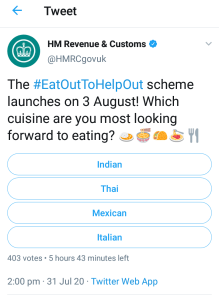
In a week of mixed messages I had one alert from GOV.UK announcing a ban on buy one get one free offers on unhealthy food, and the next one reminded me that I could go to the pub or restaurant and taxpayers will give me 50% off any meal. This is for as many times as I like. So presumably I could get a first course with chips, followed by a chocolate brownie/ice cream / sticky toffee pudding (with extra chocolate sauce) for 12 days (it’s only Monday-Wednesday) from 3rd to 31st August. All washed down with a nice glass of wine or beer – but don’t worry the discount is not off those and they don’t contain many calories. Even HMRC were putting out Tweets about the offer – even if they couldn’t bring themselves to think people might want other European or even British menus…?

The idea of making it a requirement to put calories on all restaurant menus is a good one, but many pubs and fast-food sites do that now. The problem appears to be the ‘education’ needed to allow us to make the healthier choices.

Channel 4 News had an interview with chef Jamie Oliver (who also has years of campaigning for us to make more healthy choices. He made the point that the good quality food is more expensive, and those with less money can only afford the ‘less good’. Rather than taxing sugar, he suggested that perhaps we should be subsidising healthier food.

It could be that this approach to obesity, exercise and healthy eating was related to Boris’s own experience of Covid-19 and the realisation that his own health may have meant not seeing his fiancee and young child? There are many in the Conservative Party who decry the so-called ‘Nanny State’ (itself a posh expression), but a government that claims to have been ‘following the science and experts’ appears in the past to have paid more attention to the food and drink industry lobbyists than ‘health experts’ when deciding policies. Like tobacco before it, the ‘curse of sugar’ needs mass cultural and social change if it is to be effective.

What it doesn’t need is ‘fat-shaming’ and judging people by their apparent excess weight. The majority of our population have some problems maintaining a healthy diet. No one wakes up one day and finds themselves several stones overweight.  The busyness of our lives and availability of cheap food make it hard to change. I have the luxury of a good income, the space to own an exercise bike, and a pleasant area go out for a run. In my case I have made a conscious decision to change, and am currently about a stone less in weight than I was at the start of March. I also know it will be a struggle to keep this way once we get back to eating out again on a regular basis.  I often wonder how people in poverty-stricken countries who have to walk miles to get clean water or a meagre amount of food to take back to a house with no electricity, would make of our kitchen cupboards and American-style double refrigerators. As if that wasn’t enough for them to take in, imagine trying to explain that we then pay a membership of £360 a year for the privilege of driving, three or more times a week ,to a large warehouse full of bicycles that don’t move and treadmills. All in an effort to lose the excess body mass we have!

The next item of news last Monday was one on rehabilitation from the after effects of having Covid-19, or one of its variants dubbed ‘Long Covid’, as the fatigue and memory issues and muscle weakness can last for months (maybe even years, we don’t know yet). The item showed a group using a gym closed due to lockdown, and sharing experiences with people who have been through the same thing.  This is just like my journey after brain injury, when I found the charity that brings together people from all parts of society and background to share with each other. Access to physio and rehab services across the country is patchy at best, but so vital. All of this should have happened years ago. There is a small charity that works with people who have been in intensive care for long periods of time. Patients may be physically well, but the mental effects can last a very long time.  If this step of physio is missing or not done thoroughly, there is more of a cost to the country in terms of lost working days and productivity, as well as actual treatment, medicines, and care in old age. It makes no sense health wise or economically, not having these services readily available for everyone.

The final two articles on the Monday evening news was one that US president Trump’s security advisor had tested positive, after a trip to Florida ,where there is a rise in cases of Covid-19.  Then that Brazil’s president Bolsanaro has been reported to the International Criminal Court, by an umbrella group representing health worker unions and social care organisations, for ignoring and mishandling the crisis. Their claim of crimes against humanity amounting to genocide are unlikely to be taken on by the ICC but demonstrate the strong feelings in the country.  There was an interview (on BBC news!) with a doctor in a hospital in Sao Paulo stating that they had people turn up at hospital still claiming it was all false and a hoax – but when they ended up in intensive care they say ‘doctor don’t let me die and tell my family to take care!’ 

Other news last week.

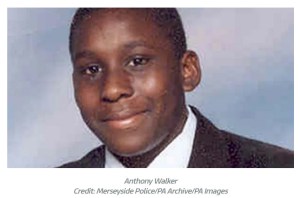
  • We watched Jimmy McGovern’s powerful drama imagining the life Anthony Walker a young black man killed aged just 18 in 2005. He wanted to become a barrister. His mum asked the writer to show him qualifying against all the odds, marrying his (white) girlfriend at the time of his death, having a child and saving his best man from a life of crime by taking him to live with his family after becoming destitute. It brought me to tears. 
    Anthony’s mother, Gee Walker, has setup a trust in his name and as a Christian she believed this was part of Anthony’s legacy.  This will be something that is hard for those without a faith to accept. But I believe, as his mother hopes, that despite not becoming a civil rights lawyer and going to America, Anthony’s legacy through the work his mum does, and the effect of this drama, means more people could be touched. Some small comfort to his brave mum.
  • Late Thursday evening health secretary Matt Hancock announced that Greater Manchester, East Lancashire and parts of West Yorkshire were told to go into a ‘local lockdown’. This was due to a ‘spike in cases’ from people going into each other’s homes. There was some confusion and a great deal of contention from the Muslim population as it was the eve of Eid one of the major feasts of Islam. One leader likened it to cancelling the Christmas Day at 9 o’clock on Christmas Eve, although another did acknowledge that when the original lockdown was imposed many Christians had to miss Easter Day celebrations.
    Writing as someone who is doing project work for a company in Sale, there was concern that some members of the team who had only returned to work because their parents could look after the children again, may have to go back on furlough until the lockdown was over.
  • Another member of the team at the company developed some symptoms and was relieved when their test came back negative – but they had to wait over 3 days for the result.
  • One report from Manchester showed a street where many of the rainbow posters drawn to put in windows to celebrate the NHS Heroes were faded and torn….perhaps a sign of how quickly we forget?
  • One of the most worrying statements last week was from Professor Chris Whitty as he stood next to Boris Johnson at a Downing Street press conference on Friday announcing that the opening of face to face beauty treatments and bowling alleys was to be delayed for a further two weeks at least. He said

“I think what we’re seeing from the data from ONS, and other data, is that we have probably reached near the limit or the limits of what we can do in terms of opening up society.

“So what that means potentially is that if we wish to do more things in the future, we may have to do less of some other things.”

He expanded to say that if we are to get children back to school in September we may need to close some other places (pubs perhaps?) or put new limits on what people can do and who they can meet.

It really does feel this week that we are not in a ‘steady state’ anymore….!

How was week 19 for us?

After weeks of training and struggling with IT and ‘HR’ Alyson finally managed to book a few shifts on NHS 111 service…but only as reserve. She responded ‘I don’t want to be a reserve I want to be on the first team!’ Her wish came true on Friday when she was given just 20 minutes notice that she was working an 8-hour shift. This was due to late cancellations by two other people on the shifts. The deal is that people are supposed to get 24 hours’ notice. So, she managed to cancel one and worked 4-8pm. It was a tough shift, not only with the types of call, but using the systems for the first time. Reflecting afterwards Alyson felt that she had helped people at a difficult time, and knew that the next shift(s) would be better.

We both signed up as volunteers for vaccine trial in conjunction with the NHS and a pharmaceutical company. Unlike last week’s attempt we both passed the age & health requirements.

After the very warm day of Friday we went to Coventry for a ‘socially distanced picnic’ in a large park to meet up with Alyson’s sister and brother and their families in  Coventry. It was good to see everyone again including our two boys and our nieces. There were three generations and one of our nieces is expecting her first child in October  – she works in a hospital so was concerned about getting too close to us, but I think she enjoyed the day. The only member of the family who couldn’t come was our nephew who returned from the Spanish Balearic Island of Majorca so was self-isolating in his London flat.

On Sunday I attended my now weekly Zoom service at Westminster Central Hall Methodist Church. It was great to be part of a ‘congregation’ of over 1,100 people sharing in worship. Rev Howard Mellor gave an amazing sermon on the ‘original picnic’, the feeding of the 5,000, a miracle told in exactly the same way in all four gospels. Howard pointed out a small word that I had not noticed before – grass! Despite the disciples only having meagre rations of five loaves and two fishes, and thinking that was not enough to feed the crowd, Jesus managed to make it sufficient for all the people (more than 5,000 when including the women and children) and ‘still there were 12 baskets left over’. All this in an area which, because of the grass, was clearly a place of abundance where crops could grow. Howard’s message to those of us hoping to be modern day ‘good disciples’ was however little (in terms of skills and gifts) we think we have, if we give it to Jesus, he can help us achieve so much more than we ever believed.

Stay safe and let’s see if there is enough for another blog next week!

Life & Death – Coronavirus week 5 – what’s the next step?

An uncertain timescale, and new ways of working.

As the total passed 20,000 this week I fear the announcement of a high number deaths in the previous 24 hours is becoming part of our daily routine. I had some favourable comments about last week’s blog on statistics and am grateful to our son David for sending a publicly available link to the NHS Statistics site that details how these are compiled and it is at;

https://www.england.nhs.uk/statistics/statistical-work-areas/covid-19-daily-deaths/

David pointed out that the term ‘daily death toll’ is misleading as they are compiled from a series of numbers, some of which can be from a few weeks before. If you want to see how many have died in your local hospital trust these are on the different sheets in the spreadsheets.

The daily briefings are now showing some of the additional community and care home figures, which increases the totals. There has also been a discussion this week on how exactly registrations of death in the community are classified. The new guidelines allow for dying of Covid-19 or dying with Covid-19 and having one of the reasons as ‘pneumonia-like’ symptoms.

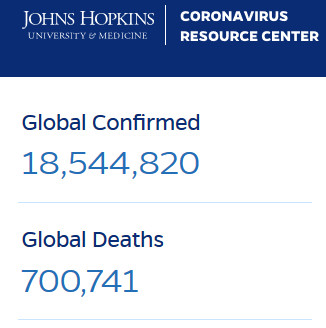
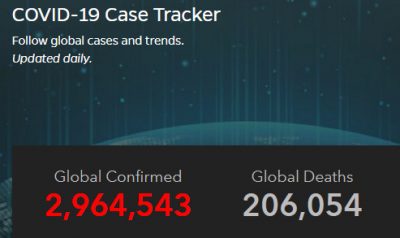
Looking at the current versions of the Johns Hopkins charts from last week’s blog, there is not really a definite ‘plateau’ in the figures, never mind any sign of a decline.

Unlike the virus, the shock of a high number of daily deaths appears to be something we are becoming immune to. Chief Medical Officer (CMO) Professor Chris Whitty suggested the current measures might need to be in place until the end of the year. The situation has been compared to a war, and in my less optimistic moments I worry that like the First World War when the ‘experts’ of the time, the military analysts, declared it would be ‘over by Christmas’, we will need to come to a more realistic appraisal. The first few months of the Great War were characterised by patriotic parades, rousing speeches, a general call to arms, volunteering and government spending. After Christmas, however, when it was clear that the proposed strategy of a short campaign followed by bringing enemies together to negotiate, was not working, countries had to change their economies and society and put them on a ‘war footing’ for the long-haul. Most of the time, however, I am optimistic that we can see out the current ‘war against an unseen enemy’, and a return to ‘normal’ is on the horizon.

No one wants to think of this war going on for a few years and our government having to borrow over 25% of Gross Domestic Product (GDP) annually, as happened in the two wars, compared to the short term 15-20% our chancellor has sanctioned so far. In the two wars GDP increased due to more production of munitions and uniforms etc. There is already some increased activity in sectors of the economy such as supermarkets, food manufacturers, logistics, suppliers of PPE and the pharmaceutical sector supplying medication and carrying out testing.  The problem (as it was during the previous wars) is that much of this expenditure is government-funded and needs to be repaid at some point.

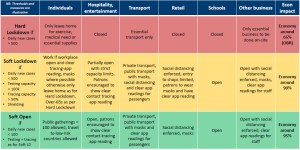
An increasing theme of questions to ministers at the daily briefings, and from some of the government’s own MPs, has been a desire to talk about the plan to get out of lockdown.  The week started with former prime minister Tony Blair’s Foundation the Institute For Global Change producing an outline 10-point plan for how this might happen. It uses a ‘traffic light’ system of the metrics that would allow certain activities when an amber stage is reached, and more when a green might follow. If infections, hospitalisation and deaths start to climb again, it allows for a red stage and return to lockdown.

Nicola Sturgeon Scotland’s First Minister released a similar document to start what she called an ‘adult discussion’ about the gradual release of restrictions.  For example, on how schools might have to be adapted to keep social distancing measures. One of the opposition parties in Scotland claimed that this was as much to do with trying to have a separate track from the UK government, and to steal a march on the ‘English Parliament’, as it is a real attempt to plan.
We had an idea of how releasing the lockdown might look after I joined an ‘on-line queue’ last Sunday to place a small order with DIY retailer Wickes. We had a text on Tuesday when it was ready to collect. Alyson drove to an empty car park where a member of staff brought the order out and put it to one side for her to place in the car. It was so long since Alyson had been out that the car clock was an hour behind. Alyson was so excited that in a Shirley Valentine moment she said, ‘hello car, it’s been a long time, how are you doing?’

It may be that any retailer that wants to re-open, must think about making such adjustments and change the layout and operate a queue and collection system. As our good friend David said during a Skype call ‘every shop will be like Argos’. Talking to my brother-in-law Paul, on a Zoom call for Friday evening drinks, about Jaguar Land Rover (JLR) planning to restart production at two of their car plants, he said they will have ‘re-engineered’ the line. Paul knows about such things having been involved in similar plans before retirement. Instead of having two or three people working on the cars as they go down the line, the engineers will be changing the order and reprogramming the robots used to allow the build to continue within the ‘social distancing’ guidelines. Whether there will be the customers to buy the finished vehicles is a different question.

The UK is fortunate to have some really educated and clever people working in our small and large private and public enterprises. We must hope that, like JLR, they will have been working on ways to ‘re-engineer’ what they do in a ‘post-pandemic’ world. Some of these changes may have been the way to improved productivity anyway, and the space and time during this outbreak was needed to get them implemented. Other businesses less able to adapt and change and whose business model was not ‘fit for purpose’ will disappear.

Apparently a group of experts are meeting with the various sporting bodies to determine how the leagues and events might resume in May/June. There is talk of playing behind closed doors with safety measures in place for players/officials and broadcasters. I will return to this topic in the coming weeks, after more details are released. For now, I am curious how a game of football will look if players must keep two metres apart and the ball must be wiped down with sanitiser after every header or a throw by the goalkeepers!

For me the first few weeks of lockdown has brought an increasing number of video calls. Two months ago I knew about Skype, but Zoom was a new product to me. Such is the growth of this platform that, like Google, it has gone from being a noun to a verb quite quickly. We now say we are ‘having a Zoom’ with a colleague or we say we have ‘been Zooming our family’.  Looking back I have had 16 such meetings in the last fortnight and a few more 1-2-1’s helping people setup Zoom. This week we had our first ‘virtual coffee morning’ with members of the head injury charity I am trustee/volunteer for. Given one of our aims is to reduce the social isolation of people who suffer such injuries, I have no doubts that this is an aspect of our work that will continue whenever the situation gets back to ‘normal’. It was a wonderful time of sharing for the ten of us on the call from all over Cheshire.

Technology is another sector of our economy that is booming as people need to be setup for working from home. Some of this business-to-business (B2B) spending is from the private sector so, even if it is funded by borrowing, is adding to our GDP.

Another crisis in the nations’ health being stored for the future?

After last week’s headlines about the current crisis in the care sector, this week doctors leaders and Sir Simon Stevens, Chief Executive of the NHS, highlighted a fall in general attendance at hospitals and GP surgeries. There could be people who need on-going treatment for heart conditions, cancers and other serious issues not getting these. People showing other serious symptoms of stroke, early-warning signs of cancers are choosing not to get checked out. 

Related to this is the mental health of those who are isolated or trapped in homes with an abusive partner or parent. The increase in retail sales of alcohol, the boom in business for wine delivery merchants, some of which is the result of the closure of pubs and restaurants, should also be an area of serious concern.

Alyson and I are blessed to live as a couple with all the interaction that brings and so far are generally getting along amicably! I saw a piece on one of the news channels about the lack of ‘human touch’ that is becoming a real problem even for those who wouldn’t normally classify themselves as ‘touchy-feely’ types. This could be something as simple as a touch of a hand when upset or a hug with a child or grandchild. One new grandparent said, hopefully semi-seriously, ‘well perhaps I will get to see them before their first day of school…’

My thoughts have been with a church friend who lives on her own following the death of her husband last April. This lack of touch is becoming a real problem for her. She had to manage the anniversary of her husband’s death on her own, without the special touch from her son who lives 150 miles away. Her daughter lives in Australia and has a son who was born a few days after her husdand’s death. So she couldn’t even share a first birthday cuddle with him, just a ‘virtual cuddle’ via the ‘FaceTime’ app on an iPad.

Other news this week.

  • Not a new item but a ‘correction’ from two weeks’ ago when I stated that the birds were singing more loudly as a sign of new life. During one of our virtual coffee chats with friends David and Janis, they sent a link to some research showing that the decibel volume of birdsong has actually fallen. This is true particularly in urban areas and near airports as they don’t have to compete with the ambient background traffic noise anymore.
  • This week a potential vaccine against the coronavirus was injected into a human in the first stage of a trial. The remarkable speed at which this has happened is a chance for some optimism, but the scientists tell us that it will take months for any useful results to be available and analysed. In the rush to get this game-changer out to the world, great care needs to be taken to be sure that there are no side-effects that could make the harm done in the long-term far greater than the deaths of the outbreak.
  • The science needed to understand vaccines and terms like re-infection rates, on-going immunity, blind trials, cohort selection, existing morbidities, aggravating factors etc are not simple. I tried to resist mentioning President Trump again this week, but his suggestion of injecting or inhaling disinfectants to ‘clean out the virus in a minute’ was not only dangerous but showed a complete lack of any of the science on which his experts have briefed him. I do think this quote, and his subsequent attempt to pass it off as sarcasm towards the reporters in the briefing room, will be seen as a ‘game-changer’ in the longer term. The idea that a President who has any sort of basic education is unable to see the difference of putting a powerful chemical on surfaces such as metal, porcelain or man-made plastics is no different to the delicate structure of skin or the inside of a human lung is frightening. It is like a parody of the story of ‘The Emperor’s New Clothes’ or in this case ‘The President’s New Coronavirus Treatment’ where everyone else can see it is completely ridiculous idea, but the person elected to lead thinks it is a brilliant one. Will any of his advisors or leaders in his administration have the courage to criticise him in public?
  • There was some ‘outrage’ that Richard Branson would apply for a loan from the government to support his airline Virgin Atlantic. It was pointed out that he has a lot of personal wealth and despite putting his private island (valued at ‘only’ a few tens of millions of pounds) as an asset against the £500Million loan, his press was not favourable. I can see the need to support his employees in the UK, but this is one example for the government and big businesses to negotiate over. The ownership of the company by one of the major US airlines and the tax regimes they operate in needs considering. Denmark was one of the countries this week to announce that any company that hides some of its tax offshore, without true transparency, will not be allowed a loan.
  • On Sunday morning it was announced that prime minister Boris Johnson had recovered enough from his coronavirus after effects to return to Downing Street and lead the government again. Writing as someone who has also come close to death during a 12-week stay in hospital, my hope is that the episode might have given him a new perspective on what really matters in life. The decisions he takes, the way he views the NHS and key workers, might mean a change in approach.

Thoughts at the end of week 5.

Covid-19 has claimed the life of another person I knew. Sharon was a local church treasurer in our circuit, and we talked at meetings. She had some other health problems, but the loss of any life, particularly from this virus, and the effect isolation has on close family is devastating.

The weather continued to be warm and dry so we enjoyed lovely walks outside viewing plants and wildlife. I went for two more substitute parkruns. The goods we managed to get from Wickes meant we could get on with work in the garden and complete painting the fence.

I have really enjoyed all my Zooming this week, particularly catching up with friends and family for coffee and chat.

Alyson continued learning her new skill of sign language and sewed a mask from cotton material should she need to wear it outside.

My lack of any new improved DIY skill was demonstrated by the fact that it has so far taken me over three hours to put up three simple shelves in our garden shed. The phrase ‘all the gear and no idea’ definitely applies to me. What made it worse was that the neighbour who backs onto our garden has made a whole Japanese design inspired pergola from scraps of wood in the same time. Complete with a decorative hand-carved finial. I looked on with some envy at the way he constructed it and used his power tools and screws in a way that I can only dream of. I will report how long it took to put my final shelf up in the next blog.

Stay safe and let’s see what week 6 brings.

Theology Everywhere

Discuss theology today to transform tomorrow

verbalising

ruminations on life at fifty ... or so ...

Discover WordPress

A daily selection of the best content published on WordPress, collected for you by humans who love to read.

The Daily Post

The Art and Craft of Blogging

WordPress.com News

The latest news on WordPress.com and the WordPress community.