This is the longer story of the reason I am doing a sponsored 10k for three charities that you can read about in my last post So Whats the Story…? A 3-2-1 offer on a sponsored 10k.
During the Olympic summer of 2012 I was training for my first short triathlon, having been a ‘slow plodder’ for about 30 years of doing 10K’s and around 15 Half Marathons including five Great North Runs. I was never competitive and my motto was ‘when the going gets tough…..it’s time to slow down or even walk if needed’.
I woke up one Wednesday morning with a splitting headache and some numbness in my right foot. Putting it down to ‘man flu’ and an old back injury I worked that day but took the next one off. On Friday I woke up and could barely move my right side and the headache was excruciating. By the time we got to A&E I could barely stand unaided. A stroke was diagnosed, and I was put in a ward and pumped full of aspirin. On Sunday after a CT scan I was told that it could be a cancerous brain tumour and I was being sent to a specialist hospital 18 miles away. They confirmed that it wasn’t a tumour but a large amount of infection. They were not able to operate, as I had so much aspirin in my blood there was a danger that I would suffer a bleed in the brain. By Thursday my condition deteriorated, and they did an emergency biopsy. This didn’t go well and early the next morning I went for a second operation to drain the infection. Alyson was told that I might not make it, and when our two sons arrived from their homes in the south, they had what we now refer to as ‘the organ donation conversation’.
Memories of the next 24 hours are sketchy but when I arrived back on the ward from intensive care, I still couldn’t move my right side and although I understood what people were saying I couldn’t answer at all. The only words I managed were a tentative ‘yes’ (when I meant no) and no (meaning yes). Later I managed to speak a little but then it was mainly swear words which, as people who know me will confirm, I rarely use.
So began treatment involving two antibiotics intravenously five times a day every day. I was also put on anti-epileptic medication to prevent fitting, and antidepressants for my low mood. The days were endless, the restless nights even longer. I was struggling with tiredness and extreme confusion. Coming to a dead stop after my life as a busy IT Project Manager was hard. I wanted to be back at work but had to learn that in the brain business, days turn to weeks and weeks to months.
I tried to read newspapers and magazines but by the end of a paragraph I had forgotten what the headline was about. I had asked for my Bible to be brought in and that was even harder to read. I couldn’t even remember The Lord’s Prayer. My Bible was still a source of some comfort, although starting on Psalms was probably not my best idea. I do have a vivid memory of Carmen, a Columbian nurse singing quietly a hymn while she gently washed my back. I shared stories with other overseas nurses who, on seeing my Bible, talked about life ‘back home’ and what their faith meant to them.
I started intense physio and speech therapy. Being left-handed was a bonus as at least I could do some basic tasks. It took three people to get me out of bed using a hoist and either onto the toilet or eventually to prop me up in a chair. What I couldn’t do was muster the words to ask to be put back, so often sat there frustrated for hours as people came in and out of my room.
Alyson visited me twice a day every day for the next 12 weeks. I owe her a debt that will never be paid. Church friends and close family helped relate my story each day to our wider circle. My brother and cousins drove mum and dad from their home 3 hours away. I barred any visitors other than close family at first, as I looked awful and couldn’t concentrate enough. When I relented our friends were faced with Ian who didn’t have any personality. The lights were on, but no-one was at home.
Then started daily visits from close friends, our sons, Alyson’s sister and brother, cousins. I couldn’t remember who had been from one day to the next – but I know that they all made me feel better – even if it didn’t always show on my face. Chocolates, grapes, biscuits and particularly ready-made custard were very welcome!
Work colleagues from the IT & Business Consultancy business I worked in visited and I was grateful for their support covering the projects I was supposed to be managing. Alyson’s employers Co-op Pharmacy were very understanding and allowed her all the time off with compassionate leave. The stress and worry meant that she was unable to work in any useful way.
Eight weeks in I needed a third operation as infection was still collecting in my brain. I had ‘drains’ fitted linked to bags on my shoulder – I looked like ‘Dracula’s Bride’ for a week or so.
This is a scan of my brain just before the operation on the left, and what a ‘normal’ brain looks like on the right – you don’t need to be medically trained to see the pools of infection and damage….

Scan 3rd September 2012

Scan of healthy brain
The result was a small improvement in all my symptoms; I managed to move a toe then bend my ankle. I managed some ‘freedom’ with a wheelchair that I could push myself around the ward and, if Alyson came with me, to the café or even outside. Friends and family began to see some big changes in both my alertness and mobility.
Steve Ingrouille, the minister at my local Methodist church, came to visit and we had the strangest communion I have ever received sitting in a corner of the public restaurant. Steve did the complete service with the bread and wine used at my church the previous Sunday.
Alyson also had great support from church friends who rallied around to help and I believe that the prayers they gave aided my recovery. Val Mayers and our neighbours Stuart & Veronica Rhodes need a special mention. I continue to gain strength from my church fellowship and my faith.
My mood slowly improved and when mum visited me one Saturday as she left we hugged and she said ‘Love you son, keep getting better and see you soon’. These were the last words she said to me as the next day she had a heart attack and was put into a coma on a life support system for a week. One Friday as I was taking my first steps unaided by physios I had a missed call on my mobile. It was my brother telling me that mum had died…she never got to see me walk again.
I was allowed out of hospital for one day to travel to her funeral 150 miles away and managed to stand using a frame to give part of her eulogy.
I had my laptop back by then to write and plan my ‘escape’ from the rehab hospital until my condition improved enough for Alyson to take me home in a wheelchair. The skilled consultants, surgeons, nursing team and physios had ‘fixed me’ – physically at least.
18 months of hard work started, to recover from my ongoing symptoms, regain my driving licence, and build my strength enough to stand on my own with a stick, and climb stairs. I did some part-time work in the IT Consultancy Business, helping the owners to sell the part of the business I was in. I knew about this before my illness but it meant me being made redundant. I then managed to get a little paid work with my church on finance and property.
Alyson went back to work as a pharmacy manager in a very busy community pharmacy attached to a surgery. This is an extremely demanding role with a team of around 20 to manage and unrealistic targets set. At least I was able to support her in this, being at home to look after practical things around the house, waiting for trades people, doing some of the household chores that until then had fallen mainly on Alyson. I was happy with a lower pace of life than before, and could rest when needed.
I had the hip replacement that I needed before going into hospital, and it was through this that I met Annette Turner, a brilliant physio specialising in hydrotherapy. When my consultant had signed me off in February 2013 he said it would be two years before we would know the lasting damage and implied this would be substantial. Annette convinced me that, whilst that was true, she could get me to the point where it might be that the only thing I couldn’t do was to move my little toe. That has proved to be the case.
In January 2014 I was encouraged by Beth Fisher, Service Manager from the Acquired Brain Injury service in Chester, to attend a support group who met for coffee. This is an amazing organisation who provide help for people with a brain injury to reduce the loneliness that can come from hidden symptoms, loss of confidence in social situations, along with memory issues and extreme fatigue. During the last few years this group has formed into a formal charity. I am now a trustee of Head Injured People in Cheshire.
Steve Price, an accountant who had been one of my project managers, had left to concentrate on his own business. In August 2014 he offered me the opportunity to work with him a few days a month to get out of his front room into an office, taking on some people to help him. I am eternally grateful to Steve and the team for the opportunity to work with them putting new systems, marketing material, social media, lots of new business processes in place as we grew. I became Compliance & Training Manager. (In April 2019 Steve and the rest of the team merged with another practice and he is now one of 5 directors in a company with 23 employees and a growing list of clients. I took the opportunity to retire).
I had another 18 months of physio and got to walk correctly and slowly, then six months later I decided to try running a few steps. I did a short route around our home in streets that I had used for training. It took me about 30 minutes to do a couple of miles with intense concentration on my foot placement and staying upright. I had to sleep for an hour afterwards. Fatigue is a lasting symptom of brain injury and several afternoons a week I sleep for 40 minutes, and each time I run I must sleep for around 50% longer than the time I take.
I don’t remember how I heard about Parkrun but in April 2016 I arrived at Delamere with my barcode and did the whole 5k without stopping. It was very emotional, and my account can be found at https://skatchat.wordpress.com/2016/04/.
Alyson used to come with me and walk the course before we started and meet me at the end but then two weeks before her 59th birthday she announced that she fancied running it. As someone who has asthma and have never run before I was amazed. She did her first run in 37 minutes, beat my PB the next week and after 5 more successive PBs she now runs around 30 minutes. She even fell over once and after dusting herself off for a short while still beat me by four minutes.
So the 100th Parkrun completed yesterday was an emotional one too, coming as it did on the 7th anniversary of mum’s death. Alyson did her 24th and our son Michael volunteered. My brother Andrew did his 100th at Newcastle on the same day along with his son Thomas.
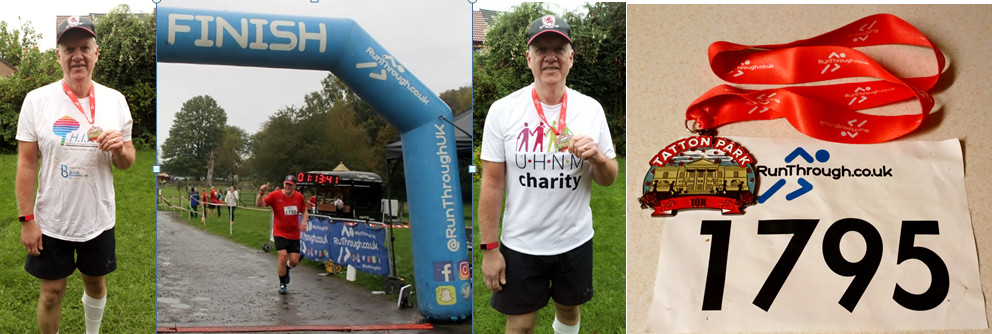
As we lost dad in 2016 and have received some money from their estate, it seemed a good time to celebrate my recovery and use their legacy to raise funds for the three charities that have helped me. So next weekend I will take on 10k at Tatton Park.
So Whats the Story?…..where I am now.
Reflecting on the past seven years, I genuinely feel that I am in a better place than before my brain injury. Sure, it has been a tough time and I wouldn’t want to inflict the stress and worry on my family that was some of our experience. Overall the positives are;
There is no substitute for confronting your own mortality and asking the real
questions of what your life is about…
- I have been able to spend more time working for my local church on finance and property issues, to support the Leadership Team looking at new ways of working, recruiting some amazing lay workers to support our ministers and churches.
- I have had more time to give to Alyson and our family. Supporting them through difficult times at work and being there to help with looking after her parents and supporting her when they died these past two years. Our two sons are in well-paid roles and have been able to buy their own homes. They too have benefited from their grandparents’ legacies, and by that I don’t just mean the financial ones.
- We are fortunate to have built up enough savings to be comfortable in our retirement. I had several good jobs in companies with strong ethics and who made a difference to their employees and the patients/customers they served. I have been able to help a friend build his business to repay his faith in me.
- I work with some amazing people in the head injury charity and have met some truly inspirational survivors, who live in much more challenging after effects than mine. Head injury doesn’t discriminate on the basis of age, wealth, personal background, education or experience. I am fortunate that the relationships with family and close friends have survived – that is not always the case.
So as I look forward to enjoying some travel and a forthcoming pilgrimage to the Holy Land, I wonder what the future holds, and the next challenge we will face. I hope that I am up to the task but know that I will have a lot of support.
Thank you for reading my story.
Ian Skaife, October 2019
 Skat's Chat