Coronavirus 18 months in – Gareth v Boris.

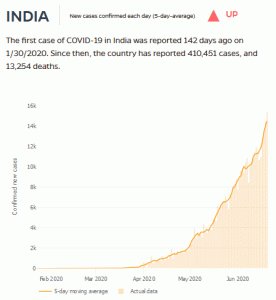
Since I wrote my last blog before Christmas a lot has changed both personally and with the virus. We have moved from Crewe to a new house in Oswestry. We are still not quite sure (despite only Alyson and me being involved) how we ended up here!. The virus has ‘moved on’ as well with and is now the delta variant, under the new naming convention so as not to stigmatise India – the country where the mutation was first found. The number of new infections is doubling every 9 or 10 days and could be as high as 50,000 a day soon. Many of the restrictions we have been living with will be removed on July 19th, so-called ‘Freedom Day’. There is a mixture of moods and opinions of optimism, fear, hope, sadness, concern, joy, uncertainty, division, and a belief that as a nation/country we are on the brink of a bright future where we will end up once again as world-beaters. Those same words could describe the expectations placed on the England football team as they prepare today for the final of a major international tournament for 55 years.

1966 was the middle of a decade of growth described by the then Labour Prime Minster Harold Wilson in part due to ‘the white heat of technology’ with the economy and the country generally on its ‘uppers’. No doubt the current Conservative Prime Minster the first name politician Boris is hoping that a win for England can be framed as overcoming the ‘doomsters and gloomsters’ he referenced in his pre-Brexit election victory in December 2019 – colliding as it did with the start of the current pandemic.

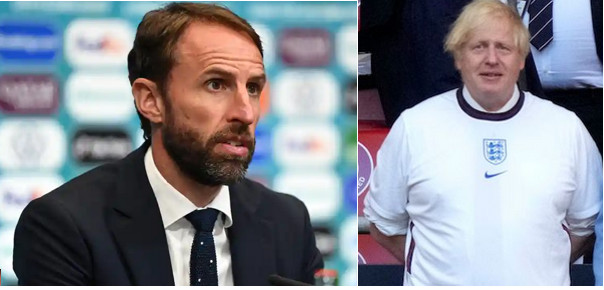
The two national passions of football and politics clashed after England’s semi-final victory on Wednesday when the ex-England and Manchester United footballer Gary Neville, in his capacity as a pundit for ITV’s coverage of the match, said these words as manager Gareth Southgate and his team paraded around the pitch, applauding England fans

The standards of leaders in this country in the last couple years has been poor. And looking at that man there that’s everything a leader should be: respectful, humble, telling the truth, genuine. He’s fantastic Gareth Southgate, he really is unbelievable and has done a great job.

Unsurprisingly the comments drew attention from all side of the political divide. The left-leaning papers jumped on them as an example to show up the perceived problems of the government and much of the right-wing press criticised the ‘Corbynista Neville’. Whatever the result tonight, I get the impression, from conversations in the media and with friends, that if the choice was between Gareth or Boris as leader I am pretty certain Gareth would win by a large majority.

Some might say what does Gareth know about being a political leader, to which others would respond what do many in the present Government know about running a large organisation, such as the National Health Service. I am certainly not going to criticise former Secretary of State for Health Matt Hancock for the actions which lead to his resignation, as we are all subject to our human failings, and it is a sad situation for all the families involved. What I have criticised before in these blogs is Mr Hancock’s part in the failings during the pandemic. The majority of government ministers were elected as MPs, and appointed to cabinet because of their desire to be part of a Brexit-focused government. It is easy to say ‘no one could have done better in the circumstances’, but, as has been pointed out not just by Dominic Cummings -someone not beyond criticism for his part in the ‘Barnard Castle’ affair – but by early parliamentary inquiries, there have been serious failings. Rewriting history over the failure to protect those in care homes, the lack of provision of PPE, and the fiasco of the ‘testing and tracing’ procedures, does not deflect from the errors that have been made.

People who have experience in commercial business and doing ‘real jobs’ such as teachers, doctors, engineers, or running care or health or even large sporting bodies are, in my opinion, better placed than those whose only exposure to ‘real life’ is being a political analyst or researcher to ministers in government or opposition. I know they appoint ‘special advisors’ and have civil servants who know the systems and processes, but simply relying on your own narrow view or that of like-minded people does not lead to good leadership or good governance. Apart from a short time working for the family IT company and as an economist at The Bank of England, Matt Hancock’s time has been spent studying for an MPhil and being chosen aged 26 to be a special advisor to then Chancellor George Osborne in 2005. He became an MP 5 years later aged 31 with no more experience of the real world.

To be fair to Boris he has been a journalist. I will leave it to others to decide if that is a ‘proper job’, or whether he was a particularly rigorous in his research, and he also led London as Mayor responsible for a huge organisation, and important areas like transport and policing.

As a fan of Middlesbrough football club I have a long affinity with the work of Gareth Southgate as he came to our club in 2001 (on July 11th as it happens) from Aston Villa, signed by that other former Middlesbrough manager who also went on to become an England manager, Steve McClaren. I have an interesting ‘joint autobiography’ written by Gareth and his long time best friend Andy Woodman called ‘Woody & Nord’.

It is a fascinating read as it charts the lives of two young friends started as youth players with Crystal Palace, but whose football careers took very different paths. Nord was the nickname given to Gareth by Walley Downes a coach at Palace who thought Gareth sounded posh like the TV personality Denis Norden. Another person at Palace manager Alan Smith clearly ‘old school’ looked into his eyes and told the then seventeen year old trainee Gareth ‘Son, no f***ing chance’. It is a sign of Gareth’s character that in the book he says that Smith is one of the good guys.
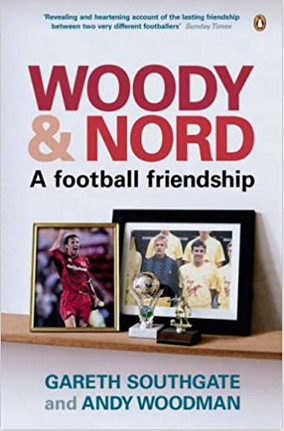
Ten years later Woody had his moment of glory for Northampton as a goalkeeper winning a playoff at Wembley (saving a penalty) and Gareth played for England at a European Championship – the famous one in 1996 when he missed that penalty! As their paths diverged and Woody moved further down the leagues and Gareth continued his rise in the Premiership they stayed close friends. The book is about how their lives remained entwined with holidays together and being best men for each others weddings. The book was written in 2003 while Gareth was Middlesbrough’s captain, but that was before he and Steve McClaren lead us to our first trophy winning the League Cup, and then two seasons in Europe culminating in a UEFA Cup final against Seville in Eindhoven in 2006.

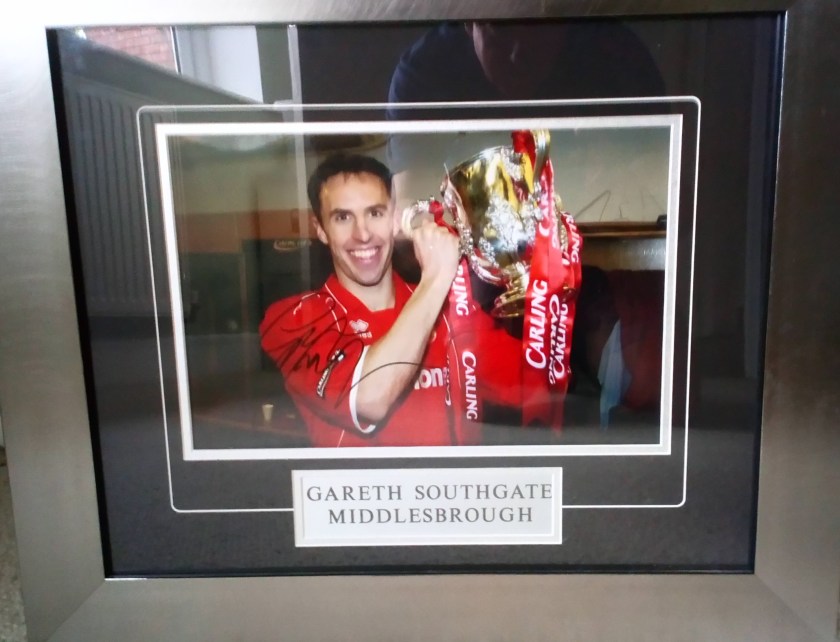
I have an original signed photo of Gareth holding that League Cup in 2004. I have the same replica shirt as it is one that I am willing to wear, given that it doesn’t have a betting company logo on it. The picture was presented to me when I was made redundant in 2007 after the Co-op took over the company I was working for. One of my sales manager’s partners ran a sports memorabilia company and gave me an authenticated copy.
After the match in Eindhoven Steve McClaren left for England and Gareth was appointed manager of Boro. He had two seasons of mid table finishes (including an 8-1 victory over Manchester City managed by the former England Manager Sven-Goran Eriksson). Following relegation the next season Gareth was replaced in October 2009 by another soon to be international manager, Gordon Strachan.

I have always had a soft spot for former players who have been our manager and like the fact that generally our Chairman Steve Gibson sticks with them, even after many others have started losing faith. I have a vivid memory of sitting in the away end at the Ricoh Arena in Coventry the weekend before Gareth was sacked a few days later – ironically after a mid-week match when we beat Derby and were in 4th place. It came to light that Steve Gibson met Strachan(a former Coventry manager) at the match and discussed the job with him, even as Gareth was managing the team that day below where they sat.

It is not too much of an understatement to say that Gordon Strachan’s time with us was an utter disaster. He criticised Gareth and the team and brought in a whole new team of former Scottish players, some of whom were ok, but others didn’t fit. To be fair he walked away less than a year later, when Boro were 20th in the Championship, without any compensation admitting he had failed.

I had wondered if ‘Woody and Nord’ were still friends but saw an interview this week on ITV with Woody, now managing National League side Bromley FC out of a wooden hut, while his best friend was giving the team talk at Wembley, and was pleased to see that they are still best mates.

Gareth still lives in North Yorkshire and used the nearby Middlesbrough training facilities and had two warm up friendly international matches at the Riverside Stadium. It may be a pipe dream but I hope Gareth comes back after his international career has ended and manages Middlesbrough in the Premiership again and brings us more success!

A large part of Gareth Southgate’s success is his willingness to surround himself with good people and to listen and learn from them. I read an article by one of the team, former Olympic Athlete Matthew Sayed who pointed out that many people in leadership roles surround themselves with like-minded people who in effect become an ‘echo chamber’ telling them what they think you want to hear, and in reality they only know the same things that you do. Gareth has people from other sports, business people and tries to learn what they do to bring success. Sayed states.

“One source of these ideas is the FA Technical Advisory Board, an eclectic group that has been advising on performance in regular meetings since 2016. Members (all unpaid volunteers) include Sir Dave Brailsford, a cycling coach, Colonel Lucy Giles, a college commander at the Sandhurst Military Academy, the Olympic rower Kath Grainger, Manoj Badale, a tech entrepreneur, the rugby coach Stuart Lancaster and David Sheepshanks, mastermind behind the St George’s Park national football centre.

At first, football insiders were horrified by this group, with negative articles appearing in the British press, on why they are not “footballing men”. But this is why the group is capable of offering fresh insights on preparation, diet, data, mental fortitude and more. This is sometimes called “divergent” thinking to contrast it with the “convergence” of echo chambers.

“I like listening to people who know things that I don’t,” Southgate told me. “That’s how you learn.”

It is clearly a winning formula at the moment. He has also appointed a diverse group of coaches who he relies on to get advice during games. You will often see him discussing something with his assistant, former Chelsea & Crewe Alexandra coach Steve Holland, immediately after a goal, or other key moments.

Whatever the result in the final, most decent people will judge this campaign as progress Even if we lose in an awful way or one person makes a similar mistake to Gareth’s 25 years ago, getting to a final is a huge step forward. One last quote from ‘Woody & Nord’ serves as a pointer to how Gareth will deal with it. In a section where he talks about not loving the game as much as he did in his youth, and giving everything for Middlesbrough in every game he is part of, to improve our position to the highest it can be he writes:

” Cynicism has coloured my view of the professional game . The attitude of some of the players, the behaviour of clubs, even the fans. Nothing appals me more than those endless and mindless phone-ins. Some guy, reacting to a defeat that afternoon, thinks the manager should be fired. Someone else agrees and in no time there is a bandwagon rolling. Spare me all of that. But the nonsense is everywhere. I’ve played with blokes who are happy to pick up the money, with others who have given everything and been treated dismally by their clubs. Fairness doesn’t come into it. Supporters call for loyalty from the players, but it’s a one-way street, expected from players but not reciprocated.”

Sport can be a joy and in good times can bring people together. Football can provide real health benefits and opportunities for young people from deprived backgrounds to make the big time. But recent stories about the greed of clubs in the failed European Super League, the ridiculous wages and transfer fees some of the current England team are on at their clubs and the racist and hateful social media comments, are the darker side. We saw at the start of Euro 2020 with the incident involving the Danish player Christian Eriksen collapsing on the pitch, that many were saying that some things are more important than the game. But even in the sleepy market town of Oswestry we have already seen the other aspect, with a fight between youths at a pub in a local square after the semi-final. Sadly, I can predict that if the result doesn’t go England’s way this will be repeated in a lot more other places. Gareth will want to celebrate the good things and learn and move on, but he knows there will be some for whom winning is everything.

If England do win, which will be fantastic, there will be some politicians who will frame it as a victory for us leaving the EU and one in the eye for Brussels. In the same way that the success of the vaccination scheme has been framed. It should be acknowledged that the willingness of our government to put money into the research, and to commit funds to orders for any vaccine has been a huge success. But please, spare me the view that this would not have been an option if we were still in the EU.

Turning back to the current situation of the pandemic. Politicians and scientists are divided on what will happen next. For every view that we need to ‘learn to live with it’, there is one that states it is still too early to release everything. In my view the lessons of the last 18 months have not yet been learned. Those who are vulnerable will still suffer. Those who can afford to self-isolate and are in relatively stable and well-paid jobs, live in good housing. with good support structures will survive, and even flourish. Those who have few of those things will not. There is a reluctance from the government to provide the support needed. The issue of ‘long covid’ and large numbers of people who won’t die but have long-term health effects caused by the virus will need even more of our limited healthcare resources, over a long period of time.

The rush to get ‘back to normal’ and go on expensive overseas holidays is not a right, but a luxury open only to those who can afford it. Even the idea of a ‘staycation’ has lost its original meaning. That of enjoying days our and time spent at home, rather than as now ‘of having to only go on holiday in this country rather than overseas’.

What has not happened yet is the sharing of the vaccine more widely with countries who can’t afford them. It is true to say ‘no one is safe until we are all safe’, but the reality is that the recent G7 summit in Cornwall whilst announcing the sharing of over a billion doses, missed the opportunity to extend that to the 11 billion which the WHO says are needed to vaccinate 60% of the world population by mid-2022. The International Monetary Fund (IMF) predicted that the $50 Billion dollars needed to do that, will be dwarfed by the $9 Trillion of increased global output that would result from it. The other side of the argument we all need to face up to, is that if it comes to a choice between vaccinating children in our country who don’t appear to suffer severe effects of the virus, or giving it to the most vulnerable populations in other countries, we need to choose the latter. It is a hard political sell, which is why we need good leaders who understand that, and work to change opinions by actions rather than ‘playing to the gallery’, or being an ‘echo chamber’ of those who think the same way.

Few people enjoy a good sporting occasion more than me, and it is hard to keep focus on the 95% of the rest of the world population, many in our own country, who aren’t as well off as me in terms of actual real wealth, or in terms of education and opportunity to achieve a basic standard of living.

An estimated audience of 33-35 million of us are expected to watch the final on TV and that’s just in this country. That figure is less than 5% of the 785 Million people worldwide who don’t have access to basic drinking water and less than 2% of the 2 billion who use a water supply contaminated with faeces. A sobering thought for all the people throwing beer in the air when England score. Come Monday morning whatever has happened, the sun will rise, and set later in the day. Sure we may have made some minor sporting history and a few individuals will have achieved ‘greatness’, but in the end will anything of real significance have happened?

Keep safe everyone, but please let’s also keep some perspective.
Coronavirus week 13 – The best and worst of the NHS – the old normal is back…

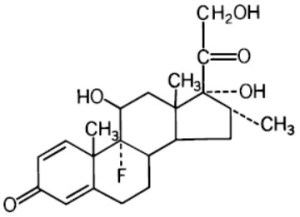
C22H29FO5 – the wonder drug

As it is nearly 40 years since I was awarded a BA(Hons) in Chemistry, I think I can be forgiven for not being able to give the modern name for dexamethasone. This is the drug announced this week used to treat patients with Covid-19 resulting in reduced deaths for those receiving oxygen or on mechanical ventilators.

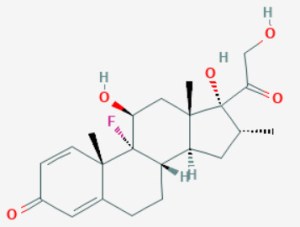
Nomenclature has changed since I taught chemistry for five years in the mid-80s. Looking back at the literature of the time it was called 9α-fluoro-16α-methylprednisolone or 6α-methyl-9α-fluoroprednisolone, but either way even having done a biochemistry module I am not sure I would have known it was a steroid derivative of the well-known drug hydrocortisone. One of the main topics I enjoyed was organic chemistry, that of carbon compounds. Looking through the 1,280 pages of Hendrickson, Cram and Hammond’s textbook from 1977 there is no mention of it, despite being used in a clinical way since 1961. To complete the confusion that people often express when I tell them I used to teach chemistry, it is always good to have a chemical structure to describe the compound. Here are two for this drug.

The slightly more modern version on the right shows the different elements hydrogen, oxygen and fluorine as different colours and the methyl (CH3-) structures as a dark triangle. My pharmacy consultant (and wife) Alyson tells me that I was on dexamethasone for a short time in 2012. I was in hospital for 12 weeks (the time we have been locked down now) with a brain abscess, and was given it to reduce the resultant swelling of my brain.

The research on dexamethasone done in British hospitals, with volunteer patients involved in the clinical trials, has been hailed as ground-breaking. The drug has potential to save tens of thousands of lives worldwide. It must be devastating for those who have lost loved ones who may have benefited from it. This and the amazing dedication of the care staff, cleaners, physios, pharmacists, therapists, doctors, nurses, and administrators demonstrate the best of our NHS. As a country and tax payers we need to fund them to the level required. We will have a thorough review and ‘learn the lessons’, but I fear that once ‘real life’ takes over and self-interest resumes its ‘normal life’, we will forget those weeks early on when as one voice we said ‘this can’t be allowed to happen again’.

The whole system needs a thorough rethink. There have been many reviews and reorganisations over the years, and it would be natural for those who work in it to think ‘oh no not again’.  The NHS needs rebuilding from the ground up, and possibly renaming. Before Covid-19 I think most people thought of the NHS mainly as the hospitals and local surgeries. In latter years, and certainly during the crisis, there have been concerns that care homes, mental health services, and some social care is linked to the NHS. Many people comment on ‘private business’ not getting involved in our health system as a bad thing. Well I have news for them, much of what we think of are ‘private businesses’. Community pharmacies which I worked in for over 20 years and Alyson has worked in for 40 now, are private limited companies owned mostly by pharmacists but some by medical wholesalers. The same is true of almost every doctor’s surgery who are businesses of doctors setup as a partnership of lead GPs who employ other GPs to help them. These private businesses operate as ‘contractors’ and are paid by Department for Health and Social Care (DHSC), itself only renamed in January 2018.  They are paid a rate for their services, whether that’s seeing patients, running clinics or dispensing prescription or carrying out medicine use reviews that is negotiated by their professional bodies with DHSC. It should not be a surprise that negotiating with what is in effect a ‘monopoly’ supplier is not one that leads to mass riches. What does surprise those doctors who visit pharmacies or chat to owners is unlike their partnerships, DHSC pays nothing towards premises or staffing costs of pharmacy businesses, or pay for the holding of large amounts of drug stocks. And don’t even get me on the subject of Dispensing Doctor practices – people who can write a prescription if they have too much stock of a particular drug, or choose the one that’s best for their business rather than the patient.

‘Business’ and the idea of accountability and competition has been part of the health service for many years, and now we have ‘Trusts’ who are independent organisations running services at a local or regional level. They contract to suppliers and surgeries, pharmacies and ‘buy in’ other services from blood and organ donation services, laboratory services and a host of other clinical ones. There are companies who contract for IT projects, finance, property building and maintenance, catering, cleaning etc. This started when I was still in pharmacy 20 years ago and even then I could see the problems of having local GPs on trusts. As with teachers and risk assessments I wrote about in an earlier blog, most GPs are not businesspeople and they can’t be blamed for conflicts of interest between their business and that of patients and other contractors.

Many governments have presided over reforms but the last major one by the coalition government in 2010 and overseen by Andrew Lansley has proven to be disastrous. Even before starting it drew criticism from a lot of areas. The idea of giving even more power to GPs and frontline staff and increased ‘competition’ on one level might seem like a good one, but in reality it led to a mix of systems and lack of any central accountability. The devolving of the social care and public health issues to local government foundered as the secretary of state for health, Jeremy Hunt, cut the budgets under the guise of ‘austerity measures’. The well-publicised ‘scandals’ with Mid Staffordshire NHS Trust and others in care homes can be laid at the lack of oversight on patient safety.  The organisation Public Health England (PHE) was formed as a result of abolishing Strategic Health Authorities (SHAs), and at the time several directors warned that this would compromise our ability to ‘fight any future pandemic’. SHA’s would have been able to lead on organising the local response and would have people on the ground able to conduct a ‘track and trace’ system. Andrew Lansley stepped down from government in 2015 and was rewarded for his efforts with a seat in the House of Lords.

Jeremy Hunt was the secretary of health who ignored the results of ‘Operation Cygnus’ in  October 2016 used to check the resilience of the NHS to respond to a pandemic (albeit one of influenza). As widely reported at the start of this pandemic, this led to a failure to replenish our stockpiles of PPE, antiviral drugs and ventilators. It is shocking to see him in recent weeks, as the now chair of the parliamentary health and social care select committee, taking the government to task over their failure on issues he was responsible for. When he was elected by MPs to this role in January there was a feeling that this conflict of interest might stop him questioning too much. It’s extraordinary to see the exact opposite happening, but his ability to wipe clean his own responsibility is equally unbelievable.

Andrew Lansley promised a ‘bottom up’ review but ended up with more ‘top down’ structures in place and setting up a whole series of ‘independent bodies’ to monitor things.

Several people have expressed surprise that hospices receive so little funding from DHSC and other government bodies that they have to rely on local fundraising and charitable status to continue. This was put in the spotlight early in the current crisis when fundraising stopped and no provision was forthcoming to help with PPE. If a national health service is supposed to cater for us from ‘cradle to grave’, what has gone so wrong that patients and their families who are facing the real end of the health system are left to donations and sales from charity shops for the provision of care to their loved ones. Another part of the health service that I have experience of, and which has been neglected are rehabilitation units. It seems Covid-19 is an illness that takes a terrible toll on survivors, with months of aftercare needed to even walk again. Many weeks on a ventilator in a medically-induced coma leads to mental health issues as well as physical weakness.

NHS IT provision, which I had some experience of when trying to implement the Electronic Prescription Service (EPS) in our pharmacy branches in 2005/6 was one riven with problems. With the help of our wholesalers and investment in NHS broadband we got all 50 branches setup just as we were sold to the Co-op. Alyson continued working in branch and even now, 14 years on, the system is not fully implemented and looks unlikely to be any time soon. Only recently can pharmacists see a very small amount of information held nationally on any patient who comes into their branchwhen they are away from the place they live. I know from personal experience that my local hospital, 15 miles from the one in another county and a separate trust where I was treated for my brain injury, can’t access any of my scans or records. This is why I have a lever arch folder with all my records and several CDs of my scans/x-rays that I can take in should it happen again.

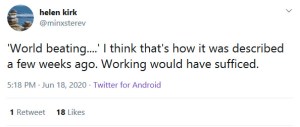
As predicted by my sons in a blog six weeks ago NHS IT, or NHSX as it is now called, was criticised this week for the failure to deliver the NHS Test & Trace app, and are considering reverting to the Google/Apple model. As my chair of district tweeted;

In all the ‘clap for carers’ and accolades given to those in the health and care systems, we shouldn’t fall into the trap of thinking everyone is working for the common good. In an organisation of about 1.5 million people there will be some ‘bad apples’ and strong management and administration supported by decent pay and training is needed.

Our National Health service should be as much about prevention and encouragement to live a healthy lifestyle as it is about treating us when we fall ill. The effects of obesity, diabetes, heart disease and respiratory conditions on the death rate from coronavirus demonstrates this need. The savings made from prevention should outweigh the costs of later treatment.  Education, as in many things, is vital for health outcomes as is reducing poverty.

Let’s hope the next review takes all of the factors into account and, as I wrote last week, as a country we can fund the necessary changes. Our National Health Service has become a ‘Reactive Illness Programme’ (RIP), and needs to change, and quickly.

Other news this week

  • The ‘old normal’ resurfaced in our area this week when 6,000 people attended raves in two separate areas of Manchester on Monday. Several people were stabbed, one girl allegedly raped and local people had to clear up the mess after everyone had left.
  • Crime seems to be on the increase (or at least being more reported) and terror is back on our streets with the stabbings in Reading this weekend.
  • There is more talk of reducing the social distancing requirements to one metre to get hospitality and self-catering holiday accommodation open.
  • Dame Vera Lynn died this week at the age of 103. She was called the ‘forces sweetheart’ during World War Two and had shared her thoughts during the current crisis and her song was echoed in the address to the nation by our Queen when she said ‘we will meet again’.
  • The Labour Party review on the reasons for disastrous results in December’s general election was published. It didn’t make comfortable reading for members of the party like me. We must work for Labour to produce policies which chime with the need to do things differently in relation to funding the new health and social care system, tackling poverty, improving education and closing the gap between the wealthy and poorer in society.
  • The daily death announced totals continue to fall with the Monday-Friday total this week being 853 down from 1,065 last week (a fall of 20%). The total of deaths at the end of the week was 42,632.
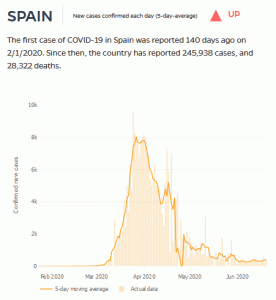
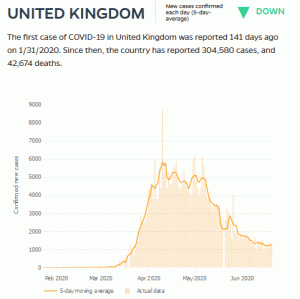
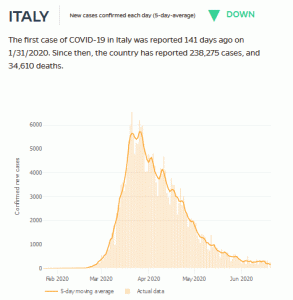
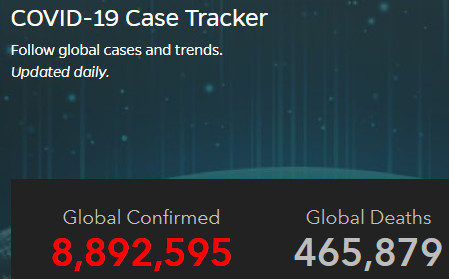
  • With numbers seemingly under control in European countries despite some local outbreaks in Germany, I looked again at the statistics on Johns Hopkins site and there are some awful looking graphs in other areas of the world. Here are the graphs for cases in Europe;


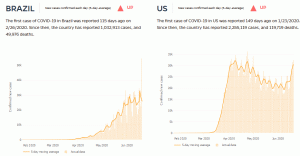
    These show that we are over the (first?) peak of infections. The story in two countries with presidents who think it is nothing to worry about, and are trying to get their country’s open again is not so hopeful…

    and note that the scales on these are tens of thousands rather than the thousands in Europe.
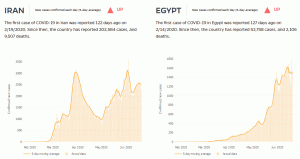
    The middle and far east countries are also showing curves which are concerning, with a ‘double peak’ for Iran. The cases are in hundreds but show no signs of decreasing.

  • We need to start looking overseas again now that we are getting the UK cases down. There is concern from aid charities that helping less well-off countries will be harder now that the department for international development (DFID) and the UKAid agency has been subsumed into the Foreign Office. A move criticised by three recent former prime ministers from both Conservative and Labour.
  • The debate and protests around racism and the ‘Black Lives Matter’ movement continued across the world.
  • I was going to write that the demonstrations and actions of climate protestors, similar to the ones for Black Lives Matters with marches and ‘direct action’ had not resurfaced, when yesterday I saw an interview with Greta Thunberg saying that she was looking forward to going back to school in Sweden, and vowing to carry on campaigning.
  • Greta’s target for criticism president Donald J Trump was back on the campaign trail with a ‘huge rally’ in Tulsa, Oklahoma where only 6,000 of a possible 19,000 seats were occupied despite over a million applications for tickets. For those who did attend there was little sign of masks or social distancing, and six of the organisers caught the virus. At the time of writing there are reports that Mr Trumps rally had been ‘turned over’ by teens and young people responding to campaigns on the Tik-Tok and K-Pop social media platforms applying for tickets then not turning up. Mr Trump said earlier in the week that a million supporters would come.

How has week 13 been for us?

Unfortunately we have another example of the ‘worst of the NHS’ in our household. Five weeks after Alyson applied to help out NHS 111 with taking phone calls from people who need to speak to a pharmacist, and after three polite chasing emails and responses from the HR team doing the ‘on-boarding’ stating that she will hear ‘in a few days’, there is still no sign of her contract or training plans. She has played her part by taking two more calls on the SOS NHS volunteering app.

We haven’t ventured to ‘non-essential shops’ yet and the crush at the Nike store in London and the lady interviewed in the Primark queue in Manchester who stated that she ‘felt like I’ve won the lottery’ didn’t pursuade us. We did go for another walk in Delamere Forest and had a picnic which was pleasant. The weather meant another postponement of meeting with friends in our garden, but we have a walk planned in a park further afield this week.

I have watched a couple of the Premier League football matches now live on ‘free tv’ and have been surprised how realistic the ‘virtual crowd noise’ is to make them seem more ‘normal’ despite empty stadiums. The  online radio commentary I heard for my team Middlesbrough was a sign of the ‘new normal’ being much like the old – we lost 3-0 and are looking at relegation again.

I had my first international Zoom with a call to our subcontractors’ office in India with the person who helps on the IT project I am doing. We have had training sessions with the team from our district who are attending the Methodist Conference in a week’s time. With over 300 representatives, Zoom will be in the form of a webinar where we can only see the person presenting and another speaker who wants to add to the debate. Voting will by the raising of a virtual hand or completing a poll on the screen, so the feedback on numbers should be much quicker than the usual manual count of raised hands in the conference hall.  I will write more about this next week. The conference service on Sunday will be at my now ‘virtual home church’ of Methodist Central Hall, Westminster in London.

Keep safe and let’s hope there is a safe further easing of lockdown in the coming week.


Coronavirus week 12 – what I have (not) done…

Looking to a more just society…

Even though lockdown has been eased and we are allowed to do more things than before, my week has been dominated by planned activities that I have not done.

Alyson gave me a lovely thoughtful present to surprise me on my birthday in April. It was something that she knows I had looked at, but dismissed as probably too expensive and not fitting in with our plans at the time. This weekend should have been the ‘London Series’ of Major League Baseball (MLB) where teams from the US play a two-game series at the ex-Olympic Stadium, now the London Stadium and home to Premier League team West Ham United. The two teams due to play were the St Louis Cardinals and the Chicago Cubs, who play in the Central Division of the National League(NL) so it would be one game in a long-standing rivalry.

The 2019 series, the first one to showcase MLB overseas by playing in the UK, was another rivalry between the New York Yankees and the Boston Red Sox of the American League (AL) East Division. Some readers may know that I have been a supporter of another AL East team the Toronto Blue Jays since I first saw them in the early 80’s and have been to matches each time we have been to Toronto since, including last September. So, it would have been great to see a live game in London, but the virus put a stop to that.

I am sure more people would have been looking forward to the next thing I have (not) done this week – the Euro 2020 football championships. Friday would have been the first match in Rome where Turkey would have taken on Italy at 10pm UK time. Saturday would have seen Wales play and today England would have played Croatia at Wembley. I had put all the matches into the calendar on my computer which I do months before each major tournament in case people try to arrange church or charity meetings. Not that I wouldn’t go if they did, I just want to be able to inform them, and to have the chance not to do so!

The third activity I have (not) done this week like the 11 weeks before is my regular Saturday morning Parkrun at 9am in Delamere Forest. I have written about Parkrun before if you look back at posts, starting in April 2016 when I did my first run and first post, to February 2018 when I did my 50th, and last October when I did a sponsored 10k the week after completing my 100th. I really miss the run, the team of volunteers and other runners. During lockdown I have done a 5k run on Wednesday and a longer 6.1k on Saturday morning. The great thing is that I have come first every time, and today was my second fastest time of the 12 weeks.

However, the one thing I have (not) done and want to write about the most is an event I chose not to go to on Tuesday, despite being successful in my application to attend. We met up with Alyson’s sister and husband in Cannock Chase Forest park for a lovely walk and a ‘socially distanced picnic’ sitting either end of a felled tree. There were a lot of people around, but it was easy to keep a safe distance on the miles of paths. There was a takeout service from the cafe and there were plenty of Portaloo facilities which were clean and had plenty of hand sanitiser.

The event I chose not to go to was a Zoom conference with the Shadow Work and Pensions Secretary Jonathan Reynolds and other MPs and Labour Party members. It was to discuss policies that feed into the National Policy Forum consultation taking place this summer. The agenda looked an extensive one;

This policy discussion is on the subject of the future of social security after coronavirus and we would like to hear your thoughts and ideas on the questions below: 

  1. What has the crisis taught us about the role of social security in protecting the most vulnerable in society and the gaps in the current system?
  2. To what extent has the crisis changed public perceptions of social security? How can we build on any changes to ensure wider public support for the system?
  3. To what extent should social security be a universal entitlement available to all?
  4. How can social security support self-employed workers?
  5. What role can social security play in addressing inequalities and poverty in society?

Many of these were topics I wanted to write about when I started this blog and if you look back to the first one on the 5th April there is a section on Economics where I ask

  • How we use our wealth to best effect for what both main political parties agree should be ‘for the many not the few’.
  • How corporations, public bodies, small and medium businesses, wealthy individuals, and every individual supports each other.
  • Do we need a fundamental rethink and ‘reordering’ of past conventions?

So it would have been extremely interesting to have been in the session and one of the ‘breakout room’ where we would have had the opportunity to discuss in smaller groups with other MPs acting as leaders and Johnathan popping in to listen and answer questions.

The brief paper that we needed to read before attending the forum set out the problems with the current system, many of which were there before the crisis, but have been highlighted in recent weeks. It acknowledged the steps the present government has taken in the furlough, business rates, business loan and help for the self-employed, which have been unprecedented in recent times. The paper also pointed out the issues that need a fundamental rethink.

I admit to having no formal economic training and acknowledge that the taxation and benefits system for any ‘developed’ country is complex. A balance between ‘fairness’, ‘equality’, ‘incentive’, ‘reward’, ‘ethics’, ‘environment’, the fast-moving needs of the ‘labour market’ and dealing with factors arising from being an interconnected world and ‘globalisation’. But you don’t need to be any sort of expert to know that the present system is failing. It fails not just those in real poverty and need, but large numbers of working people who are claiming benefits and slipping into poverty as housing  and other costs rise at a time when wages are rising slowly.

To pick up on the current mood, the effects of the virus and ‘Black Lives Matter’, the present system already discriminates against the BAME community, those who we now call ‘heroes’ in low-paid but vital jobs, many of who are women, the disabled, young people coming out of education trying to get employment and into a home of their own. After the virus, these impacts will only increase.

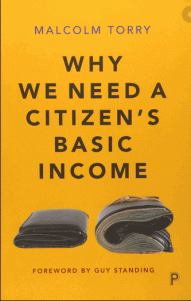
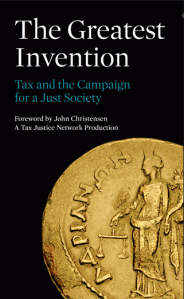
In mid-February I ordered the book below, prompted by a discussion we were having in one of our church study groups with Richard who worked at the local Credit Union. I had been reading the second one for the last year. Both have something to add to the conversation we would have had at the forum and for a policy fit for the 21st century.


Richard’s statement about what we could do to help those who he sees at the Credit Union was simple. ‘As one of the richest countries in the world, it’s time we paid everybody in the country a basic income’. The other book explains how our current taxation system is exploited by global corporations and wealthy individuals, using tax-havens and false reporting of money flows to avoid paying a fair share to support society. This can be to the point of criminality by those who setup the money markets to manipulate it in ways that even governments don’t understand, and for which there is little transparency. Radical change is needed considering the ideas in both books to reform the economy.

A Basic Citizen’s Income

There is not enough room to explain all the ideas around this and I suspect most people’s reaction would be ‘well it is a nice idea, but it will never work’.   The details need to be worked out after a full debate and explanation. The amount needs to be considered but the ‘simplicity’ of it, in my opinion, is unarguable.

Every citizen who reaches working age will receive a basic income for them to use as they wish.  It is unconditional and nonwithdrawable (with higher amounts for older people and smaller amounts for children). It will be paid by the government directly into people’s bank account on a regular basis with no means testing at all. This immediately cuts out whole swathes of bureaucracy or ‘red tape’ so disliked by many politicians, it allows citizens who live in the present world characterised as a ‘precariat’ of uncertain income and changing jobs frequently, quickly slipping into needing help. There would be no need for Universal Benefit as everyone would have some income and could build a ‘reserve’ to see them through short periods of unemployment or sickness (or lack of income caused by a situation like the present virus). It could, over time, replace the need to pay a state pension. It will give the ability to those who want to pursue higher education the means to subsidise that, those who want to setup a small business to do so, and those in work to help others less fortunate or to pool ‘unneeded income’ to give a hand up to other family members. All such income would be taxable.

It needs bringing in with another pillar of a fair society – education. I can already hear people suggesting that it is a recipe for ‘scroungers and wasters’. Children and families will be taught basic money management and the way the economy works. Banks would have to change their model to help people manage their money well, and stop them from getting into debt through bad choices.

There is not enough room in this blog to explain it all, but I hope the chapter titles in Malcolm Torry’s book will prompt you to think about it more;

  1. Imagine….
  2. How did we get to where we are now?
  3. The economy. work and employment
  4. Individuals and their families
  5. Administrative efficiency
  6. Reducing poverty and inequality
  7. Is it feasible?
  8. Options for implementation
  9. Pilot projects and experiments
  10. Objections
  11. Alternatives to a Citizen’s Basic Income

Tax and the Campaign for a Just Society

This is the subtitle of the second book I read a review in The Methodist Recorder and asked for it as a Christmas present. I have not read it all but the parts I have made me realise that the reason a universal basic income might not happen, is the people who setup our complex financial structures are also those who control and exploit it.  Although not formally setup until March 2003 the Tax Justice Network (TJN) has its roots in the almost total lack of research as to what lead to extreme poverty in Africa, South-East Asia and Latin America as money flowed out from these countries under the guise of ‘aid’ to the financial centres in Geneva, New York and London via a complex network of offshore companies and trusts located in secrecy jurisdictions. They exploited the fact that many of the countries they were ‘helping’ had poor governance and taxation systems and officials willing to be corrupted by the promise of wealth such people could only dream of.  One of the writers of the book has worked ‘on the inside’ and struggled with what he saw in terms of ‘transfer pricing’, tax havens and ‘illicit financial flows’ as part of a team working for accountants Deloitte Touche and as Economic Advisor to the States of Jersey and alongside the Organisation for Economic Cooperation and Development (OECD). He witnesses what he calls the ‘dark arts of tax havenry’ and relations with Hong Kong, Jersey, London, and Singapore. Every time he questioned something with senior people, lecturers for his degree or powerful people in government, it was side-stepped and he realised he had wandered into an ‘economic blind spot’. TJN is now an established organisation working with partners in the charity sector and other likeminded organisation to campaign for transparency and information and changes to the global economic system. Not easy when you have the full weight of large financial institutions funding lobbyists and vested interests.

Again, there is not enough space here to write in full, but the book is in the form of individual articles/papers written by a variety of authors. I urge you to read some of them and here is a selection;

  • What is necessary is possible
  • Pinstripe Outlaws
  • The Africa Question: Where Do All the Profits Go?
  • Tax Justice and the Oil Industry
  • Tax Competition: A case of Winner Takes All?
  • Revealed: How Multinational Companies Avoid the Taxman
  • Making the Link:  Tax, Governance and Civil Society
  • The City of London: A State Within a State
  • Harnessing Land Value as a Green Tax
  • How Much Should the Rich Pay in Taxes
  • Didn’t they notice?
  • Human Rights and Just Taxation
  • Public Duty, Private Gain: Professional Ethics and Tax

The one highlighted in red I found the most shocking as it exposes the City of London as the largest enablers of tax havens in the world. In four short pages written 11 years ago it explains why it is unlikely that any UK Government will agree to such a radical policy as transparency in tax avoidance, and how the narrative against a citizens income could be stopped in its tracks by ‘those who have the real power’.

Other news this week

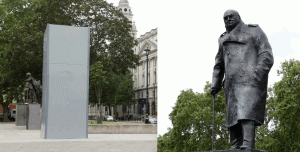
  • The Black Lives Matters protests continued and after the toppling of Edward Colston’s statue last week and the graffiti daubed on Winston Churchill’s in Parliament Square, a debate started on which others should be removed. This, like most topics I have written about, is why education is so important. The historical context of our ‘famous’ people and the benefit to society needs to be explained and the flaws of whatever size or nature drawn out. In some cases this could lead to public statues being placed into museums and others to have information that gives both sides of the stories. None of this should take focus away from what we need to do now and in the future to change society for the better.
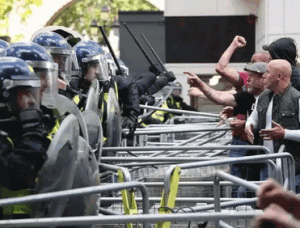
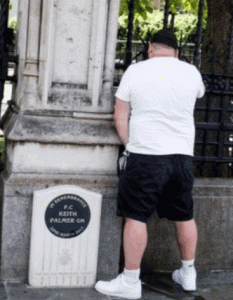
    There is no doubt that the violence on Saturday by so called ‘protectors of the statues’ was nothing more than extremist thuggery and anarchists and aggression towards the police. Many of the young men involved are clearly missing the chance to fight other football hooligans in the (not) Euro 2020 Championships.

  • I admit to being taken aback when one of my ‘local heroes’ Captain James Cook’s statue in Whitby as well as those in Australia. In the several books I have read of Cook’s life story it is clear that he is an example of someone from Middlesbrough born to a labourer who worked his way up from farmhand, to shop assistant, to junior sailor in the merchant navy, and became a senior captain in the Admiralty and who led surveys of large parts of the then ‘undiscovered continents’ and routes between them. These were ‘different times’ but Cook was known to treat his crews ‘relatively well’ and never lost one from the diseases of the time.  He is honoured in his hometown with schools and the major hospital named after him. The other parkrun I sometimes do when I am in the north east starts just outside the Captain Cook Birthplace Museum in a park in Marton next to the place where he was born in what was at the time little more than a shack and is no longer there. The cottage the family is supposed to have lived in when they moved to Great Ayton was moved to Melbourne in Australia in 1934.
    I completely understand the objection by indigenous first nation Australians that James Cook ‘discovered Australia’ and the suggestion by them that 26th January the ‘Australia Day’ national holiday should be renamed ‘Invasion Day’/ ‘National Day of Mourning’ / ‘Survival Day’ and the colonial nature of the planting of the flag on Australian soil by Co0k’s fleet that day should be set in historical context.

    But as far as being involved in the slave trade, there is nothing of that in Cook’s story that I have read, but it is true that he killed Maori warriors on arrival in New Zealand and proceeded to subdue the then self-governing people, misunderstanding their initial ‘welcome’ as one of a threat to his ship and crew. Similarly an incident of kidnapping a king on Hawaii that lead ultimately to Cook’s death was a tragic episode.
  • The protests in the US continued and another unarmed black man was shot  by a white policeman. Another name added to the ever growing list.
  • Education has been to the fore again this week. A government that put a lot of energy into the building of new hospitals and getting retired medical staff to return, appears unwilling to do a similar thing for our schools. There is no sign of building temporary classrooms or taking over unused public buildings or exhibition centres to setup places to help the generation that is missing out on six months of formal education, particularly those with no facilities at home. A straw poll of retired teachers I know shows that some might be willing to go back and help in the short term with classes to make up for lost time. As someone who left teaching 34 years ago I am not sure my ‘skills’ are up to the job or my subject knowledge of Chemistry and Mathematics!
  • The official number of total deaths announced at the daily briefings continued to fall gradually as measured by the 7-day average. The figures for Wednesday to Saturday were 151, 202, 181, 36 and on Sunday the total stood at 41,698.
  • The 14-day quarantine for people arriving at airports was introduced but other than airlines complaining there was little news on the effectiveness and no numbers on how many people had been followed up or fined.
  • In the coming week ‘non-essential’ shops who have put social distancing measures and are self-declared ‘Covid Secure’ can re-open.
  • As I write Boris Johnson, pushed by some Conservative MPs are looking to reduce the social distancing from two metres. It seems ironic that many who were in favour of ‘taking back control’ from the EU are now quoting many countries from who are using shorter distances than we are. It would be interesting to know if their views would be the same if a declaration by the EU that all member states should adopt a distance of one metre had been given when we were still part of the bloc and operating a ‘different standard? I am not sure how those retailers who have already spent millions of pounds (much of it grants from local government) on reorganising layouts and putting signage in, will feel when the advice changes again in three weeks as hospitality starts opening.
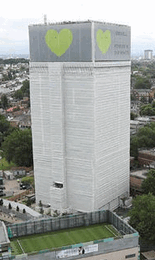
  • Today is also the third anniversary of the Grenfell Tower disaster. We saw the tower covered in screening as we drove through London last August. It was a larger example of the covered statues this weekend. At the time there was much talk about how the lower paid and largely ethnic minority key workers who live there had been forgotten by the wealthy borough next door. Three years on this seems to have been dropped from the agenda. Sound familiar? This and the violence in the centre of London makes me less optimistic that we will ‘learn the lessons’ and start being kinder to each other. 

So how has week 12 been for us?

Apart from our walk in Cannock Chase Forest, Alyson has continued daily walks and I joined her for one on Friday which was also the anniversary of her mum’s death 12 months ago. We walked on a footpath through fields of corn and stopped between the showers to listen to the sounds of birds singing. The sadness of the anniversary was tempered by feelings of gratitude that this time last year we didn’t have to cope with a pandemic, and the associated issues of visiting care homes, organising the funeral, and sorting the sale of the family house in the north east.

Alyson took another trip to the garden centre to buy a yellow rose to plant as a reminder of her mum who loved roses and the colour yellow. The garden is starting to look a blaze of colours as other plants flower and grow.

The birdlife in our garden continues to become more varied and this week as Alyson was exercising on the bike in our conservatory she saw a buzzard land briefly, and today a green woodpecker visited. The buzzard probably explained the headless body and scattered feathers from a blackbird we found on Monday.

With the announcement of ‘household bubbles’ where single person households can pair with others without social distancing and even stay overnight, we asked our son David if he wanted to travel from Bath to see us. He declared himself ‘happy in his own bubble’! He has managed to go for an open water swim and some more rowing.

Zoom coffees have continued and I attended my weekly streamed service from Methodist Central Hall, thankfully not affected by the violence just outside in Parliament Square. I am not sure that any statues of our founder John Wesley are on the ‘hitlist’ of those for removal, but like all of us his life was not without flaws. There is a statue in what was a British Colony of Georgia in the southern states of America. In 1736 John and his brother Charles travelled to the newly formed parish Savannah, as Anglican High churchmen with the primary aim of evangelising to the Native Americans. This was not successful and an incident with a young lady who he had a failed relationship with, and then banned from taking communion did not go down well.

Nevertheless, John Wesley went on to found a movement that, as as I written before, was a reforming one with social principles and members who were key in the Trade Unions and Labour Party. I try to live by his rules on wealth which sparked my interest in the two books in this blog. Those rules were;

Gain all you can. Save all you can. Give all you can.

Stay safe and let’s see what the next seven days brings. Two things are certain;

  • we will (not) be rushing to join the queues in the shops that are opening.
  • Alyson will definitely (not) be watching the restart of live sport in the form of Premier League and Championship football!


Life & Death – Coronavirus week 5 – what’s the next step?

An uncertain timescale, and new ways of working.

As the total passed 20,000 this week I fear the announcement of a high number deaths in the previous 24 hours is becoming part of our daily routine. I had some favourable comments about last week’s blog on statistics and am grateful to our son David for sending a publicly available link to the NHS Statistics site that details how these are compiled and it is at;

https://www.england.nhs.uk/statistics/statistical-work-areas/covid-19-daily-deaths/

David pointed out that the term ‘daily death toll’ is misleading as they are compiled from a series of numbers, some of which can be from a few weeks before. If you want to see how many have died in your local hospital trust these are on the different sheets in the spreadsheets.

The daily briefings are now showing some of the additional community and care home figures, which increases the totals. There has also been a discussion this week on how exactly registrations of death in the community are classified. The new guidelines allow for dying of Covid-19 or dying with Covid-19 and having one of the reasons as ‘pneumonia-like’ symptoms.

Looking at the current versions of the Johns Hopkins charts from last week’s blog, there is not really a definite ‘plateau’ in the figures, never mind any sign of a decline.

Unlike the virus, the shock of a high number of daily deaths appears to be something we are becoming immune to. Chief Medical Officer (CMO) Professor Chris Whitty suggested the current measures might need to be in place until the end of the year. The situation has been compared to a war, and in my less optimistic moments I worry that like the First World War when the ‘experts’ of the time, the military analysts, declared it would be ‘over by Christmas’, we will need to come to a more realistic appraisal. The first few months of the Great War were characterised by patriotic parades, rousing speeches, a general call to arms, volunteering and government spending. After Christmas, however, when it was clear that the proposed strategy of a short campaign followed by bringing enemies together to negotiate, was not working, countries had to change their economies and society and put them on a ‘war footing’ for the long-haul. Most of the time, however, I am optimistic that we can see out the current ‘war against an unseen enemy’, and a return to ‘normal’ is on the horizon.

No one wants to think of this war going on for a few years and our government having to borrow over 25% of Gross Domestic Product (GDP) annually, as happened in the two wars, compared to the short term 15-20% our chancellor has sanctioned so far. In the two wars GDP increased due to more production of munitions and uniforms etc. There is already some increased activity in sectors of the economy such as supermarkets, food manufacturers, logistics, suppliers of PPE and the pharmaceutical sector supplying medication and carrying out testing.  The problem (as it was during the previous wars) is that much of this expenditure is government-funded and needs to be repaid at some point.

An increasing theme of questions to ministers at the daily briefings, and from some of the government’s own MPs, has been a desire to talk about the plan to get out of lockdown.  The week started with former prime minister Tony Blair’s Foundation the Institute For Global Change producing an outline 10-point plan for how this might happen. It uses a ‘traffic light’ system of the metrics that would allow certain activities when an amber stage is reached, and more when a green might follow. If infections, hospitalisation and deaths start to climb again, it allows for a red stage and return to lockdown.

Nicola Sturgeon Scotland’s First Minister released a similar document to start what she called an ‘adult discussion’ about the gradual release of restrictions.  For example, on how schools might have to be adapted to keep social distancing measures. One of the opposition parties in Scotland claimed that this was as much to do with trying to have a separate track from the UK government, and to steal a march on the ‘English Parliament’, as it is a real attempt to plan.

We had an idea of how releasing the lockdown might look after I joined an ‘on-line queue’ last Sunday to place a small order with DIY retailer Wickes. We had a text on Tuesday when it was ready to collect. Alyson drove to an empty car park where a member of staff brought the order out and put it to one side for her to place in the car. It was so long since Alyson had been out that the car clock was an hour behind. Alyson was so excited that in a Shirley Valentine moment she said, ‘hello car, it’s been a long time, how are you doing?’

It may be that any retailer that wants to re-open, must think about making such adjustments and change the layout and operate a queue and collection system. As our good friend David said during a Skype call ‘every shop will be like Argos’. Talking to my brother-in-law Paul, on a Zoom call for Friday evening drinks, about Jaguar Land Rover (JLR) planning to restart production at two of their car plants, he said they will have ‘re-engineered’ the line. Paul knows about such things having been involved in similar plans before retirement. Instead of having two or three people working on the cars as they go down the line, the engineers will be changing the order and reprogramming the robots used to allow the build to continue within the ‘social distancing’ guidelines. Whether there will be the customers to buy the finished vehicles is a different question.

The UK is fortunate to have some really educated and clever people working in our small and large private and public enterprises. We must hope that, like JLR, they will have been working on ways to ‘re-engineer’ what they do in a ‘post-pandemic’ world. Some of these changes may have been the way to improved productivity anyway, and the space and time during this outbreak was needed to get them implemented. Other businesses less able to adapt and change and whose business model was not ‘fit for purpose’ will disappear.

Apparently a group of experts are meeting with the various sporting bodies to determine how the leagues and events might resume in May/June. There is talk of playing behind closed doors with safety measures in place for players/officials and broadcasters. I will return to this topic in the coming weeks, after more details are released. For now, I am curious how a game of football will look if players must keep two metres apart and the ball must be wiped down with sanitiser after every header or a throw by the goalkeepers!

For me the first few weeks of lockdown has brought an increasing number of video calls. Two months ago I knew about Skype, but Zoom was a new product to me. Such is the growth of this platform that, like Google, it has gone from being a noun to a verb quite quickly. We now say we are ‘having a Zoom’ with a colleague or we say we have ‘been Zooming our family’.  Looking back I have had 16 such meetings in the last fortnight and a few more 1-2-1’s helping people setup Zoom. This week we had our first ‘virtual coffee morning’ with members of the head injury charity I am trustee/volunteer for. Given one of our aims is to reduce the social isolation of people who suffer such injuries, I have no doubts that this is an aspect of our work that will continue whenever the situation gets back to ‘normal’. It was a wonderful time of sharing for the ten of us on the call from all over Cheshire.

Technology is another sector of our economy that is booming as people need to be setup for working from home. Some of this business-to-business (B2B) spending is from the private sector so, even if it is funded by borrowing, is adding to our GDP.

Another crisis in the nations’ health being stored for the future?

After last week’s headlines about the current crisis in the care sector, this week doctors leaders and Sir Simon Stevens, Chief Executive of the NHS, highlighted a fall in general attendance at hospitals and GP surgeries. There could be people who need on-going treatment for heart conditions, cancers and other serious issues not getting these. People showing other serious symptoms of stroke, early-warning signs of cancers are choosing not to get checked out. 

Related to this is the mental health of those who are isolated or trapped in homes with an abusive partner or parent. The increase in retail sales of alcohol, the boom in business for wine delivery merchants, some of which is the result of the closure of pubs and restaurants, should also be an area of serious concern.

Alyson and I are blessed to live as a couple with all the interaction that brings and so far are generally getting along amicably! I saw a piece on one of the news channels about the lack of ‘human touch’ that is becoming a real problem even for those who wouldn’t normally classify themselves as ‘touchy-feely’ types. This could be something as simple as a touch of a hand when upset or a hug with a child or grandchild. One new grandparent said, hopefully semi-seriously, ‘well perhaps I will get to see them before their first day of school…’

My thoughts have been with a church friend who lives on her own following the death of her husband last April. This lack of touch is becoming a real problem for her. She had to manage the anniversary of her husband’s death on her own, without the special touch from her son who lives 150 miles away. Her daughter lives in Australia and has a son who was born a few days after her husdand’s death. So she couldn’t even share a first birthday cuddle with him, just a ‘virtual cuddle’ via the ‘FaceTime’ app on an iPad.

Other news this week.

  • Not a new item but a ‘correction’ from two weeks’ ago when I stated that the birds were singing more loudly as a sign of new life. During one of our virtual coffee chats with friends David and Janis, they sent a link to some research showing that the decibel volume of birdsong has actually fallen. This is true particularly in urban areas and near airports as they don’t have to compete with the ambient background traffic noise anymore.
  • This week a potential vaccine against the coronavirus was injected into a human in the first stage of a trial. The remarkable speed at which this has happened is a chance for some optimism, but the scientists tell us that it will take months for any useful results to be available and analysed. In the rush to get this game-changer out to the world, great care needs to be taken to be sure that there are no side-effects that could make the harm done in the long-term far greater than the deaths of the outbreak.
  • The science needed to understand vaccines and terms like re-infection rates, on-going immunity, blind trials, cohort selection, existing morbidities, aggravating factors etc are not simple. I tried to resist mentioning President Trump again this week, but his suggestion of injecting or inhaling disinfectants to ‘clean out the virus in a minute’ was not only dangerous but showed a complete lack of any of the science on which his experts have briefed him. I do think this quote, and his subsequent attempt to pass it off as sarcasm towards the reporters in the briefing room, will be seen as a ‘game-changer’ in the longer term. The idea that a President who has any sort of basic education is unable to see the difference of putting a powerful chemical on surfaces such as metal, porcelain or man-made plastics is no different to the delicate structure of skin or the inside of a human lung is frightening. It is like a parody of the story of ‘The Emperor’s New Clothes’ or in this case ‘The President’s New Coronavirus Treatment’ where everyone else can see it is completely ridiculous idea, but the person elected to lead thinks it is a brilliant one. Will any of his advisors or leaders in his administration have the courage to criticise him in public?
  • There was some ‘outrage’ that Richard Branson would apply for a loan from the government to support his airline Virgin Atlantic. It was pointed out that he has a lot of personal wealth and despite putting his private island (valued at ‘only’ a few tens of millions of pounds) as an asset against the £500Million loan, his press was not favourable. I can see the need to support his employees in the UK, but this is one example for the government and big businesses to negotiate over. The ownership of the company by one of the major US airlines and the tax regimes they operate in needs considering. Denmark was one of the countries this week to announce that any company that hides some of its tax offshore, without true transparency, will not be allowed a loan.
  • On Sunday morning it was announced that prime minister Boris Johnson had recovered enough from his coronavirus after effects to return to Downing Street and lead the government again. Writing as someone who has also come close to death during a 12-week stay in hospital, my hope is that the episode might have given him a new perspective on what really matters in life. The decisions he takes, the way he views the NHS and key workers, might mean a change in approach.

Thoughts at the end of week 5.

Covid-19 has claimed the life of another person I knew. Sharon was a local church treasurer in our circuit, and we talked at meetings. She had some other health problems, but the loss of any life, particularly from this virus, and the effect isolation has on close family is devastating.

The weather continued to be warm and dry so we enjoyed lovely walks outside viewing plants and wildlife. I went for two more substitute parkruns. The goods we managed to get from Wickes meant we could get on with work in the garden and complete painting the fence.

I have really enjoyed all my Zooming this week, particularly catching up with friends and family for coffee and chat.

Alyson continued learning her new skill of sign language and sewed a mask from cotton material should she need to wear it outside.

My lack of any new improved DIY skill was demonstrated by the fact that it has so far taken me over three hours to put up three simple shelves in our garden shed. The phrase ‘all the gear and no idea’ definitely applies to me. What made it worse was that the neighbour who backs onto our garden has made a whole Japanese design inspired pergola from scraps of wood in the same time. Complete with a decorative hand-carved finial. I looked on with some envy at the way he constructed it and used his power tools and screws in a way that I can only dream of. I will report how long it took to put my final shelf up in the next blog.

Stay safe and let’s see what week 6 brings.

Life & Death – Part 1

Someone once said that football is not a case of life & death; it is more important than that – or did they? I have watched the video of former Liverpool FC manager Bill Shankly’s interview in 1991. After saying how, for his whole life, he had put his heart & soul into football to the extent that his family suffered, the interviewer asks if he regrets that. This is his exact reply:

‘ Yes, oh I regret it very much, yes. Somebody said football’s a matter of life and death to you. I said listen it’s much more important than that.’

When he left the game after resigning in 1974, Shankly suffered depression and ended up a sad figure. Going to the training ground at Melwood, he would talk to the players, and even started trying to take training sessions. He was barred and died of a heart attack at the age of 68. A fit man who exercised regularly and was teetotal, Shankly succumbed not to the usual excesses. He died of a broken heart; the result of an addiction to football.

Our home is in the North West. For the past week Liverpool, and the families of ‘The 96’, have been on regional news programmes as well as the national ones. Three weeks ago I watched the Europa League match when Liverpool came back from 3-0 down against Dortmund to win 4-3 in the last minute. The media were full of the usual quotes about the game being one ‘that will be talked about for years to come’. I love it when sport produces such moments, but mostly they are fleeting events and ‘real life’ resumes. The following day at Anfield was the final memorial service for the victims of the Hillsborough Stadium Disaster. 27 years after ‘real death’ had visited Liverpool.

On Wednesday 27 April 2016 coverage of the ‘unlawfully killed’ verdict by the jury at the Hillsborough inquest  was constantly on our news bulletins. At last the families had the truth they craved and the fans were cleared of contributing to the disaster. It will be some time yet before they get justice.

The very next evening the attention of Liverpool fans returned to football matters. As I started to write this blog, the dulcet tones of former player Mark Lawrenson and Radio 5 Live commentator Ian Dennis were on my laptop.  The stadium this time was Estadio El Madrigal the home of Spanish team Villarreal in the first leg of the semi-final. The match ended 1-0 to Villarreal with a goal in the last minute. Fans phoned into the post-game show and mentioned the comeback against Dortmund.

Ten years ago I met my friend Mark at Birch Services on the M62 after we had both done a day’s work. We drove the 110 miles to the Riverside Stadium, home of our team Middlesbrough. Boro were 1-0 down to Romanian side Steaua Bucharest from the away first leg in the semi-finals of the UEFA Cup. In the quarter-final we had come back from 3-0 down against Swiss side FC Basle to win 4-3. The previous Sunday we had been at Villa Park to watch us lose in the semi-final of the FA Cup. Being only 1-0 down, the chatter amongst the fans walking with us to the ground was of a real possibility of reaching the final in Eindhoven.

Manager Steve McClaren, players Gareth Southgate,  Jimmy Floyd Hasselbaink, and Stewart Downing (now back at his home town club), will be names known to today’s football fans. Andrew Taylor, now with Reading, also played that night. After 20 minutes we were 2-0 down on the night, 3-0 on aggregate. Surely it couldn’t happen again? Well it did. Like Liverpool we scored 4 goals, the final one in the last minute a diving header from our young Italian striker Massimo Maccarone  At the final whistle there were grown men in tears and, as well as Mark, I hugged a complete stranger, an enormous, bearded, bear of a man from the seat in front of me. The players came out after 15 minutes to warm down and we celebrated all over again for what seemed like an hour. Mark and I got home at 2am and were back in work early on the Friday.

The local radio commentator for that game was Alastair Brownlee, or Ali as he was known. Ali had been a fan long before he was on the radio and was unashamedly biased. His excitement that night reached its peak. His screams at the final whistle echoed those of the Norwegian TV commentator after his country had beaten England 2-1 in a World Cup qualifier in 1981. That night it was;

‘Lord Nelson! Lord Beaverbrook! Sir Winston Churchill! Sir Anthony Eden! Clement Attlee! Henry Cooper! Lady Diana! Maggie Thatcher – can you hear me, Maggie Thatcher! Your boys took one hell of a beating! Your boys took one hell of a beating!’

Ali’s slightly more weird shouts in the clip below are fuzzy. As well as his passion when Boro score the goals, after the final whistle sounds listen out for:

‘Boro have struck a stake to the heart of Dracula’s boys…’
‘It’s Eindhoven! Eindhoven!’
‘One of the most glorious nights in the history of football. We go back to 1876, the Infant Hercules, fired out of the foundries of Teesside, mined out of the Eston Hills, are roaring all the way to Eindhoven in the UEFA Cup Final.’
‘It’s party, party, party. Everyone round to my house for a ‘Parmo’!


Ali died on Valentine’s Day this year aged 56 – the same age as me. He told his listeners that he had bowel cancer in November 2015. Football and ‘The Boro’ were his life, he did a lot of charity work and promoted Teesside and the people. The fans think promotion back to The Premier League will be a fitting legacy for this season. I can’t be certain, but I think Ali, ‘Mrs B’ (as he called his wife in commentary) and his daughters would give up all that for a few more years of life.

The ‘death of the steel industry’ came to Teesside this year with closure of the modern Redcar Plant. Seemingly to our government the one in Port Talbot is more important. The estimated £200 Million boost to the local economy that promotion to The Premier League will bring, could help ease the pain of the thousands of families affected.  Boro are a club whose links to the local community are strong and important.

Boro went on to lose the 2006 final 4-0 against Sevilla. If Liverpool do indeed stage a comeback in the return leg then I hope they win the final. However, Sevilla could be their opponents too.

These days I would not drive overnight to a game, and given a chance would put time with my family first. I think I can speak for Mark  and say he feels the same about his young family.

Some things are more important than football – life & death for instance. Just ask the families of the 96.


Theology Everywhere

Discuss theology today to transform tomorrow

verbalising

ruminations on life at fifty ... or so ...

Discover WordPress

A daily selection of the best content published on WordPress, collected for you by humans who love to read.

The Daily Post

The Art and Craft of Blogging

WordPress.com News

The latest news on WordPress.com and the WordPress community.