Coronavirus week 11 – ‘I can’t breathe…’ not because of Covid-19

How many pandemics can we have at once?

When I started to draft this week’s blog the other day, the first lines were about other news breaking in, and that for the first time in weeks it wasn’t part of the first headline. I suggested that even the Daily Briefings are getting ‘bored with themselves’, with just slides and questions rather than new announcements. By Friday Matt Hancock was on his own with no scientists. I thought that by next weekend they will be finished or once a week.  It turns out that they are going to be only on weekdays, so none this weekend. The statistics were still produced by the Department of Health and Social Care and they showed that on Saturday 204 deaths were announced and on Sunday 77 bringing the total to 40,542.

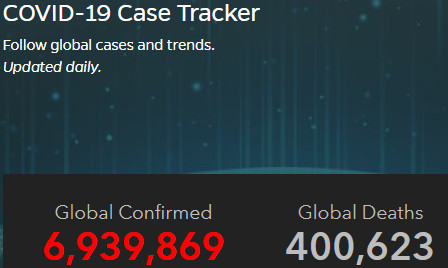
As the number of official deaths passed 40,000 it felt like a grim milestone, and the Office for National Statistics (ONS) figures of all deaths mentioning Covid-19 is over 60,000. This week worldwide deaths passed 400,000.

The news that pushed Coronavirus off the front pages of newspapers and further down the television bulletins were protests in the US and other countries about the death of George Floyd.  George was a black American killed by a white policeman by kneeling on his neck for 8 minutes 46 seconds, while George repeatedly said ‘I can’t breathe’. At first the Minneapolis Police Department denied there was anything untoward, but after mobile phone footage of the incident was broadcast, that was shown not to be true.  This triggered several days of protests in many of the larger cities across the US, several of which were used as cover for looting of shops and burning of public buildings.

I was particularly shocked by footage from a security camera of tens of people stripping a small family-run pharmacy in the Bronx area of New York of all of its stock including prescriptions made up waiting for patients to collect them.
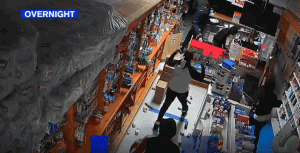
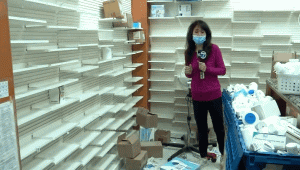
The irony of many of them wearing masks to protect them from coronavirus was lost among interviews with the devastated owners, as it had taken them 14 years to build the business up in a relatively poor neighbourhood. The Rodriguez family are themselves members of a minority community.

As the protests spread out to Atlanta, Chicago, Los Angeles and Philadelphia under the banner of ‘Black Lives Matter’ the long-standing issue of racism that has been part of American society back to the Civil War and the Civil Rights cases in the 1960’s, was high up the political agenda once more. Protesters and some policemen went down on one knee in a reminder of the act of the policeman in Milwaukee, and an echo of the protests by black players from the National Football League (NFL) a couple of years ago. President Trump had called for them to be sacked at the time. Now he sent the National Guard to clear protestors in Washington who had gathered outside a church, and then he posed in front of the church with Bible in hand, much to the indignation of the local ministers.

The Floyd family have the services of Ben Crump an attorney who takes on high profile cases for those who need representation in the areas of unlawful death and civil rights. At the memorial service in Minneapolis he said

..it was not the coronavirus pandemic that killed George Floyd. It was that other pandemic, the pandemic of racism and discrimination.

Rev Al Sharpton, a veteran of civil rights cases alongside Rev Jesse Jackson in his eulogy said it was time to stand up and say “get your knee off our necks”.
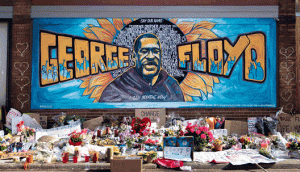
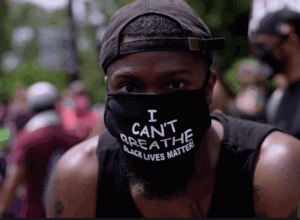
In the social media furore around the riots an interview with a former  police chief of Milwaukee appeared to show him ranting about the fact that people know the names of the last three people killed because they are black, but not the names of the last 300 killed by criminals using guns. He said there are a lot of bad policemen, but there are also a lot of unlicensed guns and he was on his way to reports of a five-year-old girl accidentally shot through the head.  The video was from 2014. The President’s son Donald Trump Jr used it to divert attention away from the race issue. The fact that the police chief was speaking after attending a meeting about the shooting of another black man Dontre Hamilton, was not mentioned.  The white officer involved was fired as he had stopped and frisked the man for no apparent reason.

Given that a record 2 million extra handguns were sold in March, many to first time gun owners, it could be that the number of Americans dying in the future from the ‘pandemic of gun ownership’, will be a high figure.

Despite the home secretary Priti Patel and Australian prime minister Scott Morrison appealing for demonstrations not to happen due to the virus this weekend, large numbers turned out in London and Sydney. Masks and gloves were handed out, but as numbers grew social distancing became an issue. This type of protests needs to be done ‘in the moment’, but it could affect the spread of the virus. So I understand those who criticise. We shouldn’t forget that in the UK we have had our own problems with ‘stop and search’ tactics of policing, and claims of ‘institutional racism’. And these things are not only apparent in police and government, but in business and housing. The scenes of disturbances around Downing Street and violence directed towards the police were shocking. During the demonstrations earlier in the week some people had defaced memorials around the Cenotaph on Whitehall.  The next morning a group of young people were filmed cleaning the graffiti off and being berated by a protestor who said ‘could you not leave it for just one day’. It turns out the ‘young people’ were cadet trainees at the Household Cavalry from barracks nearby. On Sunday in Bristol a statue of the ‘slave master’ Edward Colston was pulled down and one of the demonstrators knelt on his neck. The city is built on the wealth of the slave trade and even though Colston gave much of his wealth to charitable causes, setup schools and hospitals, there are some who think the record of their former MP was ‘sanitised’ and rewritten before the statue was erected.

On the news pictures I saw, however, most of the demonstrations were peaceful and did their best to maintain social distancing (if not the regulations about more than six people meeting). Overhead shots of demonstrations in Chicago, Philadelphia and Washington in the US and Manchester in our area of the UK showed a great deal of good distancing and masks.

Australia, like America has had problems with police brutality and race and this was the focus of the protests. in 2016 David Dungay Jr an indigenous Australian man was killed whilst being restrained by police in a hospital saying those same words ‘I can’t breathe’. We saw the pictures of people talking about their frustration that yet again something happens and again nothing happens.

The last word goes to an academic on a video my cousin Janet’s husband Chris posted on Facebook. I don’t know the name of the person or anything of their background, and it was from an organisation called ‘Atheist Republic’ and appeared to be cut together from a longer one. None of that matters as it struck a chord with its simple message . The question was put ‘why do we hate’?

We hate because we are taught to hate. We hate because we are ignorant….We have been taught that there are four or five different races…there are not…there is only one race on this earth which we are all part of, and that’s the human race. But we have separated ourselves into different races so that some of us can see ourselves as superior to others….It hasn’t worked, and it is bad for everyone. It’s time to get over this business. There is no gene for racism, no gene for bigotry, you’re not born a bigot, you need to learn to be a bigot. Anything you learn you can unlearn, it’s time to unlearn bigotry. It’s time to get over this thing…and pretty soon. I am an educator…and it’s my business to lead people out of ignorance, the ignorance that you are better or worse than someone because of the amount of a pigment you have in your skin. Pigmentation of your skin has nothing to do with intelligence or your worth as a human being. It’s time to get over that.

We are struggling to find a vaccine for the coronavirus pandemic and are worried that it may take a year rather than a few months. It seems that we have been unable to find a vaccine for the pandemics of racism and gun control, or the other pandemics of hunger, poverty, and inequality which have been with us for centuries. After the coronavirus pandemic is over there could be a pandemic of unemployment, a pandemic of economic uncertainty and a pandemic of growing debt. Can we do things to ‘unlearn’ the behaviours that make them happen.

As a representative to the Methodist Conference at the end of the month (see note later on about our week), I have been asked to complete some training on ‘unconscious’ bias as part of the church’s Equality Diversity Inclusion (EDI) policies. I commit to doing so as a small step to understanding my own behaviours and to check if I need to ‘unlearn’ some attitudes.

Other news this week

  • The news that pushed coronavirus down to third place on the television bulletins was that of the German police identifying a suspect for the abduction of Madeleine McCann in 2007 and declared it a murder inquiry.  It is a story that was horrible the first time around and doesn’t get any easier each time it crops up again. I hope that the family get some certainty soon.
  • We live in an area, the north west, where the number of infections is not decreasing, and the R-number is on the unsafe value of almost 1.  The north west as defined by the government is a large area stretching from where we live in Crewe to Kendal 110 miles away on the edge of the Lake District. However, the detailed statistical tables show that in our local hospital there was only one death on Wednesday, Friday and Sunday this week, compared to deaths every day and a total of 15 the week before.
  • Crewe is a town which is dependent on the ‘health’ of one of its largest employers Bentley Motors.  Admittedly, not as dependent as it was when we moved here 40 years ago and along with the Railway Works, Rolls Royce Bentley as it was then were the main employers in the town. The announcement on Friday that nearly 25% of the 4,200 workforce were under the threat of redundancy is a blow to the local economy. This wasn’t due entirely to coronavirus but adjustments for social distancing has cut production by half in recent weeks.
  • With the government declaring two weeks quarantine on travellers coming in through airports, there was talk of  ‘air bridges’ that would allow those from some countries with lower infections not to have to do so. The airline owners are against the quarantines and some countries will not allow UK citizens to have an ‘air bridge’ with them as we are a country with a high infection rate.
  • Track, test, and trace continued to be a point of contention with Boris Johnson challenged at Prime Ministers Questions about the lack of statistics and details around this topic.
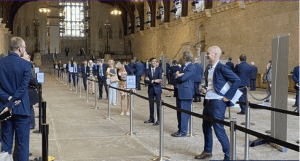
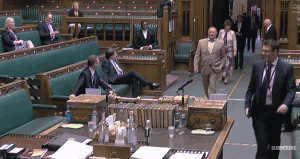
  • MPs returned to parliament and there was much discontent about having to vote by forming a queue which was over a kilometre long to walk past the Speaker to say which way they were voting. The irony was that the motion was about the type of voting that could be used if they remain away from the House of Commons due to the virus. One said it was like ‘doing the Mogg conga queuing for a ride at Alton Towers that turned out to be a little bit sh*t.’
How was week 11 for us?

Alyson took advantage of the new ‘freedoms’ to go to a garden centre 8 miles away but came back disappointed by the choice of plants and the lack of atmosphere as the main centre and shops were not open.

Alyson was delighted, however, that as we watched another week of BBC’s Springwatch we had a version going on in our garden. Visitors to the feeders included, bullfinch, greenfinch, goldfinch, long-tailed tits, and a mother blue tit feeding three tiny fledglings as they lined up on one of the supports.

I was elected as one of seven representatives from our District to go to the Methodist Conference in Telford at the end of June, but that has been cancelled in its usual form. We usually meet as a group to discuss the topics and format of the 5 days, and we did so this year but via Zoom, as we will with 300+ others this year. The Conference will not have the debate and resolution of the report we discussed last year on our understanding of relationships. This could have paved the way to same sex marriage taking place in our churches, but it has been held over to next year. It was felt that if we couldn’t give the time needed, meet in smaller groups face to face, and share on the fringes of the Conference, it could be challenged. This won’t stop us looking at more reports and ‘business’ to move our witness and evangelism forward.

Wednesday was Global Running Day, but I wasn’t aware of that as I set out in the rain for my early morning 5k run. It was only when I got back and Alyson told me that she heard it on the radio and I found out that I had joined with over a million people in 170 countries to celebrate a simple sport that those like me with little natural ability can participate in.

During my weekly virtual coffee later that morning with David, a friend from church, we reflected on the ways we need to change personally and as a church in how things are done, and lessons learned during the pandemic. My evening Bible study with 10 others via Zoom is one such example that we will continue with. There really is little point splitting us into two groups and travelling to each other’s houses, especially on cold wet winter evenings.

The cold and damp weather that started on Wednesday led to Alyson cancelling the get together with three former work colleagues in our garden on Thursday morning. The beauty of a ‘virtual coffee morning’ like the one I hosted for our head injury charity, is that the weather will not stop it taking place. There were 11 of us and I used a feature in Zoom that allowed all of us to be put in two separate ‘rooms’. One for the group that would normally meet in Crewe and the other at Ellesmere Port. It worked well and the smaller numbers meant that those who didn’t want to speak in the larger gathering chatted to members that they were used to meeting.
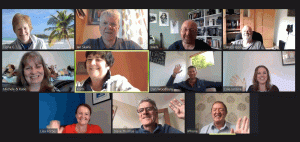
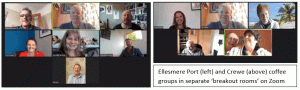
HIP Charity – Cheshire-wide coffee group members

We had ‘virtual Friday night drinks’ with Alyson’s brother and sister and then on Saturday night we had a Zoom quiz with my cousins and family. Alyson and I came second out of ten teams after 100 questions using an app on my phone called ‘Kahoot’.

Sunday brought my now weekly trip via YouTube to the service at Methodist Central Hall in London. We restated our belief in the sanctity of all human life, knelt in solidarity with those who are victims of discrimination, and prayed for the family of George Floyd. It brought to mind one of the modern songs we sing that challenges us to act for the wider good. These are three of the verses. They seem appropriate given the news this week.

Will you use your voice; will you not sit down
when the multitudes are silent?
Will you make a choice to stand your ground
when the crowds are turning violent?

In your city streets will you be God’s heart?
Will you listen to the voiceless?
Will you stop and eat, and when friendships start,
will you share your faith with the faithless?

Will you watch the news with the eyes of faith
and believe it could be different?
Will you share your views using words of grace?
Will you leave a thoughtful imprint?

Stay safe and I hope to post another instalment next week.


So Whats the Story?….. The Long Story

This is the longer story of the reason I am doing a sponsored 10k for three charities that you can read about in my last post So Whats the Story…? A 3-2-1 offer on a sponsored 10k.

During the Olympic summer of 2012 I was training for my first short triathlon, having been a ‘slow plodder’ for about 30 years of doing 10K’s and around 15 Half Marathons including five Great North Runs. I was never competitive and my motto was ‘when the going gets tough…..it’s time to slow down or even walk if needed’.

I woke up one Wednesday morning with a splitting headache and some numbness in my right foot. Putting it down to ‘man flu’ and an old back injury I worked that day but took the next one off. On Friday I woke up and could barely move my right side and the headache was excruciating. By the time we got to A&E I could barely stand unaided. A stroke was diagnosed, and I was put in a ward and pumped full of aspirin. On Sunday after a CT scan I was told that it could be a cancerous brain tumour and I was being sent to a specialist hospital 18 miles away. They confirmed that it wasn’t a tumour but a large amount of infection. They were not able to operate, as I had so much aspirin in my blood there was a danger that I would suffer a bleed in the brain. By Thursday my condition deteriorated, and they did an emergency biopsy. This didn’t go well and early the next morning I went for a second operation to drain the infection. Alyson was told that I might not make it, and when our two sons arrived from their homes in the south, they had what we now refer to as ‘the organ donation conversation’.

Memories of the next 24 hours are sketchy but when I arrived back on the ward from intensive care, I still couldn’t move my right side and although I understood what people were saying I couldn’t answer at all. The only words I managed were a tentative ‘yes’ (when I meant no) and no (meaning yes). Later I managed to speak a little but then it was mainly swear words which, as people who know me will confirm, I rarely use.

So began treatment involving two antibiotics intravenously five times a day every day. I was also put on anti-epileptic medication to prevent fitting, and antidepressants for my low mood. The days were endless, the restless nights even longer. I was struggling with tiredness and extreme confusion. Coming to a dead stop after my life as a busy IT Project Manager was hard. I wanted to be back at work but had to learn that in the brain business, days turn to weeks and weeks to months.

I tried to read newspapers and magazines but by the end of a paragraph I had forgotten what the headline was about. I had asked for my Bible to be brought in and that was even harder to read. I couldn’t even remember The Lord’s Prayer. My Bible was still a source of some comfort, although starting on Psalms was probably not my best idea. I do have a vivid memory of Carmen, a Columbian nurse singing quietly a hymn while she gently washed my back. I shared stories with other overseas nurses who, on seeing my Bible, talked about life ‘back home’ and what their faith meant to them.

I started intense physio and speech therapy. Being left-handed was a bonus as at least I could do some basic tasks. It took three people to get me out of bed using a hoist and either onto the toilet or eventually to prop me up in a chair.  What I couldn’t do was muster the words to ask to be put back, so often sat there frustrated for hours as people came in and out of my room.

Alyson visited me twice a day every day for the next 12 weeks. I owe her a debt that will never be paid. Church friends and close family helped relate my story each day to our wider circle. My brother and cousins drove mum and dad from their home 3 hours away. I barred any visitors other than close family at first, as I looked awful and couldn’t concentrate enough. When I relented our friends were faced with Ian who didn’t have any personality. The lights were on, but no-one was at home.

Then started daily visits from close friends, our sons, Alyson’s sister and brother, cousins. I couldn’t remember who had been from one day to the next – but I know that they all made me feel better – even if it didn’t always show on my face. Chocolates, grapes, biscuits and particularly ready-made custard were very welcome!

Work colleagues from the IT & Business Consultancy business I worked in visited and I was grateful for their support covering the projects I was supposed to be managing. Alyson’s employers Co-op Pharmacy were very understanding and allowed her all the time off with compassionate leave. The stress and worry meant that she was unable to work in any useful way.

Eight weeks in I needed a third operation as infection was still collecting in my brain. I had ‘drains’ fitted linked to bags on my shoulder – I looked like ‘Dracula’s Bride’ for a week or so.

This is a scan of my brain just before the operation on the left, and what a ‘normal’ brain looks like on the right – you don’t need to be medically trained to see the pools of infection and damage….

The result was a small improvement in all my symptoms; I managed to move a toe then bend my ankle.  I managed some ‘freedom’ with a wheelchair that I could push myself around the ward and, if Alyson came with me, to the café or even outside. Friends and family began to see some big changes in both my alertness and mobility.

Steve Ingrouille, the minister at my local Methodist church, came to visit and we had the strangest communion I have ever received sitting in a corner of the public restaurant. Steve did the complete service with the bread and wine used at my church the previous Sunday.
Alyson also had great support from church friends who rallied around to help and I believe that the prayers they gave aided my recovery. Val Mayers and our neighbours Stuart & Veronica Rhodes need a special mention. I continue to gain strength from my church fellowship and my faith.

My mood slowly improved and when mum visited me one Saturday as she left we hugged and she said ‘Love you son, keep getting better and see you soon’. These were the last words she said to me as the next day she had a heart attack and was put into a coma on a life support system for a week.  One Friday as I was taking my first steps unaided by physios I had a missed call on my mobile. It was my brother telling me that mum had died…she never got to see me walk again.

I was allowed out of hospital for one day to travel to her funeral 150 miles away and managed to stand using a frame to give part of her eulogy.

I had my laptop back by then to write and plan my ‘escape’ from the rehab hospital until my condition improved enough for Alyson to take me home in a wheelchair. The skilled consultants, surgeons, nursing team and physios had ‘fixed me’ – physically at least.

18 months of hard work started, to recover from my ongoing symptoms, regain my driving licence, and build my strength enough to stand on my own with a stick, and climb stairs. I did some part-time work in the IT Consultancy Business, helping the owners to sell the part of the business I was in. I knew about this before my illness but it meant me being made redundant. I then managed to get a little paid work with my church on finance and property.

Alyson went back to work as a pharmacy manager in a very busy community pharmacy attached to a surgery. This is an extremely demanding role with a team of around 20 to manage and unrealistic targets set. At least I was able to support her in this, being at home to look after practical things around the house, waiting for trades people, doing some of the household chores that until then had fallen mainly on Alyson. I was happy with a lower pace of life than before, and could rest when needed.

I had the hip replacement that I needed before going into hospital, and it was through this that I met Annette Turner, a brilliant physio specialising in hydrotherapy. When my consultant had signed me off in February 2013 he said it would be two years before we would know the lasting damage and implied this would be substantial. Annette convinced me that, whilst that was true, she could get me to the point where it might be that the only thing I couldn’t do was to move my little toe. That has proved to be the case.

In January 2014 I was encouraged by Beth Fisher, Service Manager from the Acquired Brain Injury service in Chester, to attend a support group who met for coffee. This is an amazing organisation who provide help for people with a brain injury to reduce the loneliness that can come from hidden symptoms, loss of confidence in social situations, along with memory issues and extreme fatigue. During the last few years this group has formed into a formal charity. I am now a trustee of Head Injured People in Cheshire.

Steve Price, an accountant who had been one of my project managers, had left to concentrate on his own business. In August 2014 he offered me the opportunity to work with him a few days a month to get out of his front room into an office,  taking on some people to help him.  I am eternally grateful to Steve and the team for the opportunity to work with them putting new systems, marketing material, social media, lots of new business processes in place as we grew. I became Compliance & Training Manager. (In April 2019 Steve and the rest of the team merged with another practice and he is now one of 5 directors in a company with 23 employees and a growing list of clients. I took the opportunity to retire).

I had another 18 months of physio and got to walk correctly and slowly, then six months later I decided to try running a few steps. I did a short route around our home in streets that I had used for training. It took me about 30 minutes to do a couple of miles with intense concentration on my foot placement and staying upright. I had to sleep for an hour afterwards. Fatigue is a lasting symptom of brain injury and several afternoons a week I sleep for 40 minutes, and each time I run I must sleep for around 50% longer than the time I take.

I don’t remember how I heard about Parkrun but in April 2016 I arrived at Delamere with my barcode and did the whole 5k without stopping. It was very emotional, and my account can be found at https://skatchat.wordpress.com/2016/04/.

Alyson used to come with me and walk the course before we started and meet me at the end but then two weeks before her 59th birthday she announced that she fancied running it. As someone who has asthma and have never run before I was amazed. She did her first run in 37 minutes, beat my PB the next week and after 5 more successive PBs she now runs around 30 minutes. She even fell over once and after dusting herself off for a short while still beat me by four minutes.

So the 100th Parkrun completed yesterday was an emotional one too, coming as it did on the 7th anniversary of mum’s death. Alyson did her 24th and our son Michael volunteered.  My brother Andrew did his 100th at Newcastle on the same day along with his son Thomas.

As we lost dad in 2016 and have received some money from their estate, it seemed a good time to celebrate my recovery and use their legacy to raise funds for the three charities that have helped me. So next weekend I will take on 10k at Tatton Park.

So Whats the Story?…..where I am now.

Reflecting on the past seven years, I genuinely feel that I am in a better place than before my brain injury. Sure, it has been a tough time and I wouldn’t want to inflict the stress and worry on my family that was some of our experience. Overall the positives are;

  • I am in a less stressful state than I was before – many people when they heard it may have been a stroke worried that it was due to pressure of work and church business that had caused it. I often say that my memory problems mean that I can’t remember what I am supposed to stress about
  • I feel that my faith has been strengthened, as it says in Psalm 40

    I patiently waited, Lord for you to hear my prayer. You listened and pulled me from a lonely pit full of mud and mire. You let me stand on a rock with my feet firm, and you gave me a new song a song of praise to you

    and when I hear the story in Luke’s gospel of the paralysed man whose friends prayed for him and took him to Jesus – I can really relate to that.

    But I want you to know that the Son of Man has authority on earth to forgive sins.” So he said to the paralyzed man, “I tell you, get up, take your mat and go home.” Immediately he stood up in front of them, took what he had been lying on and went home praising God.
    Everyone was amazed and gave praise to God. They were filled with awe and said, “We have seen remarkable things today.”

There is no substitute for confronting your own mortality and asking the real
questions of what your life is about…

  • I have been able to spend more time working for my local church on finance and property issues, to support the Leadership Team looking at new ways of working, recruiting some amazing lay workers to support our ministers and churches.
  • I have had more time to give to Alyson and our family. Supporting them through difficult times at work and being there to help with looking after her parents and supporting her when they died these past two years. Our two sons are in well-paid roles and have been able to buy their own homes. They too have benefited from their grandparents’ legacies, and by that I don’t just mean the financial ones.
  • We are fortunate to have built up enough savings to be comfortable in our retirement. I had several good jobs in companies with strong ethics and who made a difference to their employees and the patients/customers they served.  I have been able to help a friend build his business to repay his faith in me.
  • I work with some amazing people in the head injury charity and have met some truly inspirational survivors, who live in much more challenging after effects than mine. Head injury doesn’t discriminate on the basis of age, wealth, personal background, education or experience. I am fortunate that the relationships with family and close friends have survived – that is not always the case.

So as I look forward to enjoying some travel and a forthcoming pilgrimage to the Holy Land, I wonder what the future holds, and the next challenge we will face. I hope that I am up to the task but know that I will have a lot of support.

Thank you for reading my story.

Ian Skaife, October 2019

Sir Wiggo & the quickest sporting event ever…?

40 minutes was all it took today to see the ‘Tour of Britain’ cycle race as it passed through Cheshire, and that was only because it took 20 minutes to walk there and back! .

The third stage of the tour passed along the Crewe to Nantwich road, a 10-minute walk from our house. The road closure signs had appeared over the last couple of weeks and we watched the second stage through The Lakes on local TV last night. Alyson had gone shopping early in order to get across the road and into town before the closure. Today’s stage started in Congleton and according to the web site the riders would be at my viewing point in around 45 minutes – not bad considering it is 14 miles away.

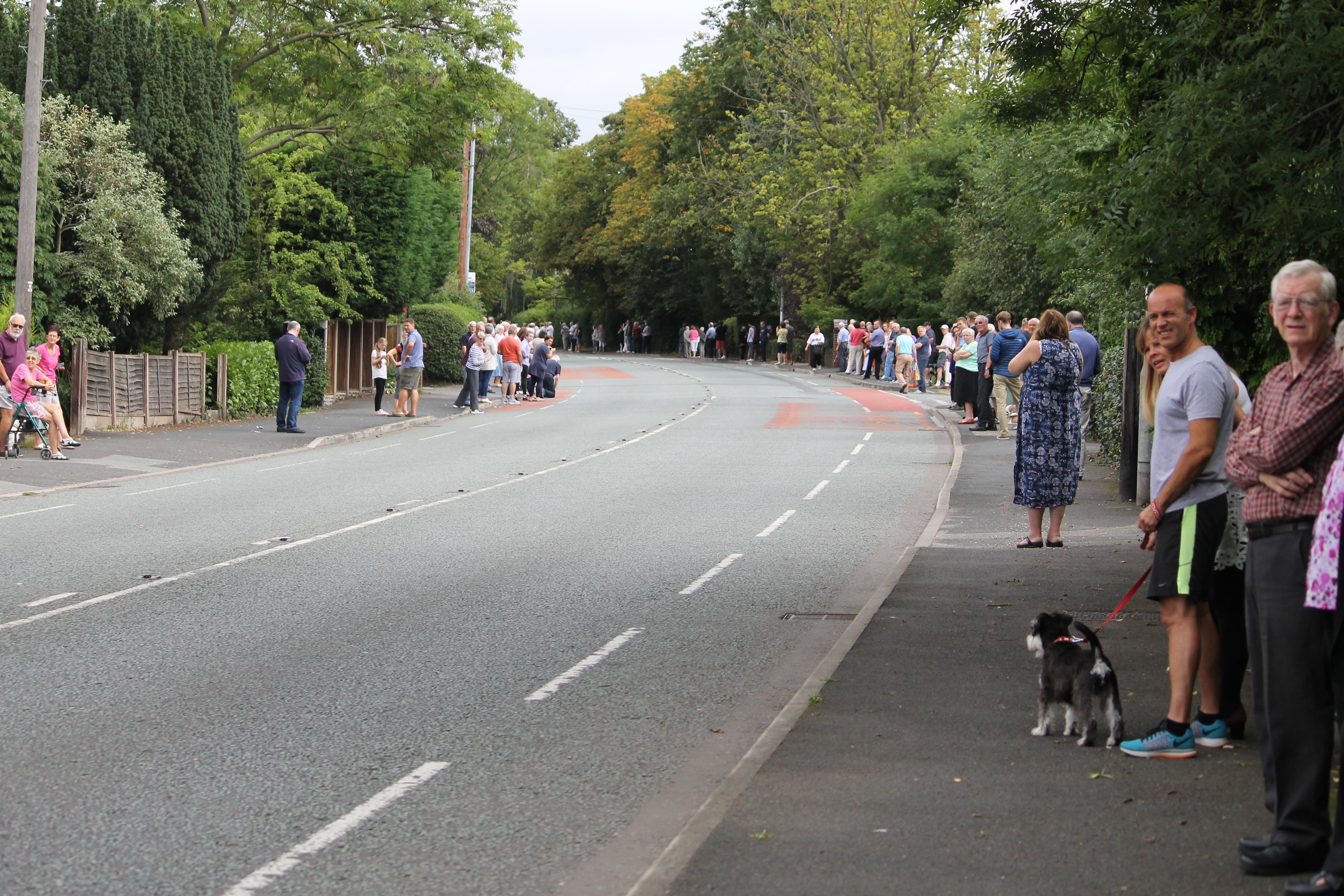
11:42am – left home with my digital SLR camera and zoom lens, walked to the main road where a reasonable crowd lined the route – well one man & his dog anyway.

nantwich-rd-crewe-6th-sep-2016

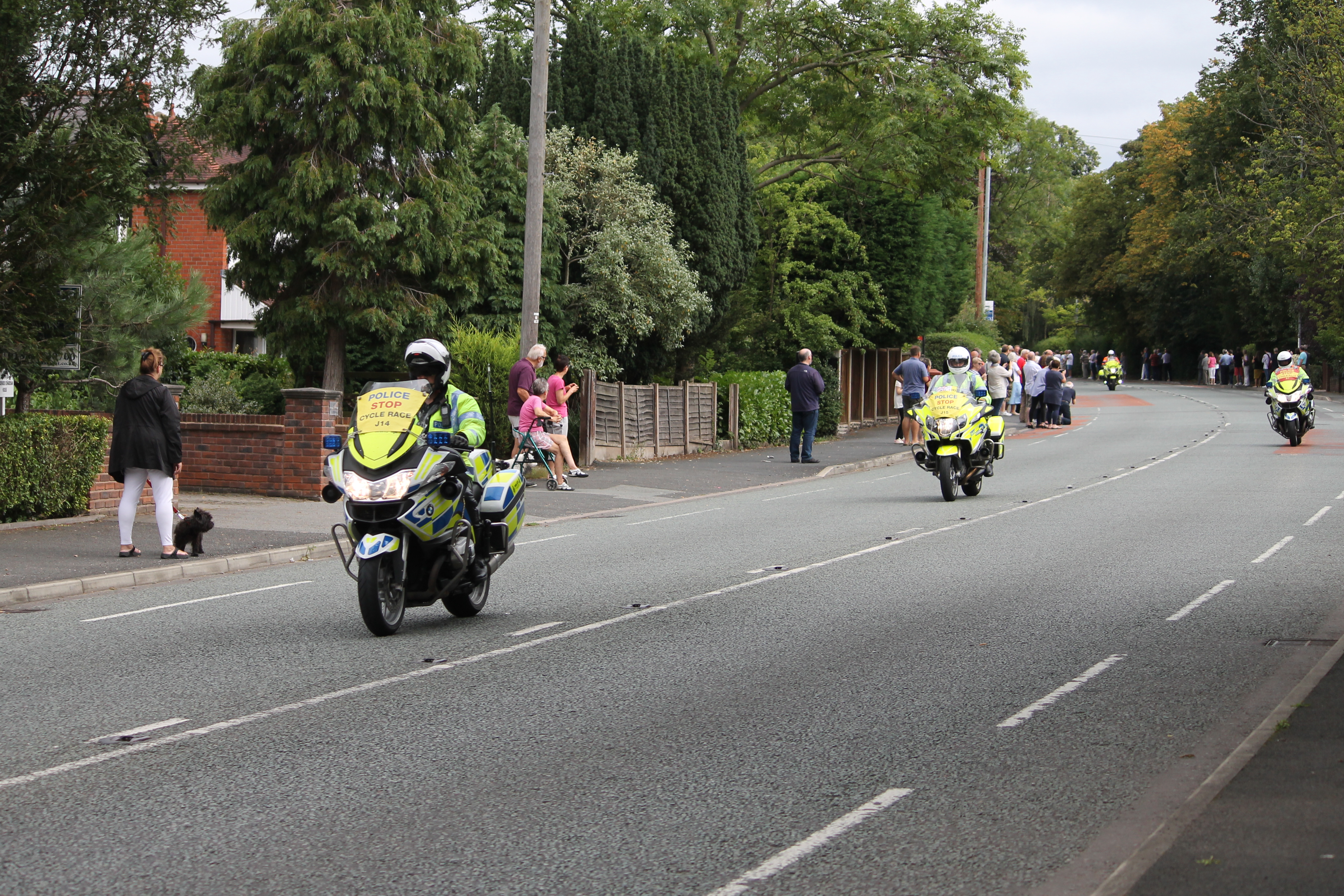
11:58am  After about a dozen police motorbikes went past in around five minutes I wondered if it was a motorcycle tour I had come to watch.

police-motor-cycles

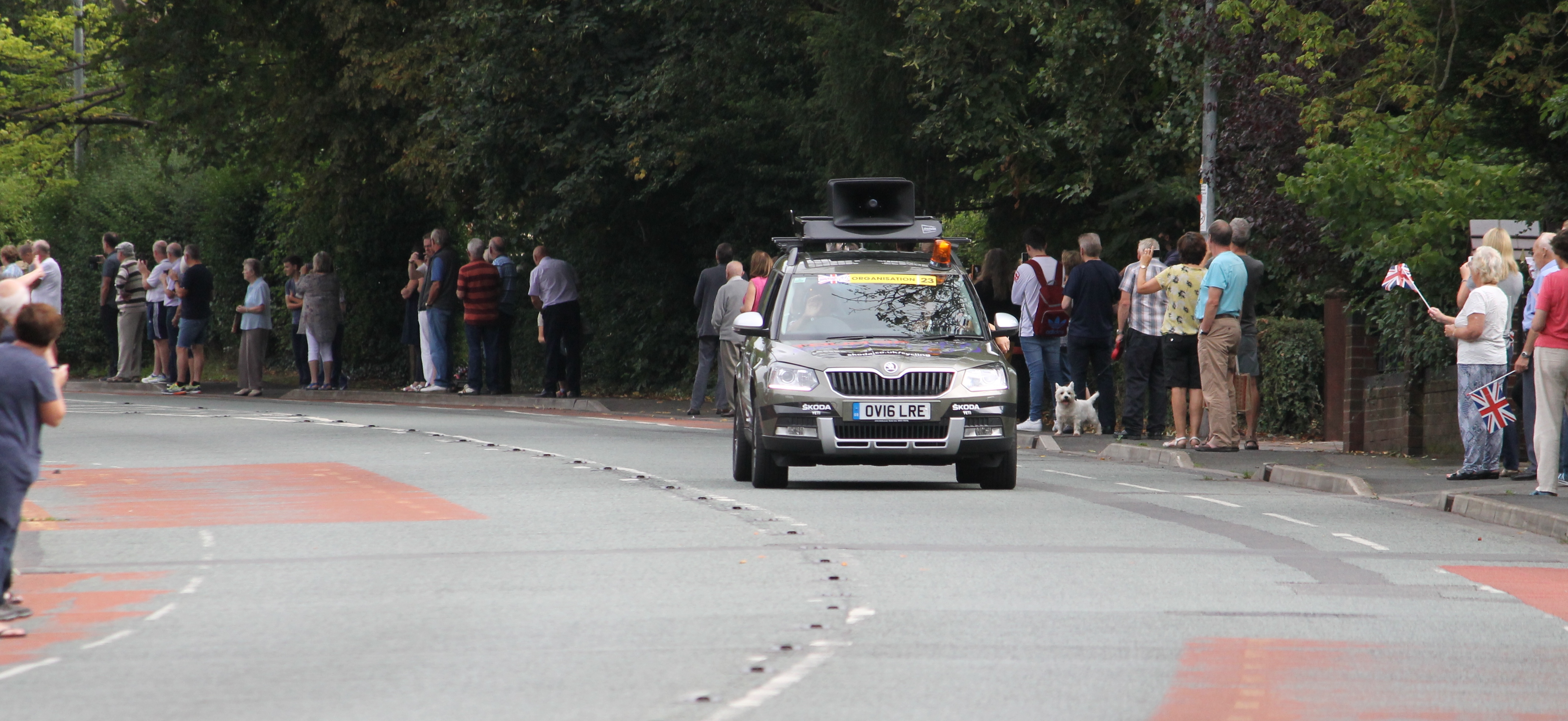
12:02pm A commentary car came past and helpfully explained that the four riders in the lead group would be coming soon, followed five minutes later by the main pack, or peloton as it is called.

commentary-car

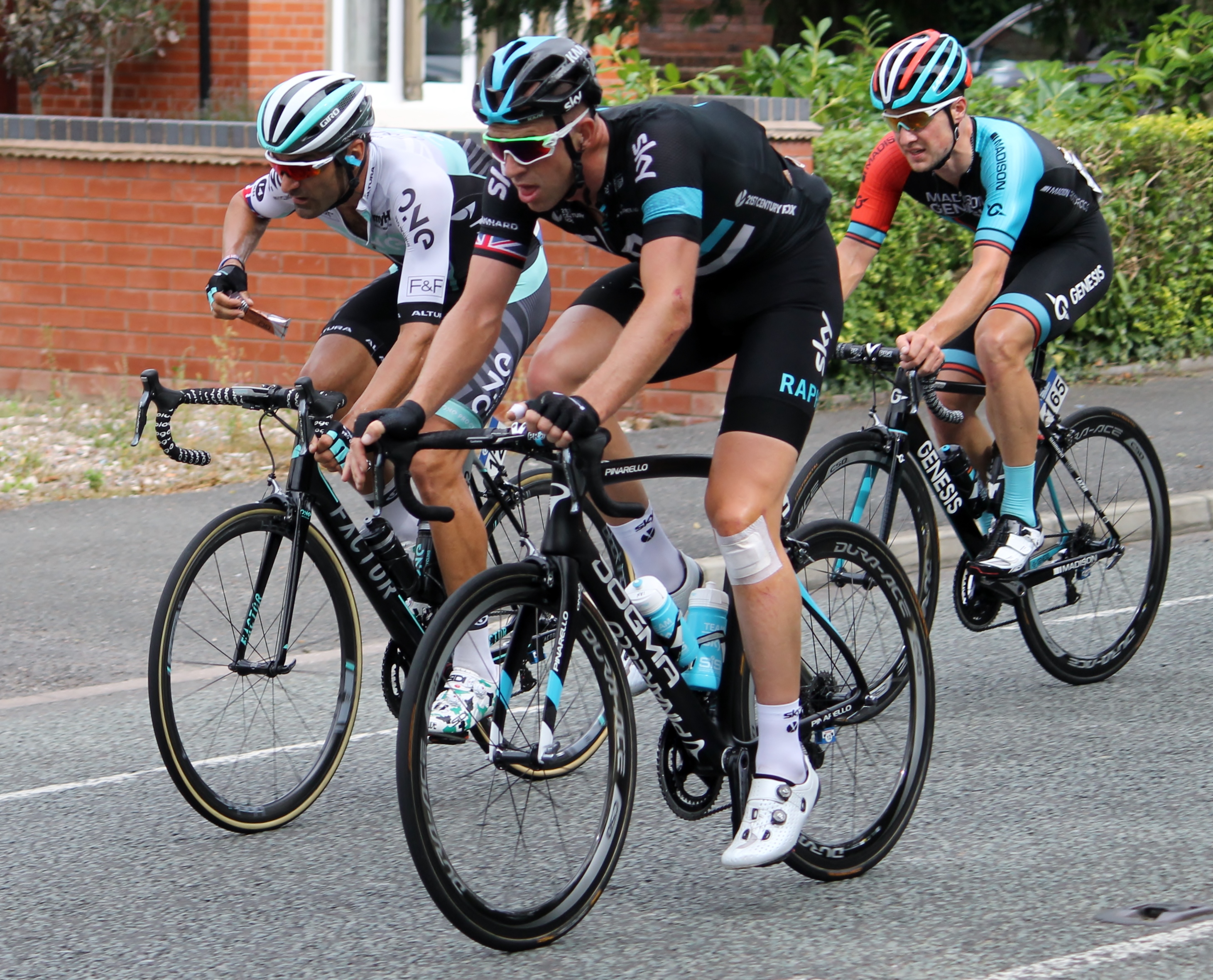
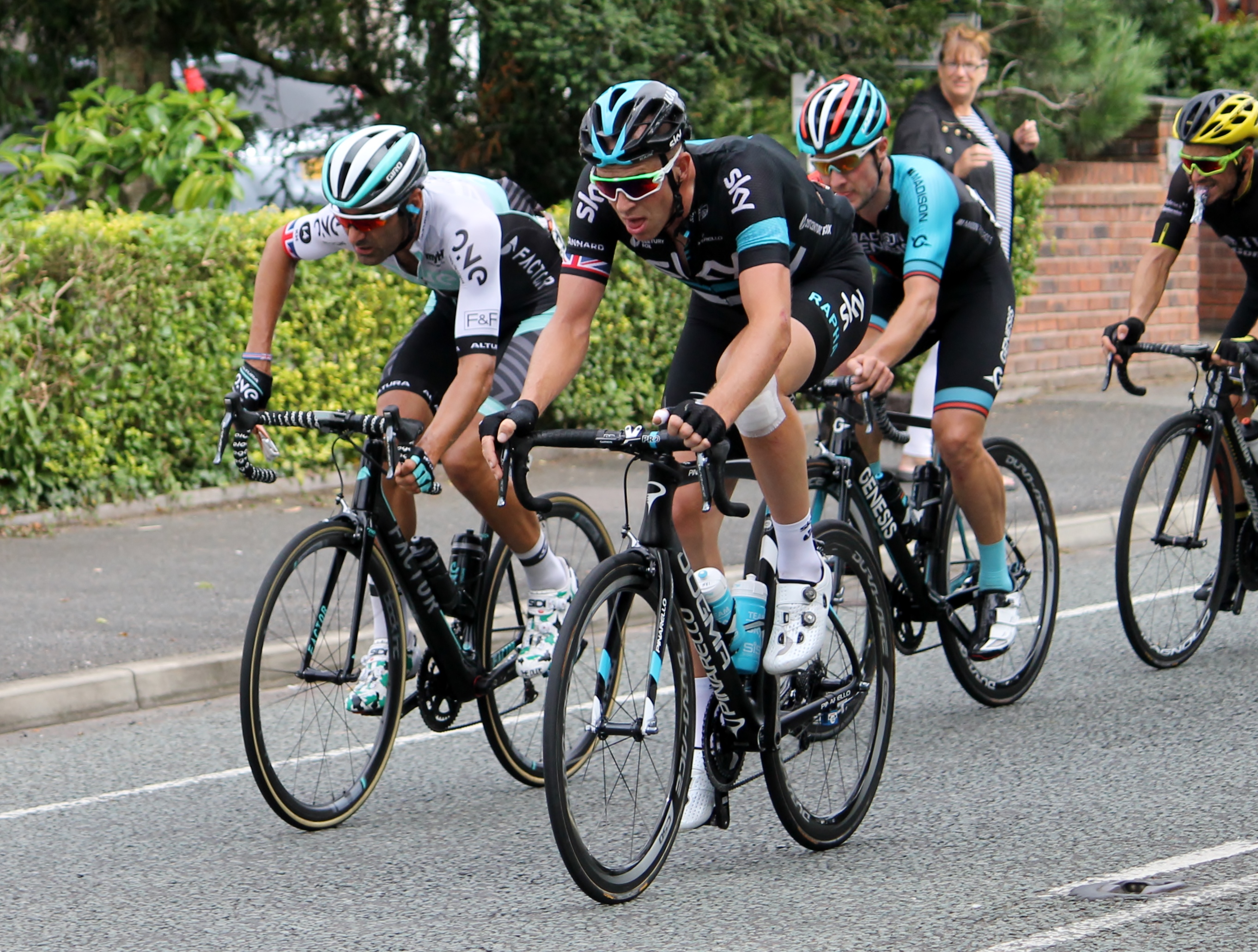
12:04pm Sure enough the four riders appeared. I heard the crowd further up the road clapping and the distinctive sound of cheering schoolchildren..

lunch-1lunch-2

Clearly the guy at the front was in need of a drink, and the one next to him, and at the back with the packs of gel, decided it was lunch time!

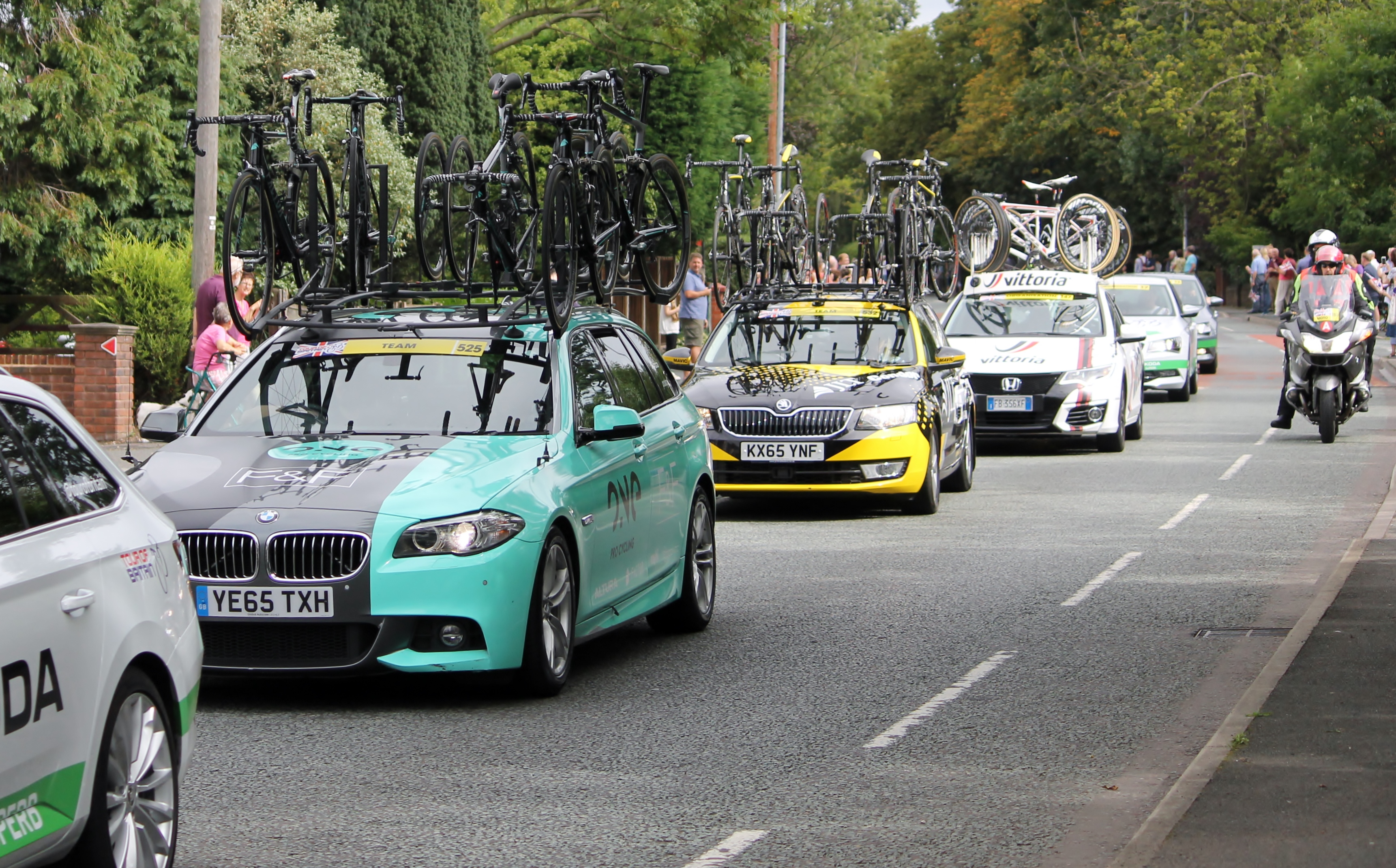
12:03pm As their support cars followed behind I wondered how many bikes four men could possibly ride…
support-cars

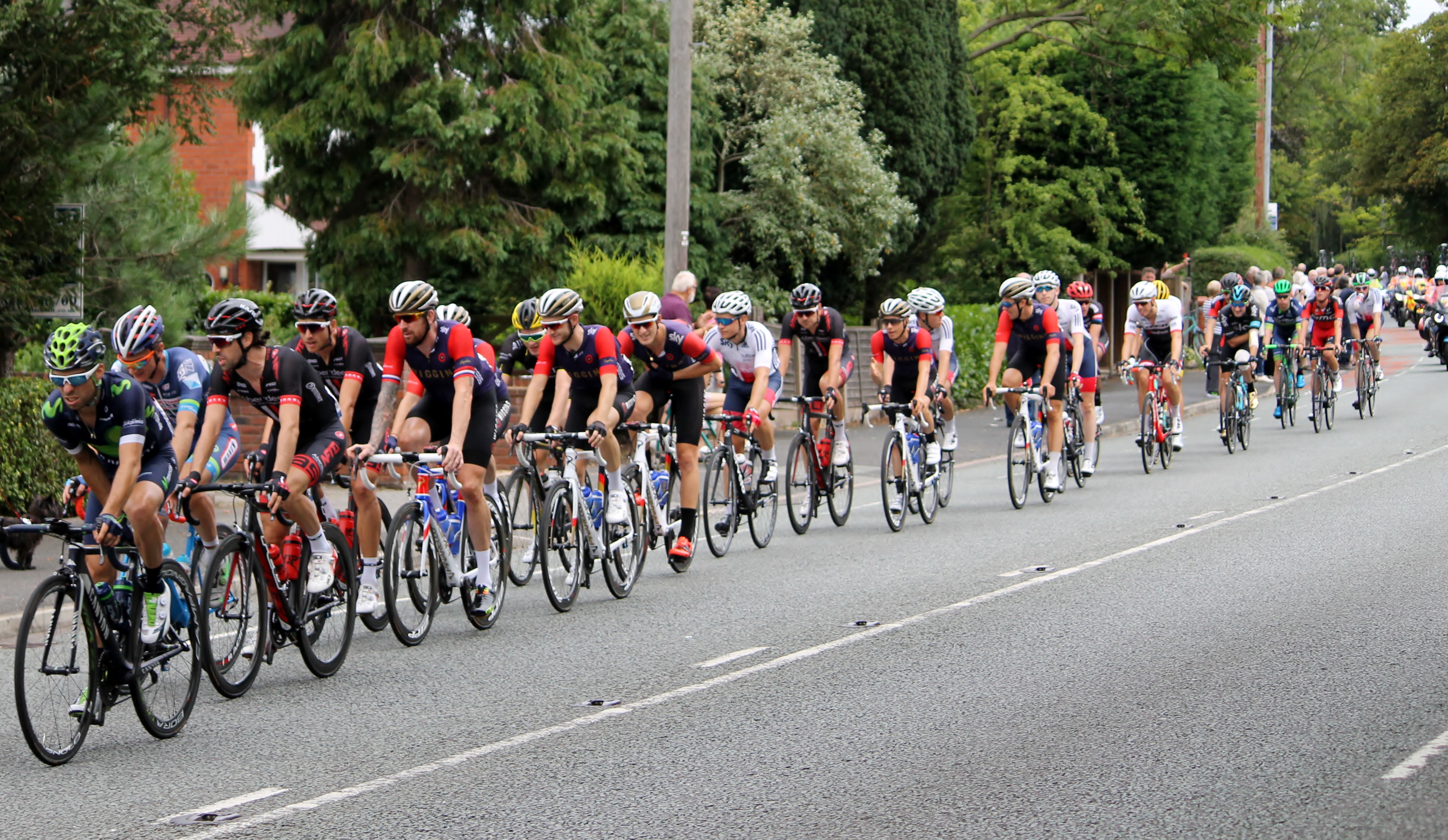
12:09pm It was a good that the commentary car had told us about the gap as after what seemed forever, the cheering school kids signalled the arrival of the main pack. I was glad to have ‘continuous shooting’ mode on my camera, as they went past and down the road in less than 60 seconds…

I turned my camera round and just caught the back of the pack as they came past me.

the-back-of-the-pack

12:10pm It was all over. More support cars loaded with even more bikes, several police motorcycles, two ambulances followed close by and disappeared down the road.

As I walked home I met Jill & Peter who had stood at the end of their drive to watch proceedings. It had been quite exciting we reflected, but we were pleased not to have driven a long way & waited for several hours to have seen 10 minutes of action.

I saw the junior school children who had clearly had a great time; let out of their lessons to bring posters and banners to cheer on the spectacle. The teachers at our local High School had decided not to open at all as the ‘traffic chaos’ caused by road closures from 11.00am to 12.30pm would prevent them getting to and from school. Well I  guess it seemed like a good reason to add an extra day to the summer holidays!

schoolchildren

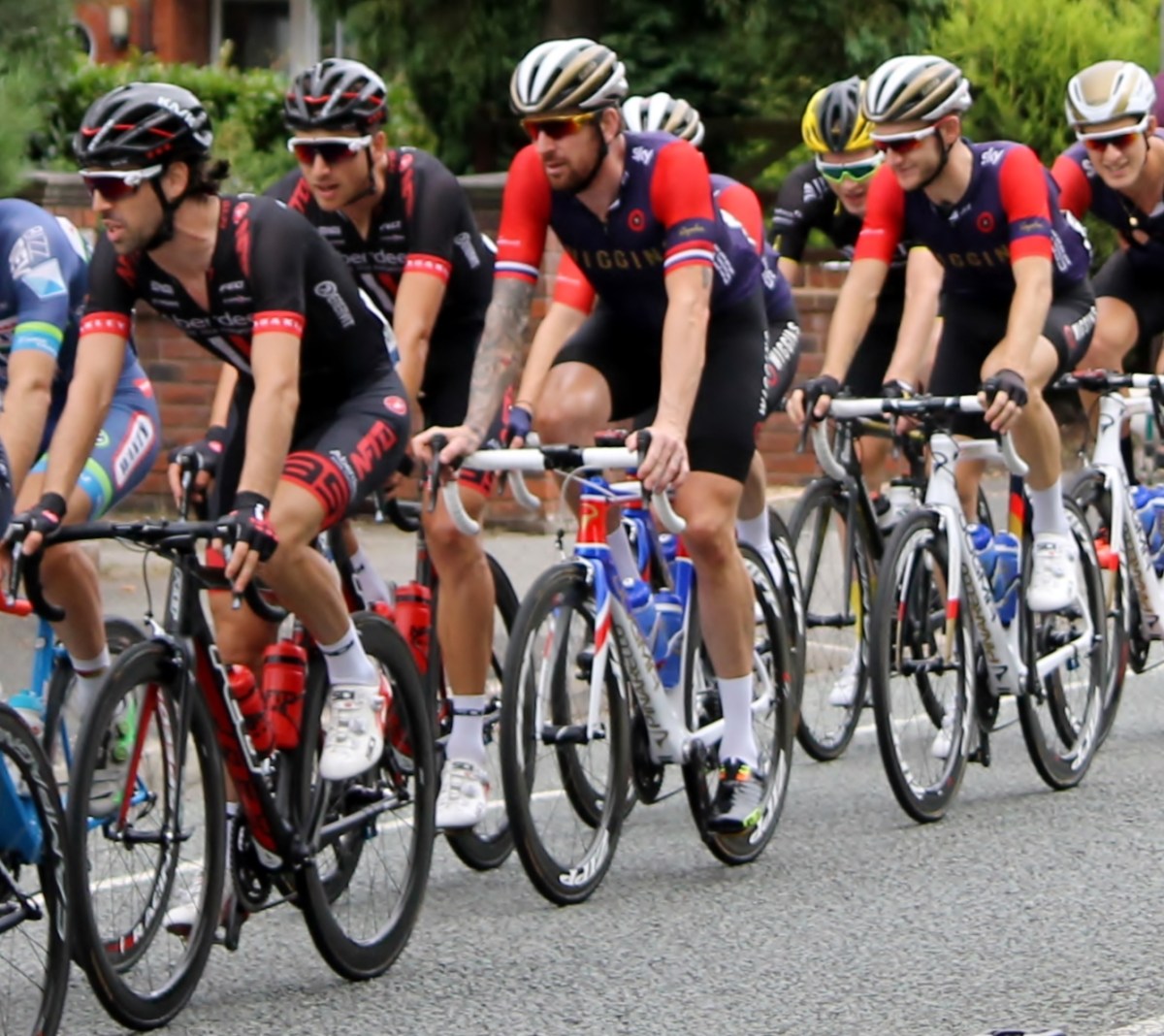
12:22pm  It was only after I arrived home and reviewed the pictures on my laptop, that I realised there was one featuring our most decorated cyclist and 2016 Olympic Champion, Sir Bradley Wiggins. I zoomed in and cropped the photo which is the one at the start of this article. You can see his self-named team shirt & the distinctive tattooed right arm. Such was the speed they were going I hadn’t seen him in real-time. Not much of a spectator sport I mused, but perhaps it would have been better viewed directly by my eyes and not through the camera’s viewfinder?

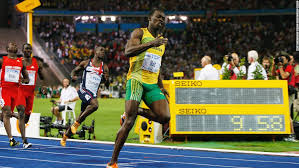
I called this blog ‘the quickest sporting event ever’, but there is a certain Usain Bolt who crowds travel for hours and thousands of miles to watch, and his event is over in less than 10 seconds!

usain-bolt-wr


Theology Everywhere

Discuss theology today to transform tomorrow

verbalising

ruminations on life at fifty ... or so ...

Discover WordPress

A daily selection of the best content published on WordPress, collected for you by humans who love to read.

The Daily Post

The Art and Craft of Blogging

WordPress.com News

The latest news on WordPress.com and the WordPress community.