Life & Death – Coronavirus week 3 (Thoughts and Prayers)

‘We are all in this together…’

When I started thinking about this blog I made a conscious decision not to go straight to the big issues of politics and even more so my personal faith and aspects of religion. The events of this week mean that is not possible.

Sunday 5th April brought three things that influenced me and many others in our country. The Queen gave an address to the nation, Boris Johnson, prime minister went into hospital and the Christian Church started Holy Week leading up to Easter. For many on ‘the left’ of politics the Queen and Boris Johnson symbolise what is wrong in our society and underline the differences in our society between the privileged ‘haves’ and the underprivileged ‘have-nots’. How easy it is to decry someone with enormous personal and institutional wealth, socially isolating in a castle giving a message of encouragement to the nation.  Similarly for a ‘posh-boy’ politician with all the advisors and support to go into hospital after getting a test not open to front-line health workers, and then moved to an intensive care unit (ICU), alongside some reports that suggested he might have taken the place of a more ‘needy’ patient.
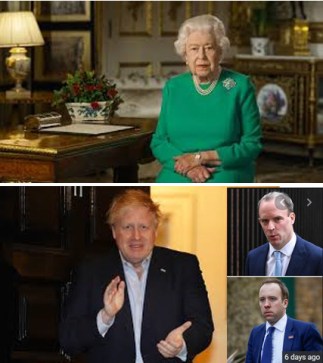
Those are not my narratives as I was brought up to try and treat everyone the same and to respect our Queen and the role she plays in our country and the mostly unseen support for our national institutions – not least through her weekly meeting with the Prime Minister. Whatever our personal view of the first-name-politician Boris, his part in the Conservative Party over issues like Brexit, his ambition to push others away in pursuit of being the leader, he is our elected Prime Minister with a substantial majority. He is easy to parody and characterise as a clown or buffoon, with that often repeated clip of him dangling from a high wire during the 2012 Olympics as Mayor of London.  I do confess to sharing some of the ‘funny’ pictures and videos on social media. As Prime Minister he has a tough job and is facing something nobody expected to have to manage, and for which there is no real ‘play-book’.

Boris’s ‘friend’ US President Donald Trump increasingly looks like a man lost in the situation. Always over-promising the end of the crisis, trying to provide hope of ‘an amazing and beautiful economic recovery…’, not able to hold supporter rallies and probably worried about the November elections. I am waiting for the day he declares he has managed the virus so well, he is going to issue an Executive Order that gives him the job for a minimum of two more years.

In the earlier part of the last seven days President Trump, and other world leaders were sending ‘thoughts and prayers’ to our Prime Minister and their ‘friend’ Boris. Social media was full of messages from people from all parts of society expressing similar wishes. Easy words to say but I wonder how many people actually said that prayer. Our local churches in Holy Week hold times of daily reflection and I joined those each day at 7pm. We did actually pray for Boris and everyone else in hospital and those who had lost family members. Our minister has had several funerals and dealt with bereaved families who can’t attend the last moments of a loved one.

I have started to hear that phrase that comes out in times of a human or natural disaster, ‘how can God let this happen and why doesn’t he put an end to this…?’. I won’t hold my breath and wait for the time this is all over and people suggest we get together to thank that same God for bringing us through it.

We journeyed through Holy Week with Jesus and shared in his suffering. The Good Friday service is always a moving one and I always leave it in a low mood. On Sunday I shared in a live-stream service from Methodist Central Hall Westminster where we celebrated the  Easter Day promise of new life overcoming death. For those who don’t share our view, signs of new life are all around.  As we walk in the local area blossom is on the trees, birds singing loudly due to the lack of traffic, and there are green shoots in our gardens and parks.
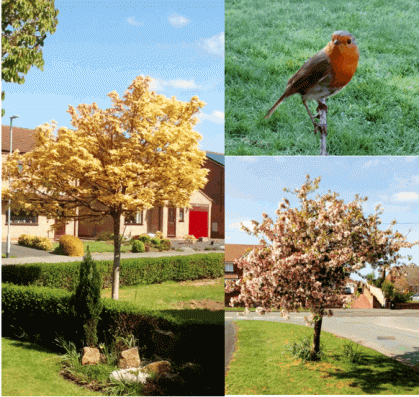
Mention was made of ‘green shoots’ during one of the daily briefings looking at the trends in new infection rates. I will look more at this in next week’s blog.

What has become clear in the last week as we all get used to (some would say bored with) the daily government briefings, is the public and the press are starting to ask the ‘hard questions’, and not allowing ministers to avoid them. There is no doubt they are ‘managing expectations’ or we are being ‘spun’ in a way that governments always do. If the lock-down had started earlier and was announced as up to 12 weeks, there may well have been uproar and even civil disobedience. As we come to the end of the ‘first three weeks’ it seems like this will go on for much longer, and other European Countries like Italy and Spain, who are ahead of us, are not showing any signs of a fully formed exit strategy.

If there is anything other than ‘Coronavirus’ that is likely to make Word of the Year for 2020 it is surely the abbreviation PPE (Personal Protective Equipment). We hear minister after minister saying they have supplied ‘hundreds of millions of items’ to hospitals etc. I am sure there are a lot, but a small calculation can explain away this figure could be ‘misleading’;
There are about 1,250 hospitals, 7,500 GP surgeries and 10,500 pharmacies in the NHS. The numbers of doctors is about 105,000 and nurses 300,000. I suspect in giving us the numbers the following could be true;

A box of 100 pairs of latex gloves = 200 items
a pack of 100 pairs of lower sleeves = 200 items
a pack of 100 plastic aprons = 100 items
a pack of 5o disposable masks = 50 items
a pack of 50 paper hair coverings = 50 items

So if each doctor and nurse is given the above items to last a few days, as they need to change them between patients, that would be
(105,000 + 300,000) x (200+200+100+50+50) = 243 million items

If every surgery & pharmacy was sent the same order this would be another (10,500 +7,500) x 600 = 10.8 million items

So that allows politicians to claim ‘literally hundreds of millions of items’ have been provided. But this leaves care homes, paramedics, home carers etc out of the calculations. Despite reassurances we hear stories in the media every day, and this has been going on for several weeks. There is no doubt it is a huge issue, and getting the kit to the right places at the right time is a massive logistical challenge. But isn’t this is something the NHS supply chain does all the time? Can’t our politicians be honest with us? Some of the ‘lower ranking’ ministers that have been put up to take questions seem to have no empathy at all and simply repeat the same platitudes and ‘party line’.
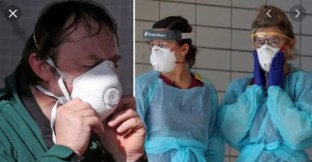
This week even Matt Hancock, Health Secretary (who is under great pressure and in my opinion seems to be leading well) resorted to apparently accusing NHS staff of ‘misusing PPE’. On Saturday the Priti Patel, Home Secretary gave a half-hearted apology when she said ‘I am sorry if people feel that way…’

On Thursday Dominic Raab, Foreign Secretary stood in for Boris at the briefing and answered a question about rewarding key workers after it was all over and said ‘this has certainly brought into focus who our key workers are’.  He encouraged the country to join in the weekly ‘clap for carers’ at 8pm.  Many of them are unskilled low paid carers, council workers and food delivery drivers.  That same day 9th April the Home Office under Priti Patel released the next stage of the governments immigration policy to limit the numbers of ‘key workers’ coming into the UK. A document on the .Gov.uk website states;

Lower-skilled workers

There will not be an immigration route specifically for those who do not meet the skills or salary threshold for the skilled worker route

On Wednesday evening as the prime Minister left ICU and was reported to be getting better, it was left to BBC reporter Emily Maitlis at the start of a BBC 2 Newsnight report to say;

‘You do not survive the illness through fortitude and strength of character, whatever the prime minister’s colleagues will tell us. The disease is not a great leveller, the consequences of which everyone – rich or poor – suffers the same. This is a myth which needs debunking. Those on the front line right now – bus drivers and shelf stackers, nurses, care home workers, hospital staff and shop keepers – are disproportionately the lowest paid members of our workforce. They are more likely to catch the disease because they are more exposed.

Those who live in tower blocks and small flats will find the lockdown a lot tougher. Those who work in manual jobs will be unable to work from home. This is a health issue with huge ramifications for social welfare, and it is a welfare issue with huge ramifications for public health….

….As the World Trade Organisation warns that it might provoke the deepest economic downturn of our lifetimes, we ask what sort of social settlement might need to be put in place to stop the inequalities becoming even more stark.

One of the hardest things about dealing with graphs and numbers, statistics, targets and flattening or rising curves, is a propensity to forget the names and lives behind the growing death toll. Tonight we want to remember some of those who died while doing their job. They were not soldiers, they did not sign up to a career in which they pledged to give their lives. They would not see themselves as heroes, but as ordinary members of the public doing their work at a time when it required immense courage and kindness’

Among the increasing death toll and loss of around 30 front-line workers, doctors, nurses, pharmacists, physiotherapists, care home staff, teachers and bus drivers were some truly uplifting stories. I watched the tale of Hugh from Market Harborough who went into hospital on day 10 of his suffering straight to ICU where he was put on a ventilator. He described the awful time he went through but also the care of the doctors and nurses he got to know by first name. His father had died the day before he went in, and with his wife and daughter having to self-isolate due to his illness, they watched a video made by his sister from the graveside. Hugh recovered a week later and was applauded out of the hospital by the nurses. Standing in his garden with the sun shining and the birds singing, he looked the happiest man alive. He described the joy of being given a shave and a marmalade sandwich by a nurse as a treat. He could now walk 300 yards unaided. He paid tribute to the staff.

Albert a 99-year-old World War Two (WW 2) veteran who had survived three years in a prison camp and was applauded by nurses as he left hospital after coronavirus. ‘World War Two, done that, Coronavirus, done that too!’ was what Albert said to his nurses.

Then there is another 99-year-old WW2 veteran ‘Captain Tom’ who  wanted to raise money for NHS charities by walking 100 times around his (not small) garden before he was 100. As I write his Just Giving page total is over £305,000. Go Tom!

The prime minister after leaving hospital on Sunday evening thanked many of the grades of workers who had looked after him. He named Jenny for New Zealand and Luis from Portugal who stood by his bedside for 48 hours. Perhaps he needs to have a quiet word with his Home Secretary about her new immigration system, to ensure the future Jennys and Luis’s can still come to work in the NHS.

Other news items this week.

I managed to find a few items related to the disruption caused by the virus that were not widely reported.

  • Yemen – a country ravaged by conflict and bombed by a coalition of countries including Saudi Arabia armed by our own government, recorded its first cases of coronavirus. Large areas of the country are suffering famine, dire water shortages and lack of sanitation (no 20 second hand washing here). Almost half the hospitals have been destroyed or closed and people are living in makeshift camps.  The Financial Times (FT) reported that there were only 205 ventilators in the country but the United Nations (UN) were sending another 420.
  • Refugee Camps in Calais – Reporter Fergal Keane of the BBC did a report showing the overcrowded camps near Calais where lines of mainly men from The Balkans queued closely together to get food and water handouts.
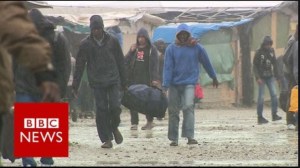
    A French volunteer interviewed said he was ashamed that we treat people in such an inhuman way. Even if they get over to the UK refugees face discrimination, poor accommodation and access to food vouchers that they can’t use.
  • Dairy Farmers pouring milk down the drain – Given the queues at supermarkets and pictures on news channels of empty shelves, it seems odd that thousands of litres of good milk are being dumped. About half of the daily production was taken by a few larger processors and sold to restaurants, specialist bakers and coffee shops – all now closed.  The demand from supermarkets is up 20% but the other part of the demand is down 70%. Cows are not industrial machines that can be ‘turned off’ and need to be milked. The dairies also aren’t collecting due to driver shortages and have reduced the price per litre the farmers get. So good milk is disposed of.

Thoughts at the end of week 3

We continue to be basically ok and able to find plenty of supplies and enjoy daily exercise, including a replacement form my weekly Parkrun with a course on my own locally.

We had several more ‘virtual coffee meetings’ with friends and family. We even had a couple of ‘virtual Easter cottage holiday’ gatherings and shared a pizza party with birthday cakes and candles, and a treasure hunt for the children.

I am extremely proud of Alyson, my wife, who has setup a WhatsApp group for some former work colleagues struggling with isolation and who had lost contact due to illness or losing jobs. After sharing a positive Easter message she had good feedback that it was helping a lot.

As the UK death toll passed 10,000 0n Sunday, we wonder whether the curve will flatten, whether the prime minister or his deputy and cabinet will review the lockdown  in the coming week, and what the result might be.

I want to finish with a prayer we used this week in one of our daily sessions. It is by John Bell and part of a booklet from the Iona Community in Scotland examining the basis of our economy. I think it resonates even if you don’t have a specific faith.

May it not be long, Lord.

May it not be long
before there are no more beggars at the door
waiting for the crumbs from the tables of the rich.

May it not be long
before the northern exploitation
of the southern economies
is  a  fact  of  history, not a fact of  life.

May it  not  be long
before poor economies
cease to be havens for sex tourism,
child labour and experimental genetic farming.

May It not be long
before  those  nations  we  once evangelised
show  us  the  larger  Christ  whom we,
too often, have forgotten .

May it not be long Lord.

May it not belong
before the governments of our nations legislate
against commercial avarice and  over-consumption which  hurts  the  poor  and  indebts  them.

May it not be long

Before  Christians  in  this  land  examine  their  economic priorities  in  the  light  of  the  Gospel  rather  than  in
its shadow.

May it not be long
before we respond out of love,
not out of guilt.

May it not be long
before we find wells of hope
deeper  than  the  shallow  pools  of  optimism
in  which  we  sometimes  paddle.

May it not be long

Before we  feel  as  liberated  and  addressed  by  your word as  those  first  folk  did who  heard  you   summon  the  oddest  of  people  to fulfil  the oddest  of  callings.

May it not be long, Lord.       Amen
Life & Death – Coronavirus week 2

Introduction

When I attended a meeting of our Constituency Labour Party four weeks ago, I was shocked when one of our local councilors, who looks after the crematorium, gave an update on contingency planning for cornavirus. They informed us, in a matter of fact way, that a large plot had been identified capable of burying hundreds of people in a mass grave. They wouldn’t have capacity to hold funerals or cremations. Families could get bodies exhumed at a later date but there would be no guarantee depending on the numbers.  It really shook me.

Thinking back to when I was first aware of the virus being a potential issue outside China, it was ‘Brexit Day’ at the end of January. We had visited friends on The Wirral when the first coach load of UK citizens arrived at Arrowe Park hospital a couple of miles away. That evening we travelled to London and the taxi we took to our hotel was delayed by the large gatherings celebrating at Parliament Square and other streets which were closed. Over the weekend we caught crowded Tube trains, went to concerts, shows and busy restaurants in the West End. No social isolation, and little extra hygiene measures then. We did pass a light comment when we walked through Chinatown that perhaps we ought not to have gone that way…

Given the pace of the changes since then and the prospects of even worse to come I decided to journal some events and my thoughts in more detail. I want to do this weekly so that when I look back in months’ or years’ time, I can see how my views changed with each dramatic turn.

I also want to explore several aspects of the crisis that may fundamentally change our country, our society and some of the norms we have taken for granted.

None of us know how this will end. We all hope that, like other crises both natural and those as a result of human action, we will come through it . But currently nothing is certain.

Why ‘Week 2’? From a personal perspective this is the end of our second week of serious ‘lock-down’ after some of the less restrictive guidelines and advice. The World Health Organisation (WHO) on 12th January 2020 officially confirmed the new virus and the four Chief Medical Officers (CMOs) in the UK moved the threat from low to moderate on 30th January.  For those in the front-line and our NHS service this is probably week 9.

With no training as an ‘investigative reporter’ and short of time for detailed research, the articles will be my own interpretation of ‘facts’ gleaned from mainstream news, written articles and ‘official’ web sites from some of the organisations involved.  My experience of being a secondary school science and maths teacher, director of operations & IT for a large retail pharmacy group, self-employed IT & business consultant, setting up systems for an accountancy practice, gives me some insight into a variety of processes and analysis. I have produced statutory accounts for a large Methodist Circuit and local Head Injury charity.

This is a public blog so feel free to join in ‘the conversation’, give alternative views, tell me where I am wrong – or right!

Whatever our views or beliefs, I think the majority would agree that we are living in ‘strange times’.

Outline of topics for discussion.

In thinking about what I need to put in the blog some large themes developed in my mind. It is hard to separate out specific topics and most are linked to one or more of the others. This is my initial list in alphabetical order rather than significance.

  • Economics
    How we use our wealth to best effect for what both main political parties agree should be ‘for the many not the few’. How corporations, public bodies, small and medium businesses, wealthy individuals, and every individual supports each other. Do we need a fundamental rethink and ‘reordering’ of past conventions?
  • Education
    Including science and mathematical modelling. Learning the lessons of history. How people react to news and the spread of ‘fake news’.
  • Faith
    In times of trouble and potential death the systems and personal and group support people of all faith and none turn to.
  • Globalisation
    How the virus and the news of it spread from China to the rest of the world. Transport, goods, news channels, sharing vital research and information. How world governments, leaders and organisations like the G20 co-operated or put self-interest before the wider good.
  • Health & Social Care
    Some would say this is the main topic. Clearly it is a health issue with Coronavirus at the centre. Our National Health Service (NHS) is at the forefront.  There are deep concerns over the elderly and vulnerable members of our society who are in hospitals and the care system.
  • Politics
    In the general sense the ways which people make choices, and in a specific sense the way different political parties have reacted and communicated. As I recently joined as a member of The Labour Party, Keir Starmer is elected the new leader as I write. We need to co-operate with the Conservative government but not be afraid to question or hold them to account now, or after it is all over.
  • Science
    The science behind the virus. The knowledge needed to trust the advice of ‘experts’. The way science will help the end the crisis.
  • Society
    How we have reacted and changed in the ways we interact with our neighbours and fellow citizens. The voluntary sector and the good and bad aspects of people’s behaviours. How we enforce those behaviours, and do we need more state surveillance and control to prevent similar crises in the future?
  • Technology
    This is the first time of real crisis when we have seen some of the ‘good’ that technology can do, but also the dangers of misinformation spread. Social Media can also be a force for good, but also a source for terrible harm.

In looking at these topics I will attempt to remember that there are other huge issues facing our world such as poverty, war, conflict, drought, famine and climate change. Many of these seem to have dropped completely from our news agenda. Significant parts of daily life such as arts, culture, sport and of course ‘socialising’ have disappeared completely overnight, and the effect on business is incalculable.

Thoughts at the end of week 2

We are very fortunate that the reality for me and my immediate family is nothing more than a minor inconvenience. We are semi-retired, relatively well off, have a large home with a garden to move around in. Getting food and essentials has not been a problem. Our two adult sons are working from home and still in full employment.
We have got the technology to hold virtual family, friend, church and social club meetings. We are using the time to do jobs around the house and garden, reading and exercising using an indoor bike and Wii Fit console on the TV.

No one we know in family or friends has had the virus (or to be correct has had serious symptoms). It all seems a bit surreal and like a Hollywood movie with empty streets in major cities around the world, and footage of overwhelmed medical facilities.

The daily government briefings are part of our rhythm of the day. They vary in usefulness and the messages can be confused and some ‘facts’ are found to be unreliable or even ‘spin’. The journalists’ questions are sometimes not the ones we need, but lately at least the presenters go back and invite supplementary questions.

While every loss of a life is awful, the rise in the last week in our own country is from passing over 1,000 last weekend to 4,932 now. The numbers in countries that we are supposedly following two weeks behind such as Italy and Spain are 15,887 and 12,418. This is getting serious.

To end I want to quote part of a letter our Chair of District Rev Helen Kirk sent us today as we start our journey through Holy Week from Palm Sunday to Easter Day. Note the use of the word ‘dis-ease‘….

Each year I challenge people to engage with Holy week for although it is not a comfortable place to be, we can too easily pass from the triumph of Palm Sunday to the joy of the Easter Day and miss the impact of the six days in between.

Perhaps that ever darkening week is one we can relate to more than ever this year as we live with the uncertainty, the anxiety, the constant underlying dis-ease that we carry for ourselves, our families, our church and our communities.

And yet for all, life is extraordinarily different and for many difficult; Spring is still arriving with a pace around us. As a novice gardener there is something extremely hopeful about planting seeds and watching as the new shoots grow. And they do grow, regardless of what is happening in my life, the plants in my garden and the seeds in my greenhouse are emerging with new life and beginning to bloom.


So Whats the Story?….We did it!

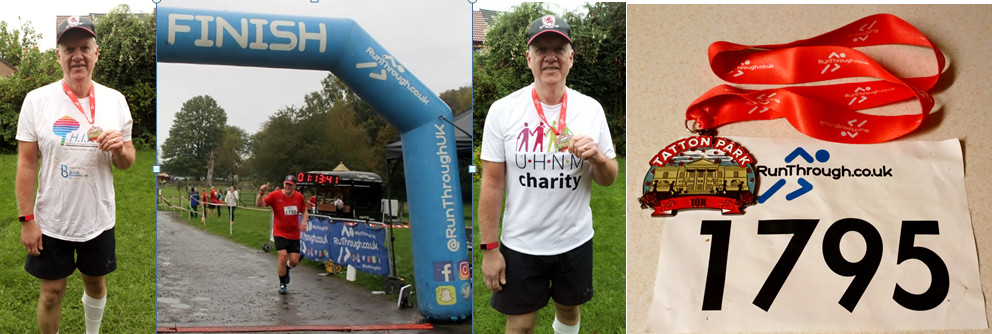
During the weekend that Eliud Kipchoge ran a marathon in under two hours, I managed to slowly jog 10k around Tatton Park in 1 hour 12 minutes and 23 seconds. Eliud could have done it in 28 minutes 32 seconds!

The real story, however, is not my running but that together we raised a lot of money for four charities. I decided to include Parkrun Forever, the charity which, along with corporate sponsors, allows Parkrun to be free for everyone to take part in.

The total sponsorship for the charities are:

Cheshire South Methodist Circuit
£1,230.00

HIP in Cheshire
£2,860.50

UHNM Charity (Royal Stoke Hospital)
£1,312.50

Parkrun Forever
£145.00

That’s a total of £5,548

Thanks to more than 65 of my family, friends, church fellowship and HIP members who donated. Your generosity is overwhelming!

I know the charities will be grateful for the funds and it will allow them to support the people they work with, or who are helped by what they do.

The on-line donation pages have now been closed and the funds passed to the charities.

Every blessing

Ian Skaife
November 2019


So Whats the Story?….. The Long Story

This is the longer story of the reason I am doing a sponsored 10k for three charities that you can read about in my last post So Whats the Story…? A 3-2-1 offer on a sponsored 10k.

During the Olympic summer of 2012 I was training for my first short triathlon, having been a ‘slow plodder’ for about 30 years of doing 10K’s and around 15 Half Marathons including five Great North Runs. I was never competitive and my motto was ‘when the going gets tough…..it’s time to slow down or even walk if needed’.

I woke up one Wednesday morning with a splitting headache and some numbness in my right foot. Putting it down to ‘man flu’ and an old back injury I worked that day but took the next one off. On Friday I woke up and could barely move my right side and the headache was excruciating. By the time we got to A&E I could barely stand unaided. A stroke was diagnosed, and I was put in a ward and pumped full of aspirin. On Sunday after a CT scan I was told that it could be a cancerous brain tumour and I was being sent to a specialist hospital 18 miles away. They confirmed that it wasn’t a tumour but a large amount of infection. They were not able to operate, as I had so much aspirin in my blood there was a danger that I would suffer a bleed in the brain. By Thursday my condition deteriorated, and they did an emergency biopsy. This didn’t go well and early the next morning I went for a second operation to drain the infection. Alyson was told that I might not make it, and when our two sons arrived from their homes in the south, they had what we now refer to as ‘the organ donation conversation’.

Memories of the next 24 hours are sketchy but when I arrived back on the ward from intensive care, I still couldn’t move my right side and although I understood what people were saying I couldn’t answer at all. The only words I managed were a tentative ‘yes’ (when I meant no) and no (meaning yes). Later I managed to speak a little but then it was mainly swear words which, as people who know me will confirm, I rarely use.

So began treatment involving two antibiotics intravenously five times a day every day. I was also put on anti-epileptic medication to prevent fitting, and antidepressants for my low mood. The days were endless, the restless nights even longer. I was struggling with tiredness and extreme confusion. Coming to a dead stop after my life as a busy IT Project Manager was hard. I wanted to be back at work but had to learn that in the brain business, days turn to weeks and weeks to months.

I tried to read newspapers and magazines but by the end of a paragraph I had forgotten what the headline was about. I had asked for my Bible to be brought in and that was even harder to read. I couldn’t even remember The Lord’s Prayer. My Bible was still a source of some comfort, although starting on Psalms was probably not my best idea. I do have a vivid memory of Carmen, a Columbian nurse singing quietly a hymn while she gently washed my back. I shared stories with other overseas nurses who, on seeing my Bible, talked about life ‘back home’ and what their faith meant to them.

I started intense physio and speech therapy. Being left-handed was a bonus as at least I could do some basic tasks. It took three people to get me out of bed using a hoist and either onto the toilet or eventually to prop me up in a chair.  What I couldn’t do was muster the words to ask to be put back, so often sat there frustrated for hours as people came in and out of my room.

Alyson visited me twice a day every day for the next 12 weeks. I owe her a debt that will never be paid. Church friends and close family helped relate my story each day to our wider circle. My brother and cousins drove mum and dad from their home 3 hours away. I barred any visitors other than close family at first, as I looked awful and couldn’t concentrate enough. When I relented our friends were faced with Ian who didn’t have any personality. The lights were on, but no-one was at home.

Then started daily visits from close friends, our sons, Alyson’s sister and brother, cousins. I couldn’t remember who had been from one day to the next – but I know that they all made me feel better – even if it didn’t always show on my face. Chocolates, grapes, biscuits and particularly ready-made custard were very welcome!

Work colleagues from the IT & Business Consultancy business I worked in visited and I was grateful for their support covering the projects I was supposed to be managing. Alyson’s employers Co-op Pharmacy were very understanding and allowed her all the time off with compassionate leave. The stress and worry meant that she was unable to work in any useful way.

Eight weeks in I needed a third operation as infection was still collecting in my brain. I had ‘drains’ fitted linked to bags on my shoulder – I looked like ‘Dracula’s Bride’ for a week or so.

This is a scan of my brain just before the operation on the left, and what a ‘normal’ brain looks like on the right – you don’t need to be medically trained to see the pools of infection and damage….

The result was a small improvement in all my symptoms; I managed to move a toe then bend my ankle.  I managed some ‘freedom’ with a wheelchair that I could push myself around the ward and, if Alyson came with me, to the café or even outside. Friends and family began to see some big changes in both my alertness and mobility.

Steve Ingrouille, the minister at my local Methodist church, came to visit and we had the strangest communion I have ever received sitting in a corner of the public restaurant. Steve did the complete service with the bread and wine used at my church the previous Sunday.
Alyson also had great support from church friends who rallied around to help and I believe that the prayers they gave aided my recovery. Val Mayers and our neighbours Stuart & Veronica Rhodes need a special mention. I continue to gain strength from my church fellowship and my faith.

My mood slowly improved and when mum visited me one Saturday as she left we hugged and she said ‘Love you son, keep getting better and see you soon’. These were the last words she said to me as the next day she had a heart attack and was put into a coma on a life support system for a week.  One Friday as I was taking my first steps unaided by physios I had a missed call on my mobile. It was my brother telling me that mum had died…she never got to see me walk again.

I was allowed out of hospital for one day to travel to her funeral 150 miles away and managed to stand using a frame to give part of her eulogy.

I had my laptop back by then to write and plan my ‘escape’ from the rehab hospital until my condition improved enough for Alyson to take me home in a wheelchair. The skilled consultants, surgeons, nursing team and physios had ‘fixed me’ – physically at least.

18 months of hard work started, to recover from my ongoing symptoms, regain my driving licence, and build my strength enough to stand on my own with a stick, and climb stairs. I did some part-time work in the IT Consultancy Business, helping the owners to sell the part of the business I was in. I knew about this before my illness but it meant me being made redundant. I then managed to get a little paid work with my church on finance and property.

Alyson went back to work as a pharmacy manager in a very busy community pharmacy attached to a surgery. This is an extremely demanding role with a team of around 20 to manage and unrealistic targets set. At least I was able to support her in this, being at home to look after practical things around the house, waiting for trades people, doing some of the household chores that until then had fallen mainly on Alyson. I was happy with a lower pace of life than before, and could rest when needed.

I had the hip replacement that I needed before going into hospital, and it was through this that I met Annette Turner, a brilliant physio specialising in hydrotherapy. When my consultant had signed me off in February 2013 he said it would be two years before we would know the lasting damage and implied this would be substantial. Annette convinced me that, whilst that was true, she could get me to the point where it might be that the only thing I couldn’t do was to move my little toe. That has proved to be the case.

In January 2014 I was encouraged by Beth Fisher, Service Manager from the Acquired Brain Injury service in Chester, to attend a support group who met for coffee. This is an amazing organisation who provide help for people with a brain injury to reduce the loneliness that can come from hidden symptoms, loss of confidence in social situations, along with memory issues and extreme fatigue. During the last few years this group has formed into a formal charity. I am now a trustee of Head Injured People in Cheshire.

Steve Price, an accountant who had been one of my project managers, had left to concentrate on his own business. In August 2014 he offered me the opportunity to work with him a few days a month to get out of his front room into an office,  taking on some people to help him.  I am eternally grateful to Steve and the team for the opportunity to work with them putting new systems, marketing material, social media, lots of new business processes in place as we grew. I became Compliance & Training Manager. (In April 2019 Steve and the rest of the team merged with another practice and he is now one of 5 directors in a company with 23 employees and a growing list of clients. I took the opportunity to retire).

I had another 18 months of physio and got to walk correctly and slowly, then six months later I decided to try running a few steps. I did a short route around our home in streets that I had used for training. It took me about 30 minutes to do a couple of miles with intense concentration on my foot placement and staying upright. I had to sleep for an hour afterwards. Fatigue is a lasting symptom of brain injury and several afternoons a week I sleep for 40 minutes, and each time I run I must sleep for around 50% longer than the time I take.

I don’t remember how I heard about Parkrun but in April 2016 I arrived at Delamere with my barcode and did the whole 5k without stopping. It was very emotional, and my account can be found at https://skatchat.wordpress.com/2016/04/.

Alyson used to come with me and walk the course before we started and meet me at the end but then two weeks before her 59th birthday she announced that she fancied running it. As someone who has asthma and have never run before I was amazed. She did her first run in 37 minutes, beat my PB the next week and after 5 more successive PBs she now runs around 30 minutes. She even fell over once and after dusting herself off for a short while still beat me by four minutes.

So the 100th Parkrun completed yesterday was an emotional one too, coming as it did on the 7th anniversary of mum’s death. Alyson did her 24th and our son Michael volunteered.  My brother Andrew did his 100th at Newcastle on the same day along with his son Thomas.

As we lost dad in 2016 and have received some money from their estate, it seemed a good time to celebrate my recovery and use their legacy to raise funds for the three charities that have helped me. So next weekend I will take on 10k at Tatton Park.

So Whats the Story?…..where I am now.

Reflecting on the past seven years, I genuinely feel that I am in a better place than before my brain injury. Sure, it has been a tough time and I wouldn’t want to inflict the stress and worry on my family that was some of our experience. Overall the positives are;

  • I am in a less stressful state than I was before – many people when they heard it may have been a stroke worried that it was due to pressure of work and church business that had caused it. I often say that my memory problems mean that I can’t remember what I am supposed to stress about
  • I feel that my faith has been strengthened, as it says in Psalm 40

    I patiently waited, Lord for you to hear my prayer. You listened and pulled me from a lonely pit full of mud and mire. You let me stand on a rock with my feet firm, and you gave me a new song a song of praise to you

    and when I hear the story in Luke’s gospel of the paralysed man whose friends prayed for him and took him to Jesus – I can really relate to that.

    But I want you to know that the Son of Man has authority on earth to forgive sins.” So he said to the paralyzed man, “I tell you, get up, take your mat and go home.” Immediately he stood up in front of them, took what he had been lying on and went home praising God.
    Everyone was amazed and gave praise to God. They were filled with awe and said, “We have seen remarkable things today.”

There is no substitute for confronting your own mortality and asking the real
questions of what your life is about…

  • I have been able to spend more time working for my local church on finance and property issues, to support the Leadership Team looking at new ways of working, recruiting some amazing lay workers to support our ministers and churches.
  • I have had more time to give to Alyson and our family. Supporting them through difficult times at work and being there to help with looking after her parents and supporting her when they died these past two years. Our two sons are in well-paid roles and have been able to buy their own homes. They too have benefited from their grandparents’ legacies, and by that I don’t just mean the financial ones.
  • We are fortunate to have built up enough savings to be comfortable in our retirement. I had several good jobs in companies with strong ethics and who made a difference to their employees and the patients/customers they served.  I have been able to help a friend build his business to repay his faith in me.
  • I work with some amazing people in the head injury charity and have met some truly inspirational survivors, who live in much more challenging after effects than mine. Head injury doesn’t discriminate on the basis of age, wealth, personal background, education or experience. I am fortunate that the relationships with family and close friends have survived – that is not always the case.

So as I look forward to enjoying some travel and a forthcoming pilgrimage to the Holy Land, I wonder what the future holds, and the next challenge we will face. I hope that I am up to the task but know that I will have a lot of support.

Thank you for reading my story.

Ian Skaife, October 2019

So Whats the Story…? A 3-2-1 offer on a sponsored 10k.

The Short Story...

For those of you who have found this page for details on my upcoming 10k sponsored run, these are the basic details with links to the pages where you can donate.

I am running the Tatton Park 10k on Sunday 13th October 2019. I have decided to do this as it is near the seventh anniversary of my mum’s sudden death in 2012. I was in hospital struggling to walk or communicate after 12 of weeks of treatment for a brain injury. I stood and took my first small steps unaided at exactly the time of a missed call on my phone from my brother telling me that, after withdrawal of life support, my mum had died. She never saw me walk again..

It has been a long journey since that time and you can read more details in the ‘Long Story’ which I will post before the event.

I am running for three charities that have helped me and others.

Cheshire South Methodist Circuit – The key unit of mission for my local church.
For more details, and to donate go to my Just Giving crowdfunding page at
Just Giving Crowdfunding – Ian Skaife

HIP in Cheshire – The charity of which I am a member trustee and which helps people like me with friendship, support and saves us from social isolation. For more details go to
HIP – CAF Donate – Ian Skaife

Royal Stoke Hospital – (UHNM Charity) – This was the hospital that fixed me physically. They need some new equipment for the Neuroscience ward that I was on. For more details go to    UHNM Virgin Money Giving – Ian Skaife

That’s the ‘3’ from the title of this page, but there is a special offer which is the ‘2’. I have been fortunate to receive a legacy from my mum and dad’s estate and want to use that to Double Your Sponsorship (before Gift Aid). To be very clear if you give £10 I will add £20 so that it becomes £30 total. If you donate £50 I will add £100 to make it £150. Go on, challenge me…..!

The ‘1’ is me taking part in the event. In so many ways I will not be on my own as I have the support of my faith, my close family and so many friends from the charities and people who have worked with me.

My target is to raise £1,000 for each charity, but my hope is that together we can do so much more and touch the lives of a lot of people.

Thanks for reading this and if you feel that you can’t give, that’s absolutely ok. Just think of me, and the charities on the day.

Coming Soon – The Long Story….

The non-competitiveness of the ‘long-distance’ runner.

As someone who ran many 10k’s & half marathons from my early 20’s to late 40’s, these days for me ‘long-distance’ is anything over 5k. I have done over 50 Park Run’s at Delamere Forest between Northwich & Chester – about 40 minutes drive from our house.

Not a natural runner, I have never really been motivated by time or position (see note 1). Competitiveness is not my usual state. It has been nearly 12 years since I entered an organised race – the 2006 Great North Run.

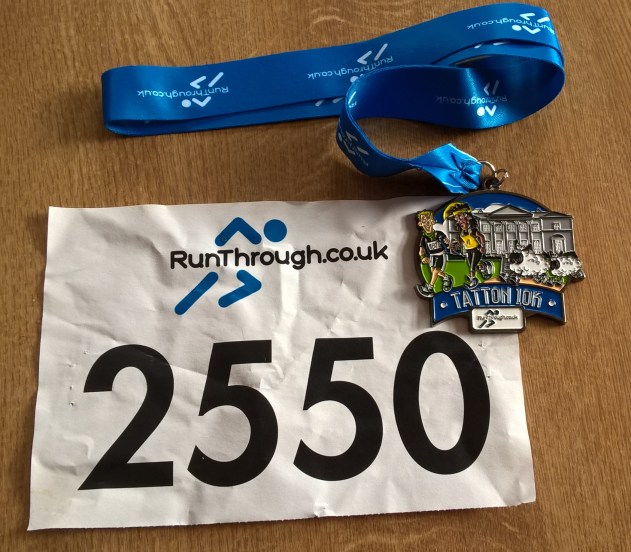
Building on my ‘success’ at Park Run I decided to enter a 10k and found the monthly ‘Run Through Series’ at Tatton Park. After the hot days of the summer of 2018 I watched the forecast with interest this last couple of weeks. It seemed that we might get more comfortable temperatures but also a possible downpour with strong winds.

My goals for the day show my lack of ambition, but I am pleased that in the end most were achieved.

  • To get up at 5.30am and get to my son Michael’s house in time to get to Tatton by 8am – Tick!
  • Pick up my number & timing chip in time to start the race – Tick!
  • Hope that the weather stayed reasonably dry for Michael in the time it took me to run – Tick!
  • Not to fall over – Tick!
  • To run at a pace that allowed me not to want to walk – Tick!
  • For my finishing time to be about twice that of the winner or at least the top 10 – Tick!
  • Not to be the last man home – Tick! I wasn’t even on the last page of the results!
  • Hoping the organisers didn’t take the course down before I finished – Tick! (see note 2).
  • Not to throw-up at the finish – Tick!
  • Not to get overtaken by anyone in an animal costume – FAILED – I was overtaken at the 9km flag by a 6ft gorilla! (see note 3)

Tatton 10k August 2018-1

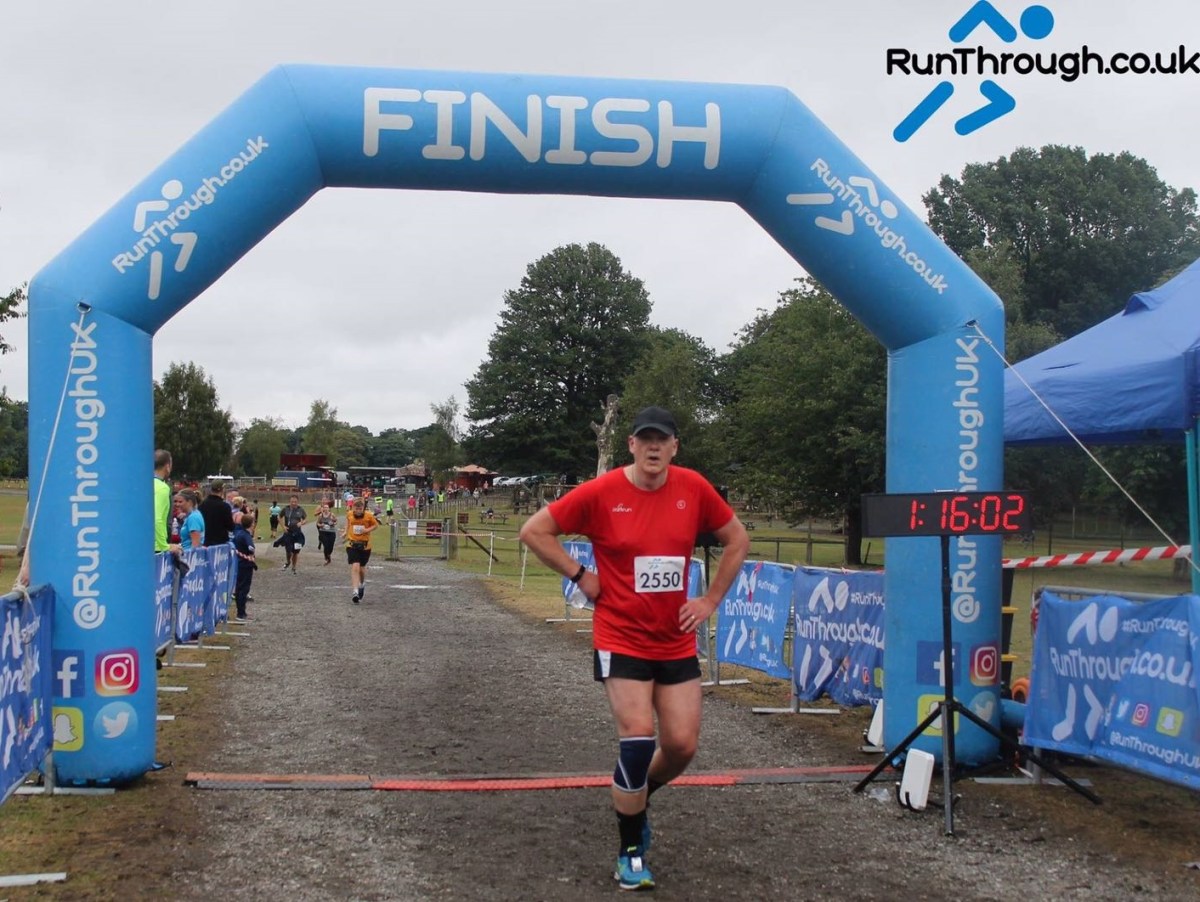
You can see the time in the photo at the start of this piece that I finished in about 1hr 16mins, but my actual time according to the chip was 1:14:41.  Given that my predicted finishing time was 1:15 it was quite a good guess, The winner’s time was 34:14 & the person in 10th was 37:35.

Overall a good day and maybe I’ll do The Kielder 10k with my brother Andrew in October!

Notes.

  1. In my earlier ‘running career’ I kept a log of times and events. I admit to being disappointed that my PB for a half-marathon never got below two hours. In October 1991 I did the Madeley Half Marathon in a time of 2hrs & 5seconds! The same year I did the Rainford 10k in 53:47.
  2. One year I entered the Scarborough half marathon when I visited friends in the early part of the year without much training. By the time I got to the 9 mile mark on the way back from Filey I was so far behind, the organisers were actually taking the mile signs down! I flagged down a St John’s ambulance and surprised my family at the finish by getting out at the end of the race.
  3. Although I am not competitive I do find it particularly hard being overtaken by a variety of people in costumes. There can’t be many things in life as disheartening after a couple of hours of hard slog, and getting ever slower, to see a 6ft chicken come past you!


Celebrating my 50th & moving on…

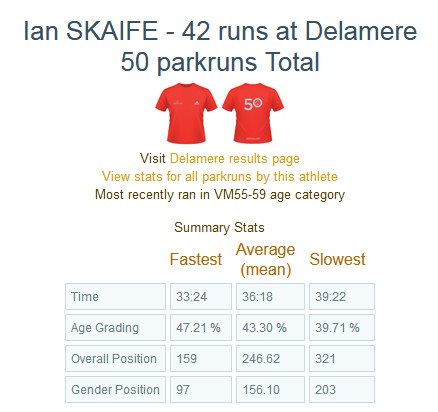
50th Park Run - Feb 2018

This week I passed two significant milestones.

Tuesday was exactly 5 years since my neurosurgeon formally discharged me from his care, following treatment for a serious brain injury that paralysed the whole right side of my body and left me unable to speak. It was 6 months after I first went into hospital.

Yesterday I completed my 50th Park run since starting to run again almost two years ago. Although it was my fastest time for several months, that was completely unimportant. Being able to enjoy the feeling of running, breathing the clear fresh air, hearing the birds sing in the trees against bright blue sky – that’s what meant the most. Thanking God for my journey and the changed person I have become is equally important.  As I ran I thought about my family, church fellowship, friends and the medical team who have helped me get to this point.

My wife Alyson (my greatest supporter of all) often tells me that I should ‘move on’. This does not mean to forget; just not to dwell on the past and look more to the future. I feel that this is the time to take up that call.

I will always have my current symptoms of fatigue, memory issues, weakness and balance problems, but I am determined that these will not stop me from seeking new challenges and adventures.

We never know what will happen in the future, and the fact that a friend from church was diagnosed with a brain tumour and had a stroke a few weeks ago, is a painful reminder of that.

I will wear my red 50th Park Run shirt with pride and, all being well, will get my black 100th in the next two years – I tend to run once a fortnight.  By that time retirement may have happened and who knows where that will lead us.

For now my faith is stronger, my confidence has returned, my stress level is controlled (partly as I can’t hold too many things in my mind so forget what I should be worrying about!), and my general health is reasonable.

Time to ‘move on’…


Mothering Sunday – traditional & updated.

Even with all the advances in medical science and technology, I think we can be pretty certain that every person on earth has a mother. Many may not remember or even know who their mother is, many may have lost touch, but mothers and ‘motherly love’ form an important part of life.

We lost our mum four and a half years ago, which means I don’t have anyone to send a card or flowers to. However, I have the less traditional means of acknowledging the love mum showed by writing about it here.

Mum brought us up in a traditional church environment of Sunday school and Mothering Sunday is the fourth Sunday in Lent, a day when people go back to their ‘mother church’. Like many of the religious festivals this one has been taken on by retail & commercial interests – think Easter eggs, M&S Christmas adverts, expensive flowers & cards. In the United States & Canada ‘Mother’s Day’ is the second Sunday in May and has been officially since 1914. It is much more commercial, and has been taken up by over 60 countries across the world.

This morning I went not to my ‘mother church’, but to our local Methodist one, where Rev Den reminded us that the traditional family is a changing one. 9 million people in the UK live in single person households, many young women choose not to join the ‘traditional’ family of mum, dad and children. The number of children in a UK household has gone down from 2.4 and is around 1.7. There are so-called ‘blended families’ formed by those whose relationships have broken down, often more than once. Same sex couples adopting add to the wonderful variety of what we call ‘families’.

I wait to see this week’s documentary following ex footballer Rio Ferdinand and his journey taking on the ‘mother’ role to his children, following the death of his wife, their mother, from cancer almost two years ago. It will be full of many different emotions. I know of someone whose wife died giving birth to twin girls leaving him not only grieving, but having to bring up two young children – I can’t imagine how hard that is. In both examples I guess ‘Mothering Sunday’ takes on a whole different form.

We need to remember on this special day, those who have never felt a mother’s love, those who had a ‘difficult’ or even abusive relationship with their mother, and those who still don’t know who their mother is.

The day is also a hard one for those mothers who have lost a child and have no one to phone them, send a card or bring flowers. For those of us who follow a Christian faith Mary, the mother of Jesus, is an example of such a person.

My mum died suddenly when I had been in hospital for 10 weeks with a brain injury that left me unable to talk clearly, or walk at all. This was what I said about that in the tribute at mum’s funeral two weeks later…

I know that mum is now at peace and I didn’t feel the need to travel to be with her when she went to sleep, but I was pleased to hear that my older brother and my younger brother’s wife had been with her the night before, and dad  my younger brother were with her the moment on that Friday lunchtime when, as dad put it, she ‘looked peaceful and in no pain’. My brother had told her on the Tuesday when they turned the life support off that I had taken my first steps on the ward, and when I missed the call on Friday to say that mum had gone it was because I was taking my first few steps unsupported by the physios…..I like to think that mum was holding my hand.

We will all have some regrets for all the things which we could have done together and the times which might have been, but I will always remember the last words we said to each other as we hugged after visiting. I said ‘I love you mum thanks for coming’ and she replied ‘I love you too son and hope you keep getting better.’

My wife and her sister told me later that they believe that mum had done a ‘deal with God’, giving up her life to save mine. I don’t think God does such deals, but understand the sentiment, and I know mum, like many others, would gladly have offered her life to end my suffering.

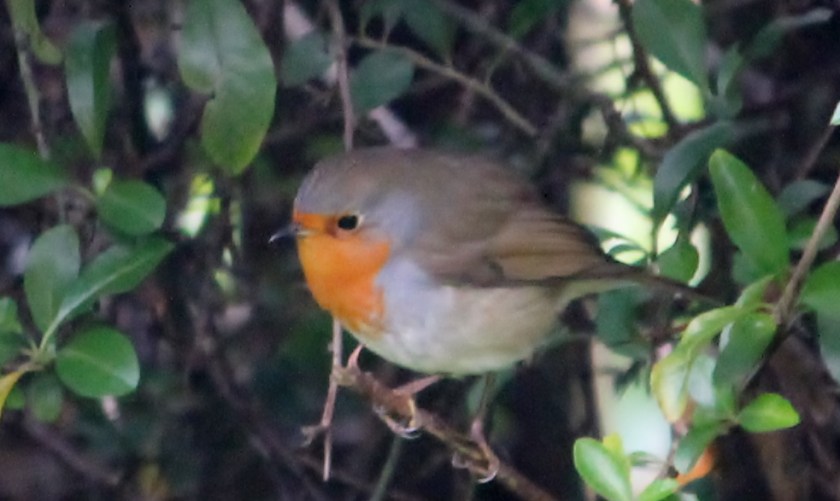
There are people who believe that robins are a sort of angel who visit us on behalf of loved ones to keep an eye on us. Again I don’t subscribe to this, but it is good to be reminded of mum whenever I see one. Just this afternoon as I was thinking about this blog whilst cutting our lawn, a robin who is a regular visitor to our garden landed on a bush. I could hear its incessant call over the noise of the motor – ‘go on write your blog’ it seemed to be saying! This is a picture I took of it last autumn…

Robin - our garden

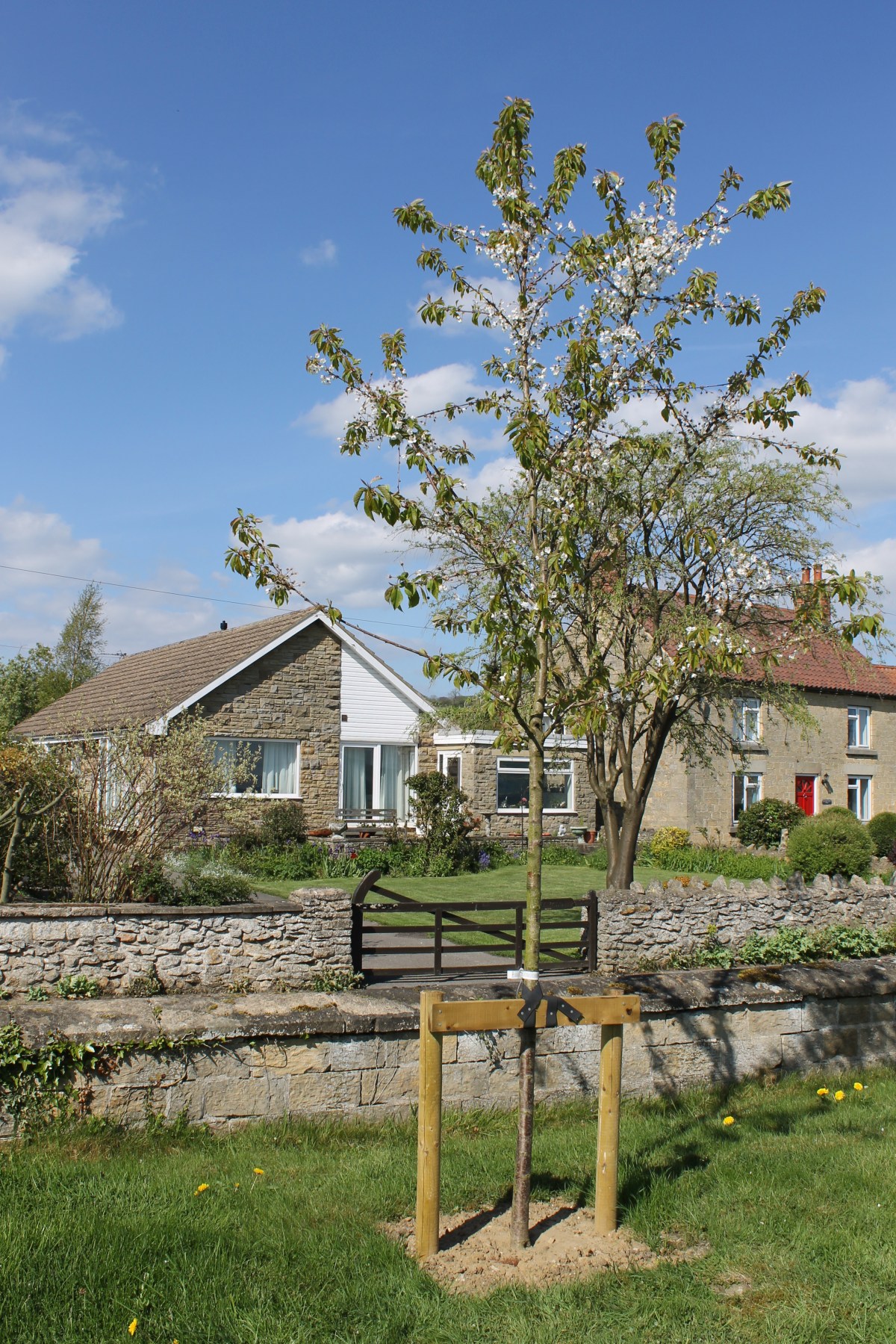
Mum was someone who enjoyed her garden and the new life that came from it. We put mum’s ashes under a flowering cherry tree that sits in the churchyard opposite her garden – the main picture at the start of this blog. As spring moves into summer it is a reminder of on-going life and vitality.

In addition to love and demonstrating Christian care, mum showed me that we need to remember those less fortunate than we are. This week would have been an upsetting one for her with television news having the following items:

  • The plight of mothers watching their young children die as the result of famine in eastern Africa.
  • The Westminster Bridge attack near parliament where Aysha Frade was strolling across on the way to collect her children from school when Khalid Massood charged down the pavement in a 4×4 and snatched her life away. She had just come from work, a school itself, where she dedicated herself to helping youngsters learn the language and culture of her native Spain.
  • Comic Relief and the many appeals showing the suffering of children who had lost both parents, with daughters taking on the mother’s role.
  • The appeal on the same programme to prevent mothers losing small children to malaria – preventable by a simple test and a cheap mosquito net.
  • The children dying as a result of the bombings in Mosul in Iraq – more mothers left childless.

We need to acknowledge that whatever we think of Khalid Massood and his actions, he had a mother whose feelings at this time we may never really know, but can imagine.

For those, like me and my brothers, who had the loving example of a mother who cared for us & others, her life carries on in the way we act towards other people. As my friend put it in a poem to her mum after she passed away at the start of the year, following a long time suffering with dementia…

Mum you always said when we were young that we should try our best;
helping you live with dementia was a truly challenging test.
We hope you would be proud of us, if you realised all we’d done;
we tried our best and in the end our battle with dementia was won.

We shouldn’t dwell on the recent past, happy memories we have a plenty;
of a devoted mum, grandma, great grandma , teacher and friend to many.
….

These are the memories we treasure, the ones that involve the real you;
that stranger that came into our lives was only passing through.

On that dull January day you passed away, but you haven’t really gone;
in the way we think, and what we do, so much of you lives on.
To make a difference and try our best we will always endeavour,
so mum goodnight and God bless, all my love, Heather xx

God bless mothers everywhere.


Life & Death Part 2. Walking in the light, a life well lived, three orphans & time to move on…

Our mum used to say  ‘..as Methodists we have faith and don’t believe in superstition’. We had no problem holding dad’s funeral on Friday 13th January. It turned out to be a day that started with a light covering of snow, but this didn’t settle and we were able to follow the hearse from Thornton Dale to the Crematorium in Scarborough. On the journey there, and also on our return, we saw a complete and very bright rainbow. Adam, our funeral director and fellow Methodist, commented – ‘Seeing a sign like that, makes you realise all will be well’.

Light also had a part to play the day dad died at the end of December. We had been staying for the week at a cottage on the North York Moors, with my wife’s family to celebrate Christmas. It was a beautiful spot with views over the hills & valleys of the moors. We enjoyed stunning sunrises and on many nights the sky was so clear we could see an endless canopy of stars. With the only artificial light from houses in the village and RAF Fylingdales early warning station, it was a ‘dark sky’ area.

sunrise-over-fylingdales-27-dec-2016
Sunrise over Fylingdales 27 Dec 2016
stars-over-fylingale-27-dec-2016
Stars over Fylingdales 27 Dec 2016

Dad was nearing death as the result of his Parkinson’s causing an inability to swallow two weeks’ previously. After a short spell in hospital – beside the crematorium that he would return to – dad was allowed to go back to his care home in Pickering for palliative care. Our cottage was only a 30 minute drive away, so we visited him several times. My younger brother, Andrew, and his family called in to see him on their way to relatives in the south.

The night before dad passed away I set off to drive the short journey, but a heavy fog had come down. It was obvious after taking 10 minutes to get less than a mile that it was a dangerous journey without streetlights or markings at the edge of the roads. A phone call to the home confirmed that it was they same there. I had already visited dad that morning and now he was settled down for a good night’s sleep. I returned to the cottage.

Next morning I woke up early; the fog had cleared and through the skylight a host of bright stars shone in. Lying in the quiet stillness I thought about dad and prayed to God that if it was His will then it was time to let go, and for dad to pass on to his next life. I also remembered my mum who had died four years ago of a sudden heart attack. Dad had missed her terribly and took about two years to get over his grief. Recently, in a cruel twist brought on by his dementia, dad had started asking us when we visited if we had seen mum, as she hadn’t been to visit him for a while. If we told dad the truth he looked shocked and said it was too much to bear. We decided not to lie but changed the subject and distracted him with something else.

As I got up and went down for breakfast, the sun was just coming up over Fylingdales and the sky was a beautiful pale orange colour. The air was still and a few tufts of high, white cloud were visible. Through the large glass kitchen doors overlooking the garden & fields of sheep, a tawny owl flew past slowly and gently settled out of sight among a clump of grasses. A rabbit hopped across the gravel driveway and under the wooden gate to the field. Four female pheasants came onto the lawn to feed on the breadcrumbs and nuts we had put out. A robin and sparrow sat on top of the wooden table where we had put the remaining food.  The place was teeming with life and the beauty of nature.

There was no mobile phone signal so we had been using wi-fi and WhatsApp to communicate. We finished breakfast and were packing up to leave, as we were due out by 10am,  when Anne Marie (the owner and nurse manager of the care home) sent me a message asking me to call on WhatsApp. I managed to speak to her long enough to tell me that dad had passed away a few minutes before. I heard her say it was peaceful then the signal went and I couldn’t phone back. Driving up the half mile farm track to the main road I managed to find a good signal to call Andrew. Anne Marie had called him already, and we shared a short silence and a sense of relief that it was over. I called the home to say I would visit after we left the cottage.

As I made the journey to Pickering the sun was rising higher against blue sky & reflecting off the rail tracks in the deep wooded valley of the preserved steam railway that curves through the moors. I passed the end of a narrow track off the road down which lie the ashes of dad’s brother and wife, overlooking the valley and the moors beyond.

The closer I got to town the fog, light at first, got thicker so that by the time I got to the care home it was dark, damp and cold. As Anne Marie took me to see dad she told me that she had checked on him at 25 to 9 and he was sleeping peacefully and five minutes later she came back and he had died. The night shift hourly care records all said ‘settled and sleeping quietly’. Dad’s earthly life had come to a peaceful and pain-free end. Anne Marie confided that when she awoke that morning she too had prayed the same words as me. When she had opened the window to ‘let his soul free’ as they do in many hospitals and care homes, I like to think that dad escaped the darkness of the town and soared up to see his brother and sister-in-law at that beautiful spot I passed on the way in. A place where the sky was blue, the sun shining and the birds singing. All would be stillness and peace.

Anne Marie gave me dad’s Bible to read whilst I sat with him. A bookmark was placed at the first chapter of John’s first letter; a section headed The Word of life, walking in the light.

God is light; in him there is no darkness at all.  If we claim to have fellowship with him and yet walk in the darkness, we lie and do not live out the truth.
But if we walk in the light, as he is in the light, we have fellowship with one another, and the blood of Jesus, his Son, purifies us from all sin.

 There was a Post-it note in dad’s writing of two other passages about faith and actions and helping those in need. A further bookmark was at Psalm 121 which we had used in mum’s service. It seemed that I had been given the readings and theme for dad’s service of remembrance.

Dad’s was the first dead body I have seen. When I kissed the top of his head it was cold, but holding his hand it was still warm. I sat quietly listening to the hymns which had been playing all week at his bedside. I cried a few tears, but the overwhelming feeling was one of gratefulness & peace.

I am usually a blubbering wreck at funerals, even for people I barely know and who have been ill for a long time. I was always amazed that the family could stay so calm. However, having spent two weeks planning the service and writing dad’s tribute, for the service back at Thornton Dale Chapel, after the shorter one at the crematorium, it seemed natural to be calm and speak joyfully of dad’s life of faith and service. We shared lots of stories and some jokes with his church friends and family from near and far. This continued over lunch afterwords.

I was given a book for Christmas written by one of my cousin’s friends Rosalind Bradley titled ‘A Matter of Life and Death’, consisting of 60 short passages by various people sharing their experiences of death.  It asks us to treat death as a natural part of life. To think, talk and plan for it, so that when it comes – which it certainly will – we and those who know us can go through the process in a peaceful, ordered way. I have yet to finish it, but some useful words found already are;

Death is not extinguishing the light; it is only putting out the lamp because the dawn has come.    Rabindranath Tagore.

Do not seek death. Death will find you. But seek the road which makes death a fulfilment.  Dag Hammarskjold’s words as chosen by Arrchbishop Desmond Tutu in his foreword.

Our dead watch over us from inside our hearts. We talk to them, they talk to us, and their love and wisdom bless us.   Rabbi Jonathan Wittenberg.

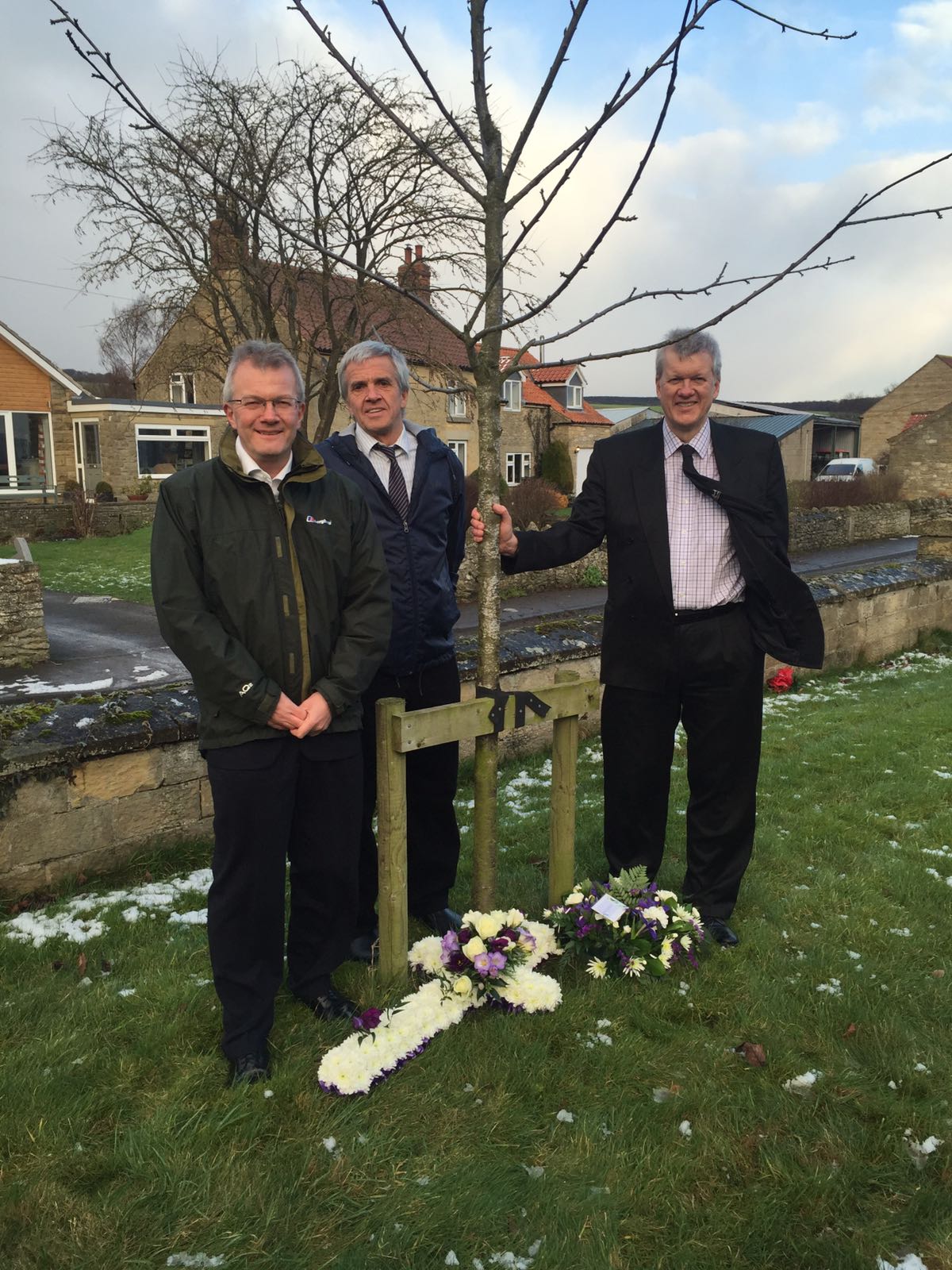
The picture at the start of this blog is we three brothers who can now be classed as orphans, standing next to ‘mum’s tree’ at Wilton in front of the small Anglican church. We buried mum’s ashes under a flowering cherry we bought to replace one that had died. The bungalow in the background was where mum & dad spent 24 years together in retirement. Mum loved her garden so now looks over that and the Wolds nearby. Dad will be joining mum in the spring. The photo was taken after the funeral service and the flowers are the cross from dad’s coffin and another wreath from our cousins (whose mum’s and dad’s ashes are in the valley overlooking the railway and moors near Fylingdales).

As we said at the end of dad’s tribute:

…we join our cousins in becoming ‘orphans’, we also join them as living testimony to the care and love of our parents.

The fact that we hopefully are contributing in a positive way to our local community and society, being aware of social injustice & poverty, the needs of our neighbours near and far, means we will continue to be a tribute to them.

And that love and care will continue as our families grow from one generation to the next.

We all need to move on to the next stage in our lives, to let go of, but not forget the past.

Legion d’honneur

Julie’s dad is a kind gentle soul and is always asking how I am. I guess we will never quite know what our parents went through in the war (hopefully). The memories will never quite fade completely. My mum was always sad when she remembered my uncle Wilf, her brother shot down in June 1940 flying back from a sortie over the channel. He was in his twenties and mum was a month before her 9th birthday…

jules's avatarverbalising

Last month my father was the recipient of the highest decoration in France, the legion d’honneur. This medals were awarded at Yorkshire Air Museum as a way of honouring and thanking those who fought and risked their lives to secure France’s liberation during the Second World War.

I had always known he landed on a Normandy beach in 1944 and had heard some of the ‘funny’ stories of the war, perhaps because the horror of war was not a story anyone would want to tell. Even when I had watched Saving Private Ryan many years ago and Dad had said that he had been on the next beach, I had hardly wondered at how he might have felt, perhaps because the imagery in this film was linked to an American flag and an American story.

Only when our family sat listening and watching as five, frail British nonagenarians were awarded their medals and I saw the…

View original post 16 more words

Theology Everywhere

Discuss theology today to transform tomorrow

verbalising

ruminations on life at fifty ... or so ...

Discover WordPress

A daily selection of the best content published on WordPress, collected for you by humans who love to read.

The Daily Post

The Art and Craft of Blogging

WordPress.com News

The latest news on WordPress.com and the WordPress community.