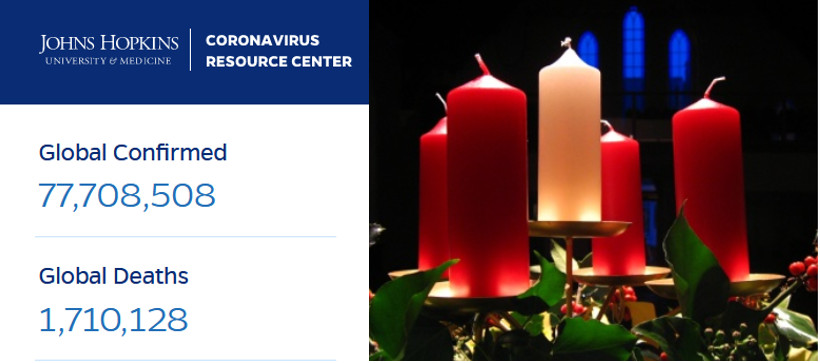
Coronavirus week 39 – Advent hope or Christmas cancelled?

It is 20 weeks since I did my last blog, or ‘CoronaDiary’ as it was named for the Swansea University project that it became part of. It seems a long time ago but serves to show how time passes quickly after I decided that the time had come to stop, with things apparently starting to ‘slow down’, ‘getting under control’, ‘living with the new normal’ or any number of ways of describing life in late summer/early autumn. There was also a possible vaccine in development.

I started several times to write another instalment as events and key points in the story of this year were reached, but each time my enthusiasm to finish them waned. Due in part I suspect to not wanting to repeat the same themes I had visited before, but mainly due to the fact that we too were doing some of the things we hadn’t been able to. We were fortunate to be in a situation where we could take a week away to each of the Norfolk coast, Cornwall and North Yorkshire. In addition we enjoyed days out walking around the Cheshire countryside and Alyson managed some open water swimming at a nearby lake in Shropshire. The project I am working on with the accountancy practice in Sale was reaching the critical ‘go-live’ point, and Alyson was getting more NHS 111 home-based call centre shifts.

Deaths – a change of measure but still increasing quickly..

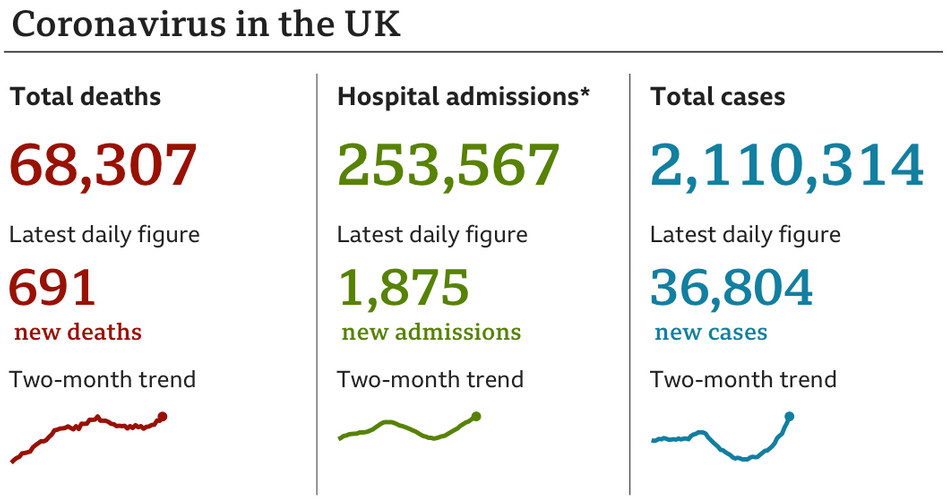
I had set myself the target of writing another blog when the official figures for the number of coronavirus deaths reached the level they were at my last blog, as the government reassessed them, just after I published it, in light of some ‘mis-recording’. On 12 August, the total fell by 5,000 overnight from 46,706 to 41,329. Until then a death was recorded for anyone who had tested positive for Covid-19 at any time, regardless of the cause. So someone who had died of a heart attack or in a car accident but had a positive test 10 weeks before was added to the virus statistics. It would take another 11 weeks to get back to 46,513 at the end of October – an average of 71 deaths per week. Just over 7 weeks later we have surpassed the grim figure of 60,000 to reach 68,307 – an average of 3,113 per week. The other measure of all deaths where coronavirus is mentioned on the certificate is likely to be over 80,000 by the end of the year.
Key events I could have written about…

There have been some major issues and milestones in the time since my last blog. Ones I have had strong feelings about are;
– The exam results ‘fiasco’
– The on-going story of migrants drowning whilst crossing the channel, and my idea of requisitioning unused cruise ships anchored off the south coast to give them decent accommodation.
– Introduction of the tiers system of restrictions
– My (and many others) perception that GPs are hiding away
– Schools and universities returning to full-time teaching
– A study I read on how the virus circulates indoor via ‘aerosol particles’
– ‘Circuit-breaker’ or second national lockdown
– President Trump catching Covid-19, US Election & refusal to accept the result
– Announcing the vaccination program earlier than planned on the day the report into the Home Secretary Priti Patel’s bullying behaviour was published.
– The seemingly endless Brexit negotiations/deadlines and extensions.

So why now…

The recent excitement over the new vaccines, the hope that brings of a ‘light at the end of the tunnel’, allied to planning for a small family Christmas get together was shattered by yesterday’s Government Briefing. Our Prime Minister, the only one in the World known mainly by his first name, Boris announced a new ‘Tier 4’ for London and the South East plus severe restrictions on ‘Christmas bubbles’ and the time they are allowed to meet. It seems like another one of the many ‘key points’ in the pandemic, coming as it does with the fact that a ‘new strain’ of the coronavirus that is much more effective at transmission is circulating and spreading rapidly through the population. The disease is called Covid-19 because it was in late December last year that the WHO office in China reported a ‘new type of pneumonia virus’ being reported in the area around the city of Wuhan. Whilst there is still some dispute about where it originated, the virus has been traced back to cases in mid-November. The first anniversary of the discovery of what we now call SARS-CoV-2 seems like a significant event to record in my blog.

For those with an interest in the science, the new variant is being referred to as SARS-CoV-2 VUI 202012/01 and the more detailed description of the mutation is as follows;

This variant has a mutation in the receptor binding domain (RBD) of the spike protein at position 501, where amino acid asparagine (N) has been replaced with tyrosine (Y). The shorthand for this mutation is N501Y, sometimes noted as S:N501Y to specify that it is in the spike protein. This variant carries many other mutations, including a double deletion (positions 69 and 70).

US Centers For Disease Control and Prevention, Emerging Variants Briefing December 2020.

It is this variation in the ‘spike protein’ that scientists think accounts for its ability for increased transmission by better binding to cells in people who get infected by the virus. It remains to be seen if the symptoms are more severe or if it is resistant to the vaccine, but the early signs are ‘hopeful’. What will certainly be the case is that the number of infections will rise and given the pattern up to now, many people will need some treatment in hospitals. This is the factor that may lead to ‘Lockdown v3.0’ and more damage to mental health and the economy.

In recent weeks I have been leading four sessions on the season of Advent with our church Bible study group and there are some themes which resonate with the current situation. As we approach the end of an extraordinary year and try to look forward to 2021 it seems an opportune moment to write down my personal thoughts and feelings. This blog has always been for my own reference, but I continue to be grateful for all the comments it attracts as each one is published.

Advent – the season of waiting – 2020 theme ‘Hope’….

It is only in the last few years, after 50+ years of being part the ‘Methodist Tradition’ through my church membership, that I have understood the ‘true meaning’ of Advent. For many it is ‘just the few weeks before Christmas’ but it is so much more than that. It is a time of ‘waiting’ and ‘anticipation’ during which we are called to lament/repent for all that has gone before and wait for the arrival of the long-promised ‘Light of the World’ to arrive in the form of a small child. Our fellow Christians in the Church of England, or ‘the Anglican Tradition’ recognise this in a more formal way. In the build up to Christmas they don’t sing ‘traditional carols’ and for them Christmas starts on the eve of the 25th December. It lasts for 12 days until Epiphany on the 6th January.

This year in the ‘real world’, the commercial one and the one that the church has hijacked from the original pagan ‘winter festival’, after all the upheaval of Covid and the challenges and illness and death, there has been a desire to ‘go early’. When I worked in retail pharmacy we would have started to plan for all the Christmas stock arrival earlier in the year. Indeed, during my time as Managing Director of our ‘Pharmacy Sundries’ subsidiary company, January would see me and the sales team attending trade fairs in the UK and Frankfurt in Germany, to meet suppliers from all over the globe to purchase, and in some cases ‘design’, the gifts our stores would sell during the ‘Christmas Season’. Stock would be ordered, shipped from China or India or wherever the suppliers were based, duty paid, containers received and unloaded at the warehouse, and delivered to the shops by a small fleet of vans ready to fill the shelves. There was always a tension between the warehouse wanting to get stock out (and our small company to invoice the larger one!) and the shops saying it was ‘too early’. In the end together with the retail marketing team for the shops we agreed a rough policy that, whilst stock could be delivered during September the, ‘big reveal’ would happen after the solemn celebration of Remembrance had taken place on November 11th. After that it was ‘all hands on deck’ to shift as much as we could. On a really good year our shops would be calling the warehouse in the second week of December pleading for us to send more – the items we had chosen that they were sceptical of selling were flying off the shelves. In the last week it might get to the point that shoppers were so desperate for a gift that even the stock we had left from previous years would look like the ideal gift for a family member!

It seems that a lot of people after the year they have had decided to ‘go early’. There was a rush to put up Christmas lights and decorations not just earlier but in bigger volumes than before. Around our estate there are so many whole garden displays and inflatable characters they can probably be seen from space! Goodness only knows what the electricity bills will be like in January. Shops have sold out and many Christmas tree growers have shut as all the stock has gone. There is an understandable desire from people wanting to celebrate and have something to look forward to. I confess to liking it, but it can get a bit wearing listening to hours of the old pop Christmas favourites from the 70s and 80s.

The theme for the Advent study we chose this year was ‘Hope’ which seemed appropriate for the year and is one aspect of the season along with joy, peace and love. As churches we have readings about John the Baptist and the Old Testament Prophets foretelling the arrival of The Messiah, the story of Mary and the journey towards Bethlehem. Many of us light four candles (and many ministers refer to the classic sketch on The Two Ronnies!) coloured red in an Advent wreath of holly, lighting the fifth white candle in the middle on Christmas day to represent Jesus. .

In many of our times of study we referenced the difficult times we have had during the pandemic. We would lament people we have lost, pray for support for those going through difficult times, missing friends and family contact, particularly those who know people in care homes or have not been able to attend the funeral of a family member. We have given thanks for the key workers helping us through difficult times. More recently we have given thanks for the God-given skills of the scientists for developing the vaccines, the hope that brings and the ability to start ‘looking forward’ in anticipation of a better 2021. Many of the Christmas cards we have received, had a handwritten note to reflect this hope too.

Watching Boris, Professor Chris Whitty, Chief Medical Officer and Sir Patrick Vallance, Government Chief Scientific Adviser on Saturday evening announcing the new ‘Tier 4’ measures, and limiting even more the Christmas travel and bubble arrangements, it would have been easy to find a new low of depression, and lack of optimism. Sunday morning’s news headlines on television and in the print media could be summed up as ‘Christmas Cancelled’. During the summer and into the early autumn with infection rates falling, deaths levelling-off to a figure that we could probably live with, health services opening, people going back to work and children to school, things appeared a little brighter. Despite having to take a lot of measures on our holiday in Norfolk and again when we went to the lodge in Great Ayton, North Yorkshire, and the early figures for the ‘second wave’ seeming not to be as high as the first, my optimism was still there.

It was whilst ‘attending’ (via You Tube) the live streamed service from Methodist Central Hall Westminster (MCHW) on Sunday morning that I decided to write this blog. MCHW of course is now in Tier 4 so the chances of a few people attending the church physically on Christmas Day has gone. The reading was about Mary and her willingness to carry the child that would become our Saviour. We sang Joy To The World and O Come All Ye Faithful and accepted the challenge from Rev Gordon to take up whatever challenges we will face in the coming months. Both Gordon and Rev Tony who leads the service said that although we were in lockdown, Christmas itself wasn’t cancelled. Tony said he had received a humorous text about there being ‘only 370 more sleeps to Christmas’ but he wanted to state that wasn’t true. I posted the image below on my Facebook page on Monday and it attracted many likes…

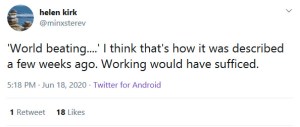
The commercial ‘winter festival’ may have been curtailed and many would not be able to see family and friends, but nothing is going to stop Christmas being Christmas for Christians. It brought to mind this tweet from earlier in the week reminding us that other religions had their celebrations ‘cancelled’ at even shorter notice – in some cases the evening before the big family gatherings.
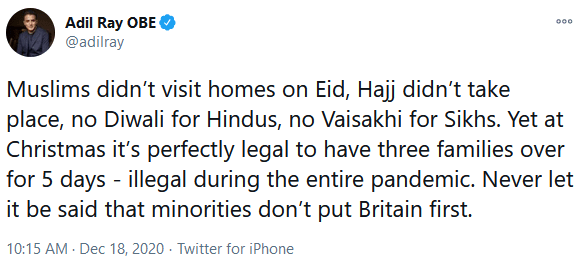
Admittedly, some replies pointed out that Easter was ‘cancelled’ at the start of lockdown and, as happens on social media these days, there were plenty of racist comments, but the point was the same one I had made the night before Eid. ‘Imagine the uproar if they cancelled Christmas…’

The most striking interview I saw on Sunday morning was with Rev Justin Welby, Archbishop of Canterbury on the BBC’s Andrew Marr Show. It appeared to me that the leader of our national church was shaken by the events of Saturday and, like many of us, struggling with an inner voice that was saying to him ‘I am really not sure that my faith is strong enough for this…’. But he found another inner voice and rallied to assure us that Christmas would indeed happen on the appointed day. He also talked movingly about the ‘hole in the celebration’ left by those who can’t be with us, either because they have died or are alone in a place we can’t travel to. He encouraged us all to celebrate the great festival by remembering those who have died, talking about them, and for those who are isolated to pick up the phone and speak to them. He encouraged the vulnerable not to attend church but to call one of the many phone numbers with services, carols or prayers being broadcast.

Some of the many people with a spare place at the table are the family of our school friend Clare who died in November aged just 61 from motor neurone disease diagnosed five years ago. Clare is the first of our contemporaries that we have kept in touch with for over 50 years to go. It is as much a sobering reminder of our own mortality as it is sad. It was also our first (and probably not last) ‘virtual funeral’, we watched the live stream whilst listening to the music chosen by Clare herself on You Tube.

As I sang along watching the service from Westminster to O Come All You Faithful I remembered the Christmas of 2016 when my dad died. We were celebrating at a cottage on the North York Moors with Alyson’s family. Dad was on end-of-life care in a nursing home nearby, and died the day we were leaving the cottage. You can read about that in the blog that I wrote at the time . I asked the minister if we could sing the hymn at dad’s funeral as he was a long-time member of the church choir and hadn’t managed to sing it that year. Rev Ruth said that it was a great idea and all we needed to change was the last verse usually sung on Christmas Day from ‘Yea we greet thee born this happy morning’ to …that happy morning..’. Alyson’s dad who was 90 and not in good health gave a short speech during Christmas Day lunch suggesting that this might be the last one he had with us. He died later that year in October.

So we had two Christmases in a row with spare places at the table. Such is the ‘circle of life’, we have lost Alyson’s mum since, but this year we have two small boys born to our nieces since. They represent the joy, love and hope of the Advent season.

Final thoughts and looking to the future…

There will be three households with us on Christmas Day, but only four people – Alyson and I, and our two sons who are single-person households. We will social distance as much as we can and maybe even eat outside. Other than that we have several ‘Zoom’ catch-ups planned with other family members and friends. We had one last weekend with my brothers and cousins (my older brother lives in San Jose California, 6 miles from the global Zoom HQ so was supporting one of his ‘local businesses’!). We have had one ‘virtual Christmas party’ with the head injury charity I am a member and trustee of. Ready-made meals were delivered along with a box of crackers, hats and gifts. We played charades, told jokes from the crackers and even tried to sing some carols. A great time was had by all who attended.
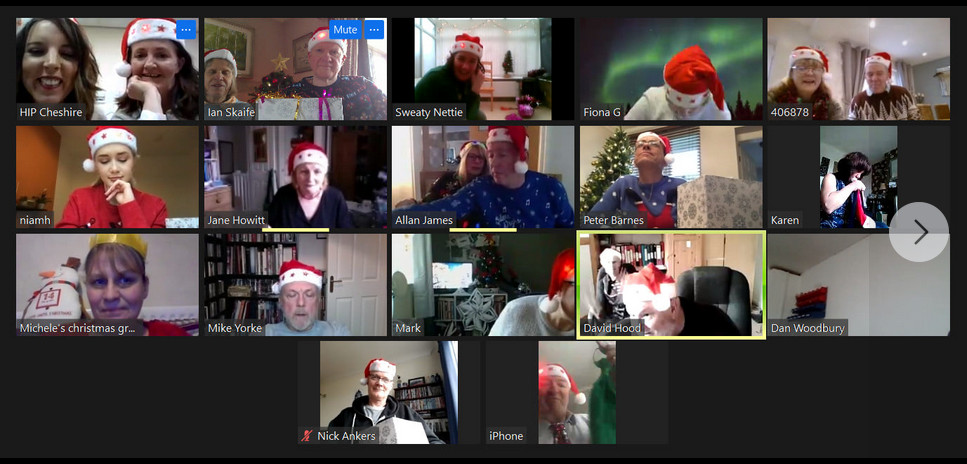
I heard from another friend that the company he works at had a ‘Zoom office party’ that started at 8pm and for some people went on until 6am. Apparently, the ability to drink and not have to drive home led to some problems with people saying and doing things that they would regret when reading the ‘chat’ the next day. So it seems a virtual party can be as good or bad as a real-world one!

I like to think I have always been generally an optimistic person, trying to see the positive in both situations and in people I meet. Alyson thinks I am a bit too laid back and even naive, and reminds me that earlier in the year I was still hoping that we would be able to get a sunny holiday overseas and was one of those who said it would be all over by Christmas. I try to find hope in the vaccination program but recognise that our governments record for ‘ramping up’ the testing capacity could induce pessimism that our ability to vaccinate the estimated 16.5 million people aged over 60. To get this done before Easter, considering the five weeks to achieve full immunity, will require an average of two million vaccinations each week. There have been half a million people vaccinated in the two weeks since 90-year-old Margaret Keenan became the first person on 8 December. We need an eight-fold increase in that rate if we are to reach the Easter target.

As I reflect on the end of a very strange and difficult year, my faith is strong, and my optimism remains at a high level. The hours of daylight are increasing from today, and I am looking forward to 2021


Coronavirus week 19 – That didn’t last long…second wave starting

A short heatwave but signs of another wave of infection.

According to one of the weather forecasters I heard, to qualify as a heatwave there needs to be a period of three days of higher than average temperatures, but ours this week was only one day. It was 20-21 degrees on Thursday and reasonably sunny, by Friday afternoon it was 35 but by the evening it was cloudy muggy and raining and on Saturday it was back to 21 with a cool wind and some showers.

At the end of my last blog I suggested that I may not do another for a few weeks as things appeared to have reached a ‘steady state’, with falling numbers of deaths and a ‘levelling off’ in the number of infections. That idea didn’t even last for 24 hours. It wasn’t that a couple of people were kind enough to comment on my Facebook post saying that they enjoyed reading them; it was watching Channel 4 News on Monday evening.  It’s a way of getting updated on current events that I get the most from. All day ‘rolling news’ is a great thing, something we never had in ‘the good old days’ when there were only three or four terrestrial television channels. The problem is that even  BBC News 24, whose coverage I also enjoy, only touch the surface of a story. I don’t want to sound like a ‘grumpy old man’, but programme makers appear to think we are incapable of listening for more than 90 seconds, or in ITV’s case, that we also need the chance to win a £150,000 prize of gifts we probably don’t need.

Anyway, it was watching the news on Monday evening that there were so many items I wanted to write about, many of them linked to each other or to coronavirus. Hence this blog with all the topics originating with the items on that edition.

Holidaymakers returning from mainland Spain complaining that there were more cases of the virus on one caravan park in Shropshire, than the whole of the Balearic Islands, and they felt safer in a country where everyone was obeying the rules on social distancing and hygiene. By the evening, the islands had been included. Transport minister Grant Shapps went to Spain but had to isolate when he came back on Wednesday. I admit to thinking that I would go if insured, and suffer two weeks quarantine or extend the holiday as I was sure there would be extra capacity. By the end of the week, however, as local lockdown was declared for large parts of Greater Manchester, Lancashire, and West Yorkshire, like others I suspect, I was more doubtful.  I listened to arguments about having to declare whole countries as giving a simpler message than trying to exclude certain areas, and had to agree. Whilst the Canaries are further from mainland Spain than Venice is from London, it would not be difficult to get around the rules by taking a flight from the mainland to the islands and return from there. There is also the danger of catching the virus and having to be in hospital in a foreign country possibly for a long time where the care may be excellent, but my Spanish is almost non-existent.

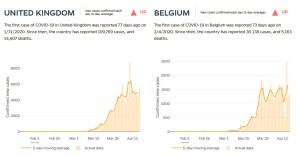
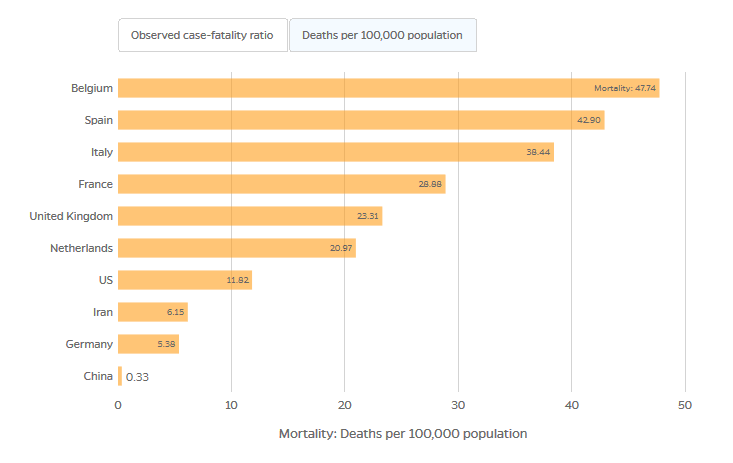
Despite early criticism there appeared to be more acceptance later in the week when the rates of infection in Belgium (which had one of the highest rates in Europe in the earlier part of the pandemic), and Luxembourg, were rising very quickly. It seems a ‘second wave’ is starting to spread across Europe.

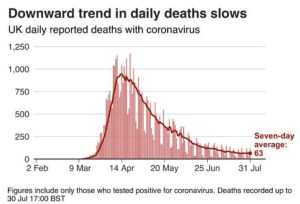
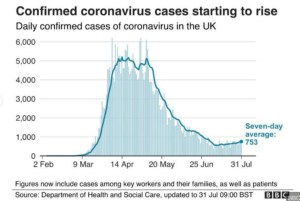
In the UK cases were definitely rising with average daily cases approaching 800 at the end of the week. The fact that average daily deaths was still falling to about 60 at the end of the week, could point to two things; that the lag between cases and serious illness is not showing yet, or that it is mainly younger people getting infections and they don’t generally suffer with the more life-threatening symptoms.

Boris says ‘get on your bike’…

Boris encouraged us (like Norman Tebbit in 1981) to ‘get on our bikes’, but this time not to look for work, but in an effort to fight obesity. The web site handing out free £50 vouchers to get bikes repaired crashed due to demand. Not surprising for £2.5million of untargeted benefits. Many would be snapped up by those who could well afford to repair the bicycle that had lain neglected in the garage for years. It all seemed a bit of a headline-grabbing gimmick. Boris has previous on this topic. As Mayor of London he encouraged people to use a Transport for London (TfL) scheme for hiring simple bicycles parked in many areas in the city to travel to other areas. Registered users could take any of the 5,000 cycles from any of the 315 docking stations in central London to any other for a relatively small fee. This was in 2010 and proved successful. The original bikes were sponsored by Barclays bank with a blue highlight. The scheme was transferred to Santander bank with the current ones mainly red and there are now 11,000 bikes and 800 ‘stations’ spread across 40 square miles of London. 

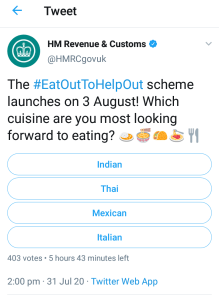
In a week of mixed messages I had one alert from GOV.UK announcing a ban on buy one get one free offers on unhealthy food, and the next one reminded me that I could go to the pub or restaurant and taxpayers will give me 50% off any meal. This is for as many times as I like. So presumably I could get a first course with chips, followed by a chocolate brownie/ice cream / sticky toffee pudding (with extra chocolate sauce) for 12 days (it’s only Monday-Wednesday) from 3rd to 31st August. All washed down with a nice glass of wine or beer – but don’t worry the discount is not off those and they don’t contain many calories. Even HMRC were putting out Tweets about the offer – even if they couldn’t bring themselves to think people might want other European or even British menus…?

The idea of making it a requirement to put calories on all restaurant menus is a good one, but many pubs and fast-food sites do that now. The problem appears to be the ‘education’ needed to allow us to make the healthier choices.

Channel 4 News had an interview with chef Jamie Oliver (who also has years of campaigning for us to make more healthy choices. He made the point that the good quality food is more expensive, and those with less money can only afford the ‘less good’. Rather than taxing sugar, he suggested that perhaps we should be subsidising healthier food.

It could be that this approach to obesity, exercise and healthy eating was related to Boris’s own experience of Covid-19 and the realisation that his own health may have meant not seeing his fiancee and young child? There are many in the Conservative Party who decry the so-called ‘Nanny State’ (itself a posh expression), but a government that claims to have been ‘following the science and experts’ appears in the past to have paid more attention to the food and drink industry lobbyists than ‘health experts’ when deciding policies. Like tobacco before it, the ‘curse of sugar’ needs mass cultural and social change if it is to be effective.

What it doesn’t need is ‘fat-shaming’ and judging people by their apparent excess weight. The majority of our population have some problems maintaining a healthy diet. No one wakes up one day and finds themselves several stones overweight.  The busyness of our lives and availability of cheap food make it hard to change. I have the luxury of a good income, the space to own an exercise bike, and a pleasant area go out for a run. In my case I have made a conscious decision to change, and am currently about a stone less in weight than I was at the start of March. I also know it will be a struggle to keep this way once we get back to eating out again on a regular basis.  I often wonder how people in poverty-stricken countries who have to walk miles to get clean water or a meagre amount of food to take back to a house with no electricity, would make of our kitchen cupboards and American-style double refrigerators. As if that wasn’t enough for them to take in, imagine trying to explain that we then pay a membership of £360 a year for the privilege of driving, three or more times a week ,to a large warehouse full of bicycles that don’t move and treadmills. All in an effort to lose the excess body mass we have!

The next item of news last Monday was one on rehabilitation from the after effects of having Covid-19, or one of its variants dubbed ‘Long Covid’, as the fatigue and memory issues and muscle weakness can last for months (maybe even years, we don’t know yet). The item showed a group using a gym closed due to lockdown, and sharing experiences with people who have been through the same thing.  This is just like my journey after brain injury, when I found the charity that brings together people from all parts of society and background to share with each other. Access to physio and rehab services across the country is patchy at best, but so vital. All of this should have happened years ago. There is a small charity that works with people who have been in intensive care for long periods of time. Patients may be physically well, but the mental effects can last a very long time.  If this step of physio is missing or not done thoroughly, there is more of a cost to the country in terms of lost working days and productivity, as well as actual treatment, medicines, and care in old age. It makes no sense health wise or economically, not having these services readily available for everyone.

The final two articles on the Monday evening news was one that US president Trump’s security advisor had tested positive, after a trip to Florida ,where there is a rise in cases of Covid-19.  Then that Brazil’s president Bolsanaro has been reported to the International Criminal Court, by an umbrella group representing health worker unions and social care organisations, for ignoring and mishandling the crisis. Their claim of crimes against humanity amounting to genocide are unlikely to be taken on by the ICC but demonstrate the strong feelings in the country.  There was an interview (on BBC news!) with a doctor in a hospital in Sao Paulo stating that they had people turn up at hospital still claiming it was all false and a hoax – but when they ended up in intensive care they say ‘doctor don’t let me die and tell my family to take care!’ 

Other news last week.

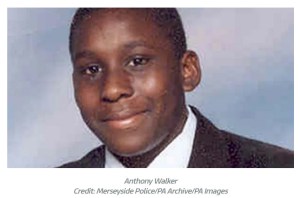
  • We watched Jimmy McGovern’s powerful drama imagining the life Anthony Walker a young black man killed aged just 18 in 2005. He wanted to become a barrister. His mum asked the writer to show him qualifying against all the odds, marrying his (white) girlfriend at the time of his death, having a child and saving his best man from a life of crime by taking him to live with his family after becoming destitute. It brought me to tears. 
    Anthony’s mother, Gee Walker, has setup a trust in his name and as a Christian she believed this was part of Anthony’s legacy.  This will be something that is hard for those without a faith to accept. But I believe, as his mother hopes, that despite not becoming a civil rights lawyer and going to America, Anthony’s legacy through the work his mum does, and the effect of this drama, means more people could be touched. Some small comfort to his brave mum.
  • Late Thursday evening health secretary Matt Hancock announced that Greater Manchester, East Lancashire and parts of West Yorkshire were told to go into a ‘local lockdown’. This was due to a ‘spike in cases’ from people going into each other’s homes. There was some confusion and a great deal of contention from the Muslim population as it was the eve of Eid one of the major feasts of Islam. One leader likened it to cancelling the Christmas Day at 9 o’clock on Christmas Eve, although another did acknowledge that when the original lockdown was imposed many Christians had to miss Easter Day celebrations.
    Writing as someone who is doing project work for a company in Sale, there was concern that some members of the team who had only returned to work because their parents could look after the children again, may have to go back on furlough until the lockdown was over.
  • Another member of the team at the company developed some symptoms and was relieved when their test came back negative – but they had to wait over 3 days for the result.
  • One report from Manchester showed a street where many of the rainbow posters drawn to put in windows to celebrate the NHS Heroes were faded and torn….perhaps a sign of how quickly we forget?
  • One of the most worrying statements last week was from Professor Chris Whitty as he stood next to Boris Johnson at a Downing Street press conference on Friday announcing that the opening of face to face beauty treatments and bowling alleys was to be delayed for a further two weeks at least. He said

“I think what we’re seeing from the data from ONS, and other data, is that we have probably reached near the limit or the limits of what we can do in terms of opening up society.

“So what that means potentially is that if we wish to do more things in the future, we may have to do less of some other things.”

He expanded to say that if we are to get children back to school in September we may need to close some other places (pubs perhaps?) or put new limits on what people can do and who they can meet.

It really does feel this week that we are not in a ‘steady state’ anymore….!

How was week 19 for us?

After weeks of training and struggling with IT and ‘HR’ Alyson finally managed to book a few shifts on NHS 111 service…but only as reserve. She responded ‘I don’t want to be a reserve I want to be on the first team!’ Her wish came true on Friday when she was given just 20 minutes notice that she was working an 8-hour shift. This was due to late cancellations by two other people on the shifts. The deal is that people are supposed to get 24 hours’ notice. So, she managed to cancel one and worked 4-8pm. It was a tough shift, not only with the types of call, but using the systems for the first time. Reflecting afterwards Alyson felt that she had helped people at a difficult time, and knew that the next shift(s) would be better.

We both signed up as volunteers for vaccine trial in conjunction with the NHS and a pharmaceutical company. Unlike last week’s attempt we both passed the age & health requirements.

After the very warm day of Friday we went to Coventry for a ‘socially distanced picnic’ in a large park to meet up with Alyson’s sister and brother and their families in  Coventry. It was good to see everyone again including our two boys and our nieces. There were three generations and one of our nieces is expecting her first child in October  – she works in a hospital so was concerned about getting too close to us, but I think she enjoyed the day. The only member of the family who couldn’t come was our nephew who returned from the Spanish Balearic Island of Majorca so was self-isolating in his London flat.

On Sunday I attended my now weekly Zoom service at Westminster Central Hall Methodist Church. It was great to be part of a ‘congregation’ of over 1,100 people sharing in worship. Rev Howard Mellor gave an amazing sermon on the ‘original picnic’, the feeding of the 5,000, a miracle told in exactly the same way in all four gospels. Howard pointed out a small word that I had not noticed before – grass! Despite the disciples only having meagre rations of five loaves and two fishes, and thinking that was not enough to feed the crowd, Jesus managed to make it sufficient for all the people (more than 5,000 when including the women and children) and ‘still there were 12 baskets left over’. All this in an area which, because of the grass, was clearly a place of abundance where crops could grow. Howard’s message to those of us hoping to be modern day ‘good disciples’ was however little (in terms of skills and gifts) we think we have, if we give it to Jesus, he can help us achieve so much more than we ever believed.

Stay safe and let’s see if there is enough for another blog next week!

Coronavirus week 18 – the long wait for a vaccine

Will it be the scientists or anti-vaxxers who stop us getting a vaccine?

For the first time in the last 18 weeks of lockdown I found myself agreeing with Boris Johnson. He was visiting a GP surgery in London to promote the importance of flu jabs in the upcoming winter. Referring to the opponents of vaccinations he called them ‘nuts’. Ever since (the then doctor) Andrew Wakefield persuaded many parents 20 years ago not to give their children the measles, mumps and rubella (MMR) vaccine following some ‘research’ linking it to autism and inflammatory bowel disease (IBD), the use of vaccines has been called into question. 

Researching the claims by (now struck off doctor) Wakefield I learned the following facts from the General Medical Council (GMC) fitness to practice hearing of 2006 published in 2010.

  • A good study will include many participants, and Wakefield’s study included only twelve children.
  • Wakefield lied in the Lancet paper when he wrote that the participating children were referred independently after being diagnosed with IBD or other major gastrointestinal issues. In fact, many of the children were chosen specifically by Wakefield, and others were recruited with the help of the same lawyer who was paying him to conduct the study.
  • Even before publication of the study, Wakefield was working on patenting his own version of a measles vaccine, which he would sell at a great profit as a supposedly “safe” alternative to the MMR vaccine. The father of one of the children in Wakefield’s study was a cofounder of the planned business that would market this product.

The problems caused by Andrew Wakefield were in the news last August. Children who didn’t get vaccinated as their parents listened to him and not their doctors were now students, and an outbreak of measles was happening leading to serious side effects. The UK along with other parts of Europe has lost its status of being ‘measles free’.

The cofounder of Microsoft, Bill Gates and his wife Melinda are an example of people who have acquired enormous wealth, but are trying to use that to help others. They have been victims of terrible social media attacks and conspiracy theories as a result of pledging literally billions of dollars to vaccination programmes for children. They are partners of Gavi a global alliance of the WHO, UNICEF,  The World Bank and donor countries with the aim of funding vaccination programmes for children in all areas of the world. This will improve health, prevent needless deaths and lead to less poverty. In June a little-reported summit of world leaders was hosted by the UK and pledged over $8billion over the next five years to the programme.

The UK can be proud of being the largest donor pledging £330million a year. As Bill Gates said at the time

To beat the COVID-19 pandemic, the world needs more than breakthrough science. It needs breakthrough generosity. And that’s what we’re seeing today as leaders across the public and private sectors are stepping up to support Gavi – especially Prime Minister Johnson. When COVID-19 vaccines are ready, this funding and global coordination will ensure that people all over the world will be able to access them.

In recent weeks Russia (who pledged no new money in addition to the $4milion per year share from a previous campaign) have been accused by the UK of trying to steal scientific secrets on the development of a Covid-19 vaccine. China, who also only pledged $4million per year, are still being accused as a possible source for the current outbreak. 

To be clear, the pledges are for vaccinations of all types and not just Covid-19. Since 2000 over 760 million children have been vaccinated against polio, pneumococcal disease, typhoid, MMR, meningitis and rotavirus (that causes diarrhoea). However, the lockdowns in various parts of the world and the WHO advice to temporarily suspend vaccination programmes, to prevent people from spreading Covid-19, could lead to an estimated 6,000 children dying every day from lack of protection that vaccination provides. It’s a terrible dilemma for many countries’ health systems.

Their personal $1.6 Billion pledge hasn’t stopped the conspiracy theorists putting false information out about Bill & Melinda Gates, accusing them of wanting to use the programme for mass sterilisation to control world population, and even implanting a microchip as part of the programmes, to track everyone in the world.

This week DHSC announced that eligibility for the programme of flu injections for the coming winter has been extended to 30 million people in an attempt to prevent the NHS being overwhelmed by a flu pandemic and a second wave of Covid-19. We have had years of creating vaccines for seasonal influenza which is a slightly different strain each time, but even these aren’t always fully protective, but can lessen the severity of symptoms and reduce the rate of infection. 

We have never succeeded in getting an effective vaccine against any of the coronaviruses. Even with about 150 programmes to develop one and almost 25 starting human trials, there are questions to be answered  before getting one. Here are seven according to an article I read this week.

  1. Is the vaccine safe? Early results suggest that there can be mild side effects from the vaccines, but more worryingly these can we worse in those more likely to be affected by the actual virus – the elderly and those with comorbidities. It is possible that a vaccine could make the disease worse in those who have it already.

  2. Does the vaccine work? The general view is that it is unlikely to be completely effective and Professor Chris Witty has said that at least 50% would be a good result.

  3. Will protection from a vaccine fade over time? There was some excitement when the vaccine being developed at Oxford produced the type of reaction expected, but it could be that this fades after a few weeks or months. However, there is also a theory that some element of ‘immune memory’ could result that helps the next similar infection.

  4. Can we mass-produce it? Whilst the UK Government claims to have pre-ordered 100 million doses and be investing £150 million in new production facilities, there will be a long timescale. Some vaccines need to be stored in specials conditions such a low temperatures before being given. This could also be a challenge both in transportation and worldwide in countries with poor facilities and health systems.

  5. When will we really have a vaccine?  Are we talking about when we have a proven vaccine after clinical trials, when it is approved by regulators, when we have enough to give it to key workers in clinical settings and then those at greatest risk, or when we have enough to inoculate the whole world?
    There is a danger that if supplies are strictly limited only those who can afford it, or have the political leverage to get it will be treated. This will only exacerbate conditions in the rest of the world who can’t afford it – and the virus will be around for even longer.

  6. Once we have a vaccine, will people want to get it? So we come back to the anti-vaxxers or even those who are just cautious. In a recent poll about one in five Americans said they don’t plan to get a coronavirus vaccine, while half said they would. The rest were unsure. The US has a system where people need to pay or have insurance, so even in the richest country in the world cost could be a barrier.

  7. What about booster shots? It is likely that any vaccine could need more than one dose to maintain effectiveness, so all the points about cost and organisation of healthcare systems come back into play.

There was an appeal for volunteers to take part in the clinical trials for vaccines produced by Oxford University and Imperial College London, so I thought I might offer – but although I am fairly fit and healthy I am over 55 so that was the end of that.

Vaccines aren’t the only treatment and this week again there have been trials of a new therapy based on a protein called interferon beta that have shown promising results when given as an inhaled dose. This was previously shown to have been effective for the treatment of SARS.

Other news this week.

  • A couple of months ago when the government was recruiting 25,000 people to train up to ‘track and trace’ contacts of those who had a positive test for the virus, there were newspaper stories of them having so little to do that they were watching Netflix movies. A story emerged this week that could have been interpreted in a way that could have suggested these people were making their own work. It was an ‘international’ story too.
    The English NHS ‘test and trace’ system has been outsourced to a US company that uses call centres based in Scotland.  Eight of the Scottish workers there tested positive for coronavirus, meaning that the Scottish system, called ‘test and protect’, had to get involved to trace their contacts – you couldn’t make it up!
  • In an interview on the anniversary of taking over as leader of the Conservatives and moving into 10 Downing Street, Boris Johnson admitted that there were some ‘open questions’ to be answered about the handling of the crisis in relation to timings of lockdown and protecting care homes. There was a less than generous video doing the rounds on social media claiming that as the virus was spreading across the world Boris missed several COBRA meetings, was uninterested in briefings and more interested in throwing a party to celebrate ‘getting Brexit done’.
  • Whilst the school holidays had started and some people were enjoying time in Spain, on Sunday morning all four UK governments brought back measures for people returning from the country to isolate for 14 days on their return. Despite FCO advice that travel to the Balearic and Canary Islands was still allowed, and only that to mainland Spain was not recommended, people returning from the islands still had to isolate. Such measures had been on the cards, but the suddenness and extent caused some controversy with many people again unsure of their holiday insurance situation. Many will also lose money as not all employers will be sympathetic to them taking more time away from work.
  • The number of cases is still falling very slowly with average daily deaths at 64 by the end of the week, down 8% from last week. The number of daily cases was averaging 662, which is up over 6% from last week. We are definitely plateauing but possibly to a sustainable level to live with as a trade off for an economic recovery.  Total deaths reported for the outbreak was 45,752.
  • At the same time as gyms and swimming pools are allowed to open, the government was trailing an old idea of getting doctors to focus on reducing the levels of obesity in the country. This is one of the key factors that makes people particularly susceptible to severe symptoms of Covid-19, as well as being bad for general health. Laws on advertising junk food will be brought in and GPs will be allowed to prescribe 12-week health plans and exercise.

How was week 18 for us?

It was back to work for me with planning for the project I am doing with the accountants in Manchester. The pressure is on to complete the first stages of the system in the next three months. We are not planning to be away on holiday any time soon so this should be manageable.

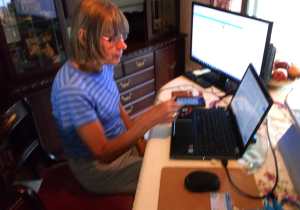
Alyson continued to come close to getting a first shift with NHS 111 pharmacy advice service. She had more technical problems but at the end of the week all appeared sorted and this is a photo of her ‘mobile call centre with a laptop with connection to the NHS systems, two screens, a smartcard and a mobile phone system that allows her to call patients using an NHS number.

In the week more sports opened up, I was pleased to be able to follow some Major League Baseball (MLB) as the team I support the Toronto Blue Jays started a shortened season in empty stadiums. As the only team in MLB outside the US, the Canadian authorities would not give them permission to play home games in Toronto as it would mean them crossing the border to play away games and US teams crossing to play at Rogers Centre in Toronto. Right up to Opening Day on 23rd the team had no base, but then it was decided to play games at their minor league team’s base in Buffalo in New York State. Their first series was away in Florida, so they need to get the stadium ready for the first home series, which was to be next weekend but has been put back until 11th August.
My other sports team, Middlesbrough football club managed to survive in the Championship on the last day of the season on Wednesday – ironically away at Sheffield Wednesday. Two teams previously managed by World Cup winner Jack Charlton, whose funeral was the day before.

Keep safe everyone and let’s see what the next week brings.

I am thinking about stopping this blog for a few weeks as the situation in the UK appears to be in a steady state.

Coronavirus weeks 16 & 17 – will it all be over by Christmas?

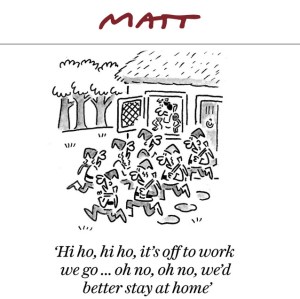
Hi ho, hi ho, it’s off to work we go..

I couldn’t decide whether to title this blog ‘it will be all over by Christmas’ or the one I settled on. Unlike Boris Johnson and his government, on balance I decided to ‘trust the scientists’.  There are still too many unknowns to be sure. I acknowledge that the recent announcements were a ‘hope’ rather than an assertion, and one role of government is to ‘get the economy going’ in order to raise the funds needed to do all the spending needed, and there will be harm to health if there is mass unemployment and economic hardship.

The dilemma was summed up by Matt Pritchett’s cartoon in The Telegraph newspaper on Saturday.

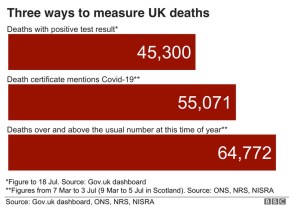
Alyson asked me how I felt about the announcement and I replied honestly that I was conflicted. On the day when the statistics on deaths and new cases were also thrown into confusion (or to be precise more confusion), this added to my uncertainty. I have looked at statistics in an earlier blog, and whilst the figure for ‘excess deaths’ produced by the ONS is a more reliable figure, I have stated the daily announced figures from the government briefings in each blog. I am no longer able to do that as they are no longer being declared. It seems that we have been counting as a ‘daily death’ in England if someone dies of any cause but had been tested positive in the last few months. The example used was somebody having a positive test in March and then dying from a heart attack in June. The effects of any ‘error’ in these figures may be a few thousand, and acknowledging that every death is tragic, but in the overall view it will make little difference.

The best estimate we can manage is that the 7-day rolling average death toll is currently around 69 per day, slightly down on previous weeks. Average new cases have steadied off but are now rising slightly again to 621 per day.  The government has three ways of measuring total deaths with differing time periods as below.

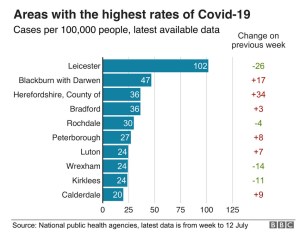
The other change recently, and one that is probably the way forward, is looking at much more localised figures, along with giving local authorities and public health managers the ability to put in effective measures – the idea of ‘local lockdowns’. I wrote a few weeks ago that local systems had been dismantled and now they will have more of a role to play. This is the current data on ‘areas of concern’.

Before leaving statistics for this week, as I write the levels of coronavirus globally are still rising and the number of daily infections is the highest recorded so far with the WHO putting it at 259,848 with 7,360 more deaths. So while the situation in our country is levelling off, this still remains a global pandemic – a fact that we all need constantly reminding of. The Disasters Emergency Committee (DEC) appeal to help those around the world where Covid-19 is adding to poverty, famine, war and poor health provision is one example of people trying to help others in a practical way. It is good to see UKAid matching the donations as well.

New ways of working and a new economy.

Anecdotally, there is a reluctance to return to ‘normal work’ and particularly in office situations. This may be due to safety concerns, childcare or possibly that people are learning that there is more to life than commuting in crowded public transport, or sitting in a traffic queue. Whatever the reasons I do think there will be, to use a phrase from my last blog, ‘a reorientation’ of the world of work. People do want to spend more quality time with family, taking exercise outdoors, working remotely, and spending less on ‘stuff’ we accumulate. Endless ‘consuming’ of the world’s resources and damaging our environment are topics that will be higher on the agenda. These are complex and interrelated issues and some initial questions that need exploring and debating politically are;

  • Economically can we come up with a new model where value is derived from providing more ‘services’ and ‘experiences’ than from manufacturing things?
  • How will money flow from those providing such things and those paying for them?
  • Will there be sufficient tax income to enable government/society to provide essential services such as education, health and social care, and a ‘safety net’ for those unable to take part due to disability, health or social conditions?
  • Who will be the people/organisations willing to invest in these new ways of working/supplying?

I worry that it is all too easy for employers to simply ask people to work from home without providing the necessary environment for that to happen effectively.  Those, like us, who are lucky enough to have a large house with two rooms we can dedicate to be ‘offices’,  with good connectivity and equipment will be able to do more effective work. However, imagine being in a shared flat in the centre of a city where four or more 18-35 year-olds are trying to sit on a bed with a laptop for hours on end, not having enough bandwidth to download data or stream video, having to be ‘available’ for your ‘boss/supervisor’ whenever they choose. Possibly you will need to be close enough to travel into the office once a week/twice a month for face to face group meetings or to talk to clients/customers. You will be stuck in a no-win situation of neither being able to move to less expensive places to get on the property ladder, or having little time to take advantage of the social interactions needed to build up any sort of ‘team / business’ culture that separates good organisations from the merely satisfactory.

There could be upsides to this if planned effectively. If there is a collapse in the commercial property sector with large office blocks being freed up, then these could be re-purposed for affordable city living, and shops on deserted high streets in smaller towns could be converted to ‘work hubs’ where people could travel short distances to ‘hot-desk’ in comfortable offices with good connectivity, shared meeting spaces and good facilities. This would allow the separation of home from work that many desire, but still leave time to spend on leisure/social activities with friends and family. If I was a larger company wondering where my market was going, this is what I would be investing in.

Why the virus will be dangerous for a long time

The other aspect of the current situation that we need to resolve in this country is the suggestion (or is it a fact?) that the ‘virus is going to be with us for a long time’. Given there are countries across the world who have been through a very hot summer and also ones where there have been winters, it seems the virus is not affected by either. There were two snippets of news that I heard, but have not been able to research much at the time of writing, which are potentially worrying.

  1.  The virus is mutating (as all viruses like the flu one do) and the ‘second’ virus which mutated from the one originating in Wuhan is now the ‘dominant’ one and causing the current pandemic.
  2. Having antibodies from an infection of coronavirus is not a guarantee that you will be able to resist a second bout of infection – the antibodies are not ‘long-lasting’.

The two issues are interrelated, and both make it hard to produce an effective vaccine. There is no evidence that the mutation makes the virus more transmissible which is the other worry. We have been lucky in one regard that although the current version of the coronavirus is quite easy to catch, it only appears to seriously affect certain sections of the population, with many getting mild symptoms.

If we had taken more notice and put in systems and plans after previous outbreaks of MERS, SARS and Swine Flu, outcomes may have been better. We have had plenty of warnings. It is vital that we learn lessons as the real ‘doomsday scenario’ is that the next virus might be all of the following;

  • Very easily transmissible via contact or being airborne.
  • Able to last for a long time on many surfaces and in many environmental conditions.
  • Affect almost everyone who gets it in an extremely serious or deadly way.

The nearest we came to this was SARS which was quite hard to catch and cross borders, but spread to 26 countries and killed almost 10% of those who caught it . It was contained in a relatively small area of the world, and this is why wearing masks and contact tracing is more accepted in south Asia than in Europe or The Americas.  MERS was relatively short-lived and contained but with a death rate of around 35%. Both of them killed between 700-900 each. Swine flu in 2009 is thought to have killed between 123,000 and 200,000 globally, spreading to 214 countries in a year, but being a variant of the ‘flu’ virus many older people already had some immunity to it.

The so-called ‘second wave’ in the coming winter in  the UK will be due to a combination of a new variant of seasonal flu, added to coronavirus, and no effective vaccine for either.  In the good weather of the summer and autumn people are willing to meet outside or queue to get into shops, but imagine the effect of cold and wet conditions on our willingness to do those things. This is the reason leading members of the SAGE group continue to push hygiene measures and social distancing as effective measures ‘for many months ahead’.

Other news in the past two weeks.

  • A support package for performing arts and venues was announced and welcomed, but there are still many who will not survive and thousands of performers and technicians who rely on seasonal income are outside the scheme.
  • The environmental damage caused by careless disposal of billions of pieces of PPE that contain ‘single use plastics’ had added to the amount of micro-plastics in our oceans and on land. Much of the PPE should be classed as ‘clinical waste’ and incinerated but personal masks and gloves are being thrown away much like other litter. The increasing use of takeaway food from restaurants has added to this.
  • Wearing of face coverings in shops is to be compulsory from 24th July, but the police are not willing (quite rightly in my opinion) to enforce the new law which is more than guidance.
  • There doesn’t appear to have been a steep increase in new cases as a result of opening of pubs and restaurants and other shops.
  • There has definitely been an increase in traffic as junctions 16-19 of the M6 motorway near to us are back on the travel news with queues and accidents.
  • Gyms, swimming pools and beauty parlours can re-open.
  • Another example of ‘police brutality’ appeared on social media in England with a young white policeman kneeling on the neck of a black man. There were examples of young black couples being stopped and aggressively searched for driving in a new expensive Mercedes, and in another case for parking outside their house in a mainly white residential area.

How were weeks 16 and 17 for us?

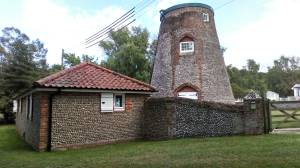
Our main news from the past fortnight and the reason there wasn’t a separate blog for week 16 is that we have been on one of the holidays we booked last year.  A five-hour drive to a small National Trust cottage on the north Norfolk coast next to a disused windmill. It was very pleasant and great to be in a different and new place. Being self-catering and just the two of us it felt ‘normal’. Even for July the caravan park we were in was very quiet. We were not able to book a place to eat as the pubs were all booked up, and we did have to queue outside the small deli and convenience shop in the village. We walked miles of coastal path, went for two 6k runs and managed to keep social distances. We had a couple of ice creams, and ate pizza outside from a manor house with outside tables, we walked to one evening.
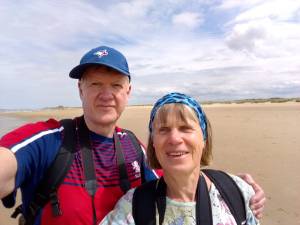
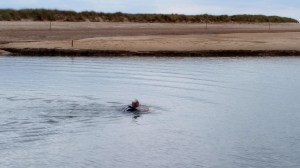
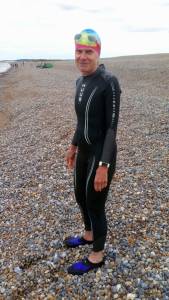
We visited several beaches which were busy with car parking but large enough to keep a decent distance and had clean and available toilet facilities. Alyson even managed to christen her new wetsuit with two swims in the sea, and on one of them she was joined by two grey seals sharing the same inlet.
Apart from having to plan stops on the way there and back – at a supermarket in Grantham on the way there and a farm cafe on the way back, our journeys were relatively straightforward. We noticed the extra traffic on the roads on our journey home last Friday as the official school holidays have started so it may be a different picture in the next few weeks.


I went to a meeting in the accountant’s office in Sale for a face to face project meeting on Wednesday 8th, and it felt strange but there were only nine of the usual 20+ people in so it was all very safe, and we managed to keep social distancing. It was much easier than holding a planning meeting via Zoom and sharing screens.

That evening I attended a church meeting via Zoom with 12 of us from across our district to look at grant funding applications. We decided that it worked so well, we would continue meeting this way in the future. It saves many of our group travelling for over an hour to an office so is ‘greener’, and we can get more people attending. It will be more pleasant than driving the narrow roads in Cheshire and Staffordshire on cold wet winter evenings.

David tried wearing his mask in a shop but declared himself feeling very claustrophobic so decided he would go shopping just once a week.

Michael has managed a few days in The Lake District in a remote cottage on his own and enjoyed early morning walks.

Stay safe everyone. 

Coronavirus week 13 – The best and worst of the NHS – the old normal is back…

C22H29FO5 – the wonder drug

As it is nearly 40 years since I was awarded a BA(Hons) in Chemistry, I think I can be forgiven for not being able to give the modern name for dexamethasone. This is the drug announced this week used to treat patients with Covid-19 resulting in reduced deaths for those receiving oxygen or on mechanical ventilators.

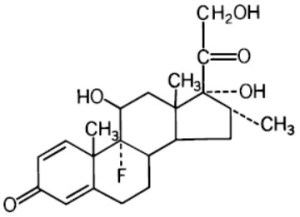
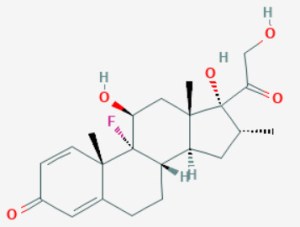
Nomenclature has changed since I taught chemistry for five years in the mid-80s. Looking back at the literature of the time it was called 9α-fluoro-16α-methylprednisolone or 6α-methyl-9α-fluoroprednisolone, but either way even having done a biochemistry module I am not sure I would have known it was a steroid derivative of the well-known drug hydrocortisone. One of the main topics I enjoyed was organic chemistry, that of carbon compounds. Looking through the 1,280 pages of Hendrickson, Cram and Hammond’s textbook from 1977 there is no mention of it, despite being used in a clinical way since 1961. To complete the confusion that people often express when I tell them I used to teach chemistry, it is always good to have a chemical structure to describe the compound. Here are two for this drug.

The slightly more modern version on the right shows the different elements hydrogen, oxygen and fluorine as different colours and the methyl (CH3-) structures as a dark triangle. My pharmacy consultant (and wife) Alyson tells me that I was on dexamethasone for a short time in 2012. I was in hospital for 12 weeks (the time we have been locked down now) with a brain abscess, and was given it to reduce the resultant swelling of my brain.

The research on dexamethasone done in British hospitals, with volunteer patients involved in the clinical trials, has been hailed as ground-breaking. The drug has potential to save tens of thousands of lives worldwide. It must be devastating for those who have lost loved ones who may have benefited from it. This and the amazing dedication of the care staff, cleaners, physios, pharmacists, therapists, doctors, nurses, and administrators demonstrate the best of our NHS. As a country and tax payers we need to fund them to the level required. We will have a thorough review and ‘learn the lessons’, but I fear that once ‘real life’ takes over and self-interest resumes its ‘normal life’, we will forget those weeks early on when as one voice we said ‘this can’t be allowed to happen again’.

The whole system needs a thorough rethink. There have been many reviews and reorganisations over the years, and it would be natural for those who work in it to think ‘oh no not again’.  The NHS needs rebuilding from the ground up, and possibly renaming. Before Covid-19 I think most people thought of the NHS mainly as the hospitals and local surgeries. In latter years, and certainly during the crisis, there have been concerns that care homes, mental health services, and some social care is linked to the NHS. Many people comment on ‘private business’ not getting involved in our health system as a bad thing. Well I have news for them, much of what we think of are ‘private businesses’. Community pharmacies which I worked in for over 20 years and Alyson has worked in for 40 now, are private limited companies owned mostly by pharmacists but some by medical wholesalers. The same is true of almost every doctor’s surgery who are businesses of doctors setup as a partnership of lead GPs who employ other GPs to help them. These private businesses operate as ‘contractors’ and are paid by Department for Health and Social Care (DHSC), itself only renamed in January 2018.  They are paid a rate for their services, whether that’s seeing patients, running clinics or dispensing prescription or carrying out medicine use reviews that is negotiated by their professional bodies with DHSC. It should not be a surprise that negotiating with what is in effect a ‘monopoly’ supplier is not one that leads to mass riches. What does surprise those doctors who visit pharmacies or chat to owners is unlike their partnerships, DHSC pays nothing towards premises or staffing costs of pharmacy businesses, or pay for the holding of large amounts of drug stocks. And don’t even get me on the subject of Dispensing Doctor practices – people who can write a prescription if they have too much stock of a particular drug, or choose the one that’s best for their business rather than the patient.

‘Business’ and the idea of accountability and competition has been part of the health service for many years, and now we have ‘Trusts’ who are independent organisations running services at a local or regional level. They contract to suppliers and surgeries, pharmacies and ‘buy in’ other services from blood and organ donation services, laboratory services and a host of other clinical ones. There are companies who contract for IT projects, finance, property building and maintenance, catering, cleaning etc. This started when I was still in pharmacy 20 years ago and even then I could see the problems of having local GPs on trusts. As with teachers and risk assessments I wrote about in an earlier blog, most GPs are not businesspeople and they can’t be blamed for conflicts of interest between their business and that of patients and other contractors.

Many governments have presided over reforms but the last major one by the coalition government in 2010 and overseen by Andrew Lansley has proven to be disastrous. Even before starting it drew criticism from a lot of areas. The idea of giving even more power to GPs and frontline staff and increased ‘competition’ on one level might seem like a good one, but in reality it led to a mix of systems and lack of any central accountability. The devolving of the social care and public health issues to local government foundered as the secretary of state for health, Jeremy Hunt, cut the budgets under the guise of ‘austerity measures’. The well-publicised ‘scandals’ with Mid Staffordshire NHS Trust and others in care homes can be laid at the lack of oversight on patient safety.  The organisation Public Health England (PHE) was formed as a result of abolishing Strategic Health Authorities (SHAs), and at the time several directors warned that this would compromise our ability to ‘fight any future pandemic’. SHA’s would have been able to lead on organising the local response and would have people on the ground able to conduct a ‘track and trace’ system. Andrew Lansley stepped down from government in 2015 and was rewarded for his efforts with a seat in the House of Lords.

Jeremy Hunt was the secretary of health who ignored the results of ‘Operation Cygnus’ in  October 2016 used to check the resilience of the NHS to respond to a pandemic (albeit one of influenza). As widely reported at the start of this pandemic, this led to a failure to replenish our stockpiles of PPE, antiviral drugs and ventilators. It is shocking to see him in recent weeks, as the now chair of the parliamentary health and social care select committee, taking the government to task over their failure on issues he was responsible for. When he was elected by MPs to this role in January there was a feeling that this conflict of interest might stop him questioning too much. It’s extraordinary to see the exact opposite happening, but his ability to wipe clean his own responsibility is equally unbelievable.

Andrew Lansley promised a ‘bottom up’ review but ended up with more ‘top down’ structures in place and setting up a whole series of ‘independent bodies’ to monitor things.

Several people have expressed surprise that hospices receive so little funding from DHSC and other government bodies that they have to rely on local fundraising and charitable status to continue. This was put in the spotlight early in the current crisis when fundraising stopped and no provision was forthcoming to help with PPE. If a national health service is supposed to cater for us from ‘cradle to grave’, what has gone so wrong that patients and their families who are facing the real end of the health system are left to donations and sales from charity shops for the provision of care to their loved ones. Another part of the health service that I have experience of, and which has been neglected are rehabilitation units. It seems Covid-19 is an illness that takes a terrible toll on survivors, with months of aftercare needed to even walk again. Many weeks on a ventilator in a medically-induced coma leads to mental health issues as well as physical weakness.

NHS IT provision, which I had some experience of when trying to implement the Electronic Prescription Service (EPS) in our pharmacy branches in 2005/6 was one riven with problems. With the help of our wholesalers and investment in NHS broadband we got all 50 branches setup just as we were sold to the Co-op. Alyson continued working in branch and even now, 14 years on, the system is not fully implemented and looks unlikely to be any time soon. Only recently can pharmacists see a very small amount of information held nationally on any patient who comes into their branchwhen they are away from the place they live. I know from personal experience that my local hospital, 15 miles from the one in another county and a separate trust where I was treated for my brain injury, can’t access any of my scans or records. This is why I have a lever arch folder with all my records and several CDs of my scans/x-rays that I can take in should it happen again.

As predicted by my sons in a blog six weeks ago NHS IT, or NHSX as it is now called, was criticised this week for the failure to deliver the NHS Test & Trace app, and are considering reverting to the Google/Apple model. As my chair of district tweeted;

In all the ‘clap for carers’ and accolades given to those in the health and care systems, we shouldn’t fall into the trap of thinking everyone is working for the common good. In an organisation of about 1.5 million people there will be some ‘bad apples’ and strong management and administration supported by decent pay and training is needed.

Our National Health service should be as much about prevention and encouragement to live a healthy lifestyle as it is about treating us when we fall ill. The effects of obesity, diabetes, heart disease and respiratory conditions on the death rate from coronavirus demonstrates this need. The savings made from prevention should outweigh the costs of later treatment.  Education, as in many things, is vital for health outcomes as is reducing poverty.

Let’s hope the next review takes all of the factors into account and, as I wrote last week, as a country we can fund the necessary changes. Our National Health Service has become a ‘Reactive Illness Programme’ (RIP), and needs to change, and quickly.

Other news this week

  • The ‘old normal’ resurfaced in our area this week when 6,000 people attended raves in two separate areas of Manchester on Monday. Several people were stabbed, one girl allegedly raped and local people had to clear up the mess after everyone had left.
  • Crime seems to be on the increase (or at least being more reported) and terror is back on our streets with the stabbings in Reading this weekend.
  • There is more talk of reducing the social distancing requirements to one metre to get hospitality and self-catering holiday accommodation open.
  • Dame Vera Lynn died this week at the age of 103. She was called the ‘forces sweetheart’ during World War Two and had shared her thoughts during the current crisis and her song was echoed in the address to the nation by our Queen when she said ‘we will meet again’.
  • The Labour Party review on the reasons for disastrous results in December’s general election was published. It didn’t make comfortable reading for members of the party like me. We must work for Labour to produce policies which chime with the need to do things differently in relation to funding the new health and social care system, tackling poverty, improving education and closing the gap between the wealthy and poorer in society.
  • The daily death announced totals continue to fall with the Monday-Friday total this week being 853 down from 1,065 last week (a fall of 20%). The total of deaths at the end of the week was 42,632.
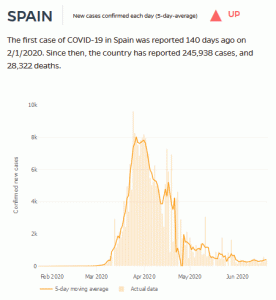
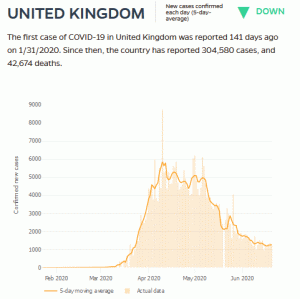
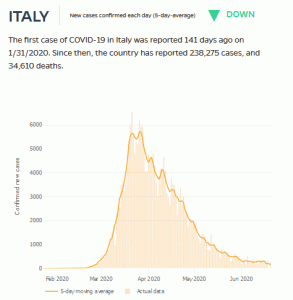
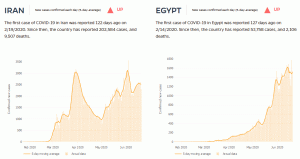
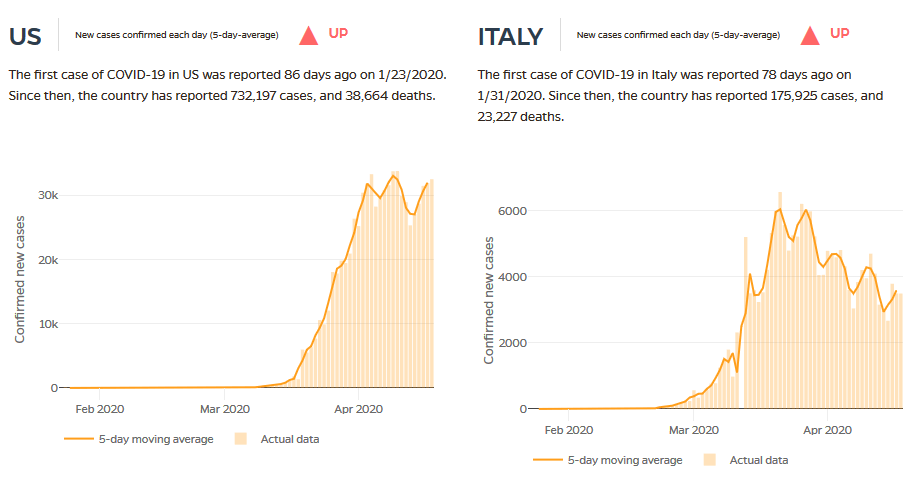
  • With numbers seemingly under control in European countries despite some local outbreaks in Germany, I looked again at the statistics on Johns Hopkins site and there are some awful looking graphs in other areas of the world. Here are the graphs for cases in Europe;


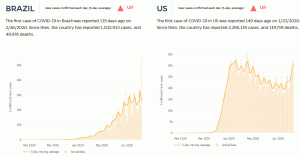
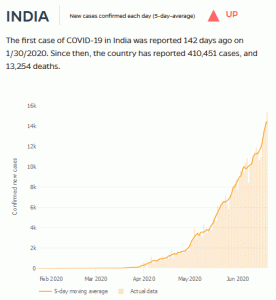
    These show that we are over the (first?) peak of infections. The story in two countries with presidents who think it is nothing to worry about, and are trying to get their country’s open again is not so hopeful…

    and note that the scales on these are tens of thousands rather than the thousands in Europe.
    The middle and far east countries are also showing curves which are concerning, with a ‘double peak’ for Iran. The cases are in hundreds but show no signs of decreasing.

  • We need to start looking overseas again now that we are getting the UK cases down. There is concern from aid charities that helping less well-off countries will be harder now that the department for international development (DFID) and the UKAid agency has been subsumed into the Foreign Office. A move criticised by three recent former prime ministers from both Conservative and Labour.
  • The debate and protests around racism and the ‘Black Lives Matter’ movement continued across the world.
  • I was going to write that the demonstrations and actions of climate protestors, similar to the ones for Black Lives Matters with marches and ‘direct action’ had not resurfaced, when yesterday I saw an interview with Greta Thunberg saying that she was looking forward to going back to school in Sweden, and vowing to carry on campaigning.
  • Greta’s target for criticism president Donald J Trump was back on the campaign trail with a ‘huge rally’ in Tulsa, Oklahoma where only 6,000 of a possible 19,000 seats were occupied despite over a million applications for tickets. For those who did attend there was little sign of masks or social distancing, and six of the organisers caught the virus. At the time of writing there are reports that Mr Trumps rally had been ‘turned over’ by teens and young people responding to campaigns on the Tik-Tok and K-Pop social media platforms applying for tickets then not turning up. Mr Trump said earlier in the week that a million supporters would come.

How has week 13 been for us?

Unfortunately we have another example of the ‘worst of the NHS’ in our household. Five weeks after Alyson applied to help out NHS 111 with taking phone calls from people who need to speak to a pharmacist, and after three polite chasing emails and responses from the HR team doing the ‘on-boarding’ stating that she will hear ‘in a few days’, there is still no sign of her contract or training plans. She has played her part by taking two more calls on the SOS NHS volunteering app.

We haven’t ventured to ‘non-essential shops’ yet and the crush at the Nike store in London and the lady interviewed in the Primark queue in Manchester who stated that she ‘felt like I’ve won the lottery’ didn’t pursuade us. We did go for another walk in Delamere Forest and had a picnic which was pleasant. The weather meant another postponement of meeting with friends in our garden, but we have a walk planned in a park further afield this week.

I have watched a couple of the Premier League football matches now live on ‘free tv’ and have been surprised how realistic the ‘virtual crowd noise’ is to make them seem more ‘normal’ despite empty stadiums. The  online radio commentary I heard for my team Middlesbrough was a sign of the ‘new normal’ being much like the old – we lost 3-0 and are looking at relegation again.

I had my first international Zoom with a call to our subcontractors’ office in India with the person who helps on the IT project I am doing. We have had training sessions with the team from our district who are attending the Methodist Conference in a week’s time. With over 300 representatives, Zoom will be in the form of a webinar where we can only see the person presenting and another speaker who wants to add to the debate. Voting will by the raising of a virtual hand or completing a poll on the screen, so the feedback on numbers should be much quicker than the usual manual count of raised hands in the conference hall.  I will write more about this next week. The conference service on Sunday will be at my now ‘virtual home church’ of Methodist Central Hall, Westminster in London.

Keep safe and let’s hope there is a safe further easing of lockdown in the coming week.


Life & Death – Coronavirus week 10 – taking things one day at a time

Week  10 in daily format.

I usually start these blogs at the end of the week but decided today that I will try doing a ‘daily’ note. This will allow me to capture my thoughts in real time and my mood in relation to events around the crisis. I will review and correct some grammar and shorten sections prior to publishing, but the essence of the days won’t change.

Monday 25th May – ‘I have never been so angry..’

Having made a determined effort in last week’s blog not to write much about Dominic Cummings, the story of his 260 mile trip to Durham, and Boris Johnson’s ‘defence’ of his actions at Sunday’s daily briefing, I woke up this morning quite angry. Not about the actions of the senior advisor, but more that I was so distracted by the whole thing that I missed a huge section of the blog which I had planned to cover.

Sunday 24th May was, for Methodists like me a special day. It is called  ‘Aldersgate Sunday’ formerly ‘Wesley Day’. As the web site for the Methodist Church in Great Britain explains;

In May 1738, John unwillingly attended worship at a Moravian ‘Religious Society’ meeting on Aldersgate Street in London. It was during this service that he felt his “heart strangely warmed”, as he experienced God’s love in a most personal and life-giving way. Until then he had known God in his mind, but not in his heart. Now he understood the value of a personal experience of God that would bring assurance of salvation to the believer.

This year the 24th fell on a Sunday so that made it even more relevant. Not so reluctantly as John Wesley, I attended a streamed service from Methodist Central Hall in London, just over two miles from Aldersgate Street in the City of London.  It was a wonderful service with over 1,500 watching. It was also the last service of their minister Rev Dr Martyn Atkins, former President of the Conference who was ‘retiring’ or as we call it ‘sitting down’ after over 40 years of service to his church. He was what we call ‘one of Mr Wesley’s preachers’, who had been ‘stationed’ in various places across the country as ministers in our denomination are called to be ‘itinerant’, usually staying in one place for around 10 years and then moving to another ‘appointment’ .

The penultimate service I attended in church before they were closed for lockdown was at Methodist Central Hall on 1st February. We were down in London for a visit and, never having been there, I decided to go for the Sunday service. It is an impressive place, built from the donations of one million Methodists, including members of my mum and dad’s families. Martyn was preaching and gave a challenging message about putting on the ‘armour of God’. I received a blessing and was anointed with oil by one of the Deacons at the end of the service. I  managed a few words with Martyn as we had briefly met a couple of years previously. It was in a small room at one of our closed churches, repurposed as a second-hand bookshop raising funds for the museum of Methodism at Englesea Brook Chapel, which is in our circuit between Crewe & Alsager. I was dropping some books off and Martyn was chatting to our Superintendent minister who worked there on his days off. Martyn had written an article for the ‘Methodist Recorder’ that came out that day and which was a challenge to modernise, and I told him it was thoughtful and a great piece. Martyn didn’t remember the conversation but knows the bookshop as he is a great collector of books, and said he would be going there a lot in the future as he and his wife are moving back to Derbyshire, less than an hour away from Alsager.

So, my anger was about not mentioning all that in last week’s blog.

However, the anger referred to in the heading of this section is my wife Alyson’s. Having never been ‘political’ before, she found the email address of our local MP this morning and wrote to him to express her anger at the situation over Dominic Cummings and her disappointment at the way Boris Johnson has handled it. I don’t think Alyson will mind me saying that her natural inclination is not to vote Labour. As a pharmacist and frontline worker who has seen the effects of coronavirus on her patients she wanted her MP to know. He is Dr Kieran Mullan who worked in the accident & emergency department prior to becoming our local MP for the conservatives and has gone back to work some shifts. It will be interesting to see if she gets a reply.

Neither of our moods was improved after the two press conferences that evening. The extraordinary lengthy one with the special advisor in which he showed no regrets but tried to explain why he could make special arrangements for his family. Followed an hour later by one with Boris Johnson. No one, particularly the journalists, was listening to details of how lockdown was to be eased by opening of shops and secondary schools in mid-June. Everyone wanted to keep talking about Mr Cummings. As the day ended the special advisor was still in place, left to be judged in the court of public opinion.

I sat and wrote my own email to Dr Mullan MP.

Tuesday 26th May – hey ho, hey ho, it’s back to work we go..

When the prime minister told the country two weeks ago to get back to work, I didn’t think it applied to me. I was enjoying my semi-retirement, time with Alyson, the warm weather and helping my church and the charities I am involved with. However, at 9.30am I found myself attending a Zoom ‘Monday Morning Meeting’ (moved due to yesterday’s Bank Holiday) with 18 of my new colleagues at an accountancy practice in Manchester.

My friend Steve had asked me back to do another systems project for his new company. If Alyson and I had been managing to take all the holidays that we had planned, there was no way I could have said yes. Truth be known I had some doubts about my ability but after a couple of meetings and 1-2-1’s my interest, and not a little ‘excitement’, was back. It took most of my day, and I had foregone the usual early morning exercise.

Meanwhile Dominic Cummings was still in his job, despite one ministerial resignation and a ‘revolt’ of 30 MPs and literally thousands of similar emails like mine to local MPs. It was left once again to the BBC ‘s Newsnight presenter Emily Maitlis in her opening ‘monologue’ to sum up as follows

Dominic Cummings broke the rules. The country can see that and it’s shocked that the government can’t. The longer ministers and the prime minister tell us he worked within them, the more angry the response to this scandal is likely to be.  He was the man remember who got the public mood, who tagged the lazy label ‘elite’ on those who disagreed. He should understand that public mood now; one of fury, contempt and anguish. He made those who struggled to keep the rules feel like fools and has allowed many more to feel they can flout them. The prime minister knows all this, but despite the resignation of one minister, growing unease from his backbenchers, a dramatic early warning from the polls, deep national disquiet, Boris Johnson has chosen to ignore it. Tonight we consider what this blind loyalty means about the workings of ‘Number Ten’. We do not expect to be joined by a government minister but that won’t stop us asking the questions.

Wednesday 27th May

Today was a warm one and started with my weekly 5k ‘local Parkrun’ which I have been doing as the usual Saturday morning one, I have done since 2016, has been suspended as part of the lockdown measures. We ate all three meals outside on our patio table and were delighted to see a pair of young goldfinches on our feeders.

The numbers of Conservative MPs asking for Dominic Cummings to  be sacked was over 40, and the prime minister was before a committee of senior members of parliament from all political parties. Their questions were supposed to be on his performance in the new parliament which started in December. However, they too concentrated a lot on his special advisor and what effect it might have in getting the message over for the rest of the pandemic.

Health secretary Matt Hancock tried to distract from the Cummings story by changing the sign on the podium at the daily press conference announcing the NHS test and trace strategy to help ease the lockdown. He was ambushed by the video question from a member of the public asking if everyone who had been fined for travelling to arrange childcare would have the money refunded. Perhaps taken aback by the questioner being,  as he so tweely described him, ‘a man of the cloth’, he desperately searched for an answer and promised to take it back and ask the treasury. The next day the answer came back – ‘no’.

At 9pm I logged onto the American businessman Elon Musk’s SpaceX website to watch a live stream of his Falcon 9 reusable rocket taking men into space in a Dragon spaceship that sits on top and carries astronauts Bob Behnken and Doug Hurley. It will dock with the International Space Station (ISS) and then return to earth. This was the first time since 2011, and it was cancelled with 17 minutes to go due to storm clouds. I looked forward to the second try on Saturday.

The virus touched this event when a photo of people watching the launch from a road bridge nearby caused a social media storm around social distancing and accusations that the picture in USA Today was an old one. I read an account on the paper’s blog that showed the picture from 2011 and you can see not quite so many  people, and some in the today’s one wearing masks.

We have watched the launch of a small rocket from a beach nearby the Kennedy Space Centre during a visit in 1994, so can understand the interest of locals in such a massive event.

Just before turning off my laptop to go to bed I made a sign parodying the one on  the daily briefing podium. Having done so, I almost deleted it immediately, worrying if such a thing was ok. I posted it on Facebook and Tweeted it to Rev Helen Kirk, our own Chair of District or ‘woman of the cloth’!

Thursday 28th May

The tactics seemed to work as the prime minister’s special advisor was not the top headline on news bulletins. My ‘funny’ podium sign was retweeted by Helen and liked on Facebook, so guess it was ok. This was the exchange between Helen and me.

When we had a coffee via Skype with friends David & Janis it was something they were annoyed about. Janis knows the road to Barnard Castle where the now infamous ‘test drive’ was taken and thought it unsuitable as a check for the type of journey back to London.

It was another very warm day and we had meals outside and did more work on the garden.

The evening briefing, after the cabinet had done their legally required 3-weekly review, brought news of another ‘easing’ of the lockdown measures. From next Monday we will be able to meet in groups of six in a garden or outside space, some non-essential shops, outdoor markets and car show rooms can open from the 8th of June.  Premier League matches would start from 17th June behind closed doors. Boris Johnson stated that he wanted to ‘draw a line’ under the Cummings affair and move on ‘as the country wanted’. Journalists had other ideas and asked more questions about the ‘illegal trip’, even trying to involve the Chief Scientist and Chief Medical Officer in the questions. There were questions about how people might hold ‘socially distancing barbecues’ in their gardens, and what if someone wanted to use a toilet in the house. Scotland, Wales and Northern Ireland announced different measures from England, just to add to the confusion.

The evening brought the tenth and final clap for carers. It was well supported and loud on our street, but it felt like the right time to end it.

Friday 29th May

We had planned to get up very early, have breakfast, drive to Delamere Forest, and see if we could manage a walk without getting too close to other people. We arrived at 8.45am and walked to a small isolated lake surrounded by some beautiful yellow orchids. It was not too busy with people, but there was a lot of litter from visitors over recent days. We resolved to take bags and collect it if we came again. We saw a lot of birds, went on a rope swing under a tree, and walked the parkrun course.  We arrived home by mid-morning and sat in our warm garden for lunch.

Alyson commented during the walk that it seemed odd to be in such a peaceful place surrounded by life when there were thousands of people in hospital fighting for their lives. I said that most days were like that, but it had been heightened in the last three months.

Rishi Sunak, Chancellor of the exchequer announced an extension of the furlough scheme and support for the self-employed until October.  It was at a slightly lower rate and employers were going to contribute towards the costs. Employees can go back part-time under the scheme.

We watched the last of the daily  BBC Two ‘Springwatch’ reports. It has been a joy to see all the birds nesting and trying to survive. Insights into nature, and a new section of ‘mindfulness’ where they show 90 seconds of pictures with no commentary. We have had river valleys, woodlands, seaside, and tonight’s was lakes and mountains. Wonderful.

This was followed by the satirical program Have I Got News For You, and we were back to Dominic Cummings again. The fun (laced with real anger) they had with the story reached new levels of satire. Apparently there is a Durham slang of ‘that’s a load Barney Castle’ meaning a pathetic excuse. It originates from medieval saying based on a siege in the castle. As one famous columnist is fond of saying ‘You couldn’t make it up!’.

Saturday 30th May

Another bright and sunny day. I got a new PB for my new regular ‘local parkrun’ and like every other week I finished in first place! Alyson was back on the frontline working a morning shift in a community pharmacy. It was again one where she felt safe with one patient at a time.

Two members of the Scientific Advisory Group on Emergencies (SAGE) broke ranks to voice concern about easing lockdown restrictions too early, risking a second wave and peak of infections. There was a worry that having announced on Thursday that people could meet up in larger groups for a barbecue in gardens, some would start early with the forecast sunny weekend. Our neighbours had two families together in their garden with little evidence of social distancing, and on Alyson’s afternoon walk she saw a group of youths playing a football game.

I watched the SpaceX mission finally take off to the ISS at 8.22pm. It was a spectacular event.

Sunday 31st May

Harold Wilson, labour prime minister in the 1960’s is quoted telling lobbyists before a general election, when it wasn’t looking good, ‘a week is a long time in politics’. He won the election with an increased majority. Well, it is a week since the papers and television were full of stories and accusations about a trip to Durham. It felt at the time like Mr Cummings would be sacked, especially after another day trip to Barnard Castle came out. Boris Johnson decided to try to ride out the storm, pushback on any questions, and focus on getting the next steps of easing restrictions out. It appears to have worked. The news today was of opening schools and some shops tomorrow, and the overnight announcement that those who have been ‘shielding’, and locked in their own homes for the last ten weeks are to be allowed out for walks in the local area but still not to go to shops. They can meet up with one person from another household in the open air but must maintain social distancing. As the virus is around less than it was the chances of infection have gone from 1 in 40 at the start of their self-isolation to 1 in 1,000 now.

This Sunday in the church year is Pentecost (what used to be called Whitsun), the anniversary of the formation of the early church and the day the first ‘sermon’ was preached by Simon Peter after the coming of the Holy Spirit. Watching the service streamed from Methodist Central Hall, preacher Rev Howard Mellor reminded us that the disciples had been effectively in ‘lockdown’ for coming up to 50 days waiting for the next stage in their work.  The image with tongues of fire raining down reminded me both of the fires burning in the US from the protests over the killings of the unarmed black man George Floyd by a white policemen in Minneapolis, and the power of the burning of kerosene and liquid oxygen that took the two NASA astronauts towards the ISS. The US riots had spread to many more cities overnight with more fires and looting. There was little social distancing going on there or at the protests in central London.

I watched the live stream of the docking manoeuvre on SpaceX’s web site as the Dragon-2 spacecraft gently attached to ISS. Despite the seemingly ‘slow and careful’ way the two vehicles came together; we were reminded by the commentator on the video that the two vehicles were travelling at 7.66km per second or over 17,000 miles per hour. As I watched the spaceship close in ‘slowly’ for the last 20 metres between the two vehicles which took just over a minute, they travelled over 300 miles or the distance from Crewe to Land’s End! All at 260 miles above the earth. Over 1.3 million people were watching live on-line.   Docking happened at 3:16pm and the alarm on my phone went off. It is set to remind me of the famous Bible verse John 3:16. My mind went back to the time last November when I stood on steps on top of the Hulda Gate up to the temple at the centre of the ancient city of Jerusalem. Our guide told us that when astronaut Neil Armstrong stood on them he said
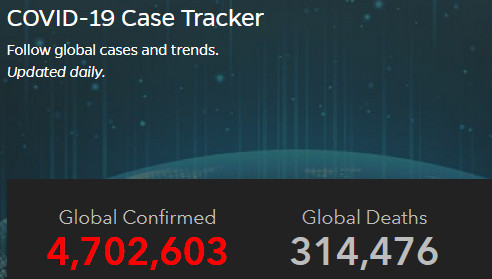
I am more excited stepping on these stones than I was stepping on the moon.”

It was seeing earth from the Apollo spacecraft and from the moon that reinforced Armstrong’s belief in something larger than humanity. He had been brought up in a Methodist family and on return from the moon he gave a speech in front of the U.S. Congress in which he thanked them for giving him the opportunity to see some of the grandest views of the Creator.

The final daily briefing of the week gave the figures for deaths on Saturday as 113 compared to 215 on Friday and 324 on Thursday. The total of deaths at the end of week 10 was 38,489.

We shared a weekly family Zoom with the boys. David was happy to be back on the river Avon after his second session of solo rowing from his club in Bath. He had also managed a short swim as he capsized his single-seater boat!  Michael had been walking in Delamere again.

Alyson has arranged for a friend from her ‘knit & natter’ group to come around tomorrow and sit in our garden to share a coffee. We are planning to meet up with her sister and husband for a walk somewhere between our home and theirs in Coventry.

Next week I am planning to look at a single issue related to the pandemic, perhaps the future of the health and social care services, or the costs of repaying the huge financial debts the government support has built up.

Keep safe.


Life & Death – Coronavirus week 8 – assessing risks, dividing the country

Tell us what we are supposed to be doing, don’t ask us to use common sense….

Looking back with the benefit of ‘2020 hindsight’ the week started with what Boris might have called ‘an inverted pyramid of confusion’ with lots of unanswered questions following his Sunday evening address to the nation.  The well-trailed/leaked message of ‘we’re coming out of lockdown’, the ‘meat of the story at the top’ was followed by the fragmented uncertainty of what was actually said, and the shrinking detail of how that would work – the narrowing at the bottom of the pyramid.

‘Stay at Home’ was replaced with ‘Stay Alert’ and we were told that ‘coming down the mountain is sometimes harder than going up’. He announced a government plan to ‘ease the lockdown’ in the next few months. Some of the measures had been widely trailed in the media in a way that I don’t fully understand. All journalists have their ‘sources’ and back-door channels into government departments. Indeed it seems that some cabinet ministers are happy to ‘leak’ when it suits them, or perhaps to gain an advantage in the game of getting more power by a higher profile. The problem was that some people were waiting to hear that they could see more family members, start planning a late summer holiday or going for a beer at a pub that has an outside garden or space.

What we heard instead was ‘go back to work tomorrow’, ‘from Wednesday we can go out more, sunbathe or play sports’, ‘schools and some shops will be opening at the start of June’, ‘hospitality being open from 4th July’.  The new alert system was underpinned by scientific advice and monitoring of the now infamous ‘R-number’. Monday morning brought more confusion when ministers didn’t appear to have details on some of the ‘rules’ and how they would be applied. Could we meet mum and dad in the park or was it only mum (presumably while dad sat in the car and waited his turn next). The situation was not surprising as the more detailed 60-page official document was not published until later on Monday and news programmes were full of traffic jams and crowded tube trains as the ‘rush back to work’ started.

By this weekend crowds were taking advantage of the warm weather to travel long distances to beauty spots in the countryside and on the coast. Some interviewed for the evening news expressed surprise at the number of people there and the lack of social distancing. 

I mentioned a couple of weeks ago the need for careful planning of how workplaces could open with ‘social distancing’ and ‘re-engineering’ of processes. Any business or workplace that had wasted the last seven weeks of the lockdown and wasn’t planning how the changes could happen prior to the announcement, can’t complain if they fail in the future. Talking to Steve, an accountant friend of mine, about how his small business customers were coping, he said there were two groups; those who had panicked and taken short term decisions, and those who had changed. He mentioned restaurant businesses who had turned into takeaway services and were now making more money as they didn’t realise just how much customers liked their dishes. We agreed that the ‘good’ well-run businesses who treat their teams well will come out of this stronger.

Trade Union Leaders were calling for their involvement in helping businesses get back working in a safe way. They have many trained ‘Health & Safety Reps’ that can help companies and reassure their members that safe-working practices are in place. Although the TUC had been on a conference call with the Prime Minister on Sunday evening, no mention of help from the unions was made by ministers in the daily round of the breakfast news media organisations. The phrase ‘it is just common sense’ was often used. The government did produce some detailed guidance on workplace changes, staff shifts, social distancing and deep cleaning measures for eight areas of work from manufacturing, offices, restaurants etc. But I repeat, most businesses should have been thinking about these things before this week.

Wednesday was the day we could all begin to get out more and play sport, but we decided to stay home and see if the beauty spots, parks and garden centres became crowded with people, as had been the concern when it was announced. It was a mixed picture and the mood was captured by a cartoon in one of the newspapers of a golfer playing a round on his own whilst his wife took a towel to sunbathe in the bunker. On seeing the queue of 30 or more customers to get into a garden centre we decided that we weren’t that desperate to get some more plants for our garden.

Parents, teachers, and their unions were raising concerns about how social distancing would be in place for reception, year one and year six classes, the first designated to go back. For some it was literally a matter of ‘life and death’ with some parents accusing ministers of treating them and their children as ‘guinea pigs’ for an experiment and saying that they definitely wouldn’t be sending their children back until schools were ‘100% safe’. Of course there is no such thing as 100% safe statistics were quoted on the risk of being injured in a car journey or playing in a park. There is also a risk of harm if younger children see parents in a state of terror about letting them out for the ‘virus to get them’. We watched an interview with a head teacher from the UK and a teacher in a primary school in Denmark that had been open for a few weeks and put in place measures to help. They put the children in small groups of 4-5 and played a game whereby they had to keep away from the other groups in the school. Washing hands at the start and end of the morning and afternoon became a physical education (PE) class where children lined up two metres apart and did various exercises such as squats, jumps, stretches as they moved closer to the sinks and after washing their hands they went back to the classroom to do a paper exercise. The UK head teacher appeared to take an interest and be willing to learn some lessons from this. The Danish teacher stated that when they opened less than half the parents sent children but after two weeks it was over 90%.

Of course we shouldn’t forget that teachers and schools have been open during the lockdown, doing frontline work and teaching smaller numbers of key worker’s children. They will have learnt something from this experience. Some of the larger ‘Academy School Groups’ that have estates departments have been planning for opening and doing individual risk assessments for their varied buildings. Some head teachers in primary schools are not trained in risk assessments. This is not a criticism, it’s just not their job which became clear when they panicked about how to keep 4-year olds apart, and not to be terrified of teachers wearing masks and full PPE! They may be great teachers, but they also need help from local authorities and others. We have to hope that the large academy groups only motivation is education of their pupils but, as with some of the larger businesses in the commercial sector, it is possible that their Chief Executives are more concerned with lost profit than with the safety of their employees.

Speaking to Chris, a friend who has a daughter that teaches primary school children in a relatively deprived areas locally, I asked his view. He said he could understand the unions asking for guarantees on safety as that is their role. His daughter has identified vulnerable pupils who should be in already but haven’t been coming. Some of her children are not capable of being controlled in the way people would expect and their hygiene habits are poor as the result of the environment they live in. She is not worried about catching the virus as she is young, but Chris is concerned about her, as there is still much we don’t know about how the virus affects children.

The Danish comparison was being used as a ‘positive example of what could be done’ by the same ministers who said it was wrong to compare the way we handled the crisis, compared to other countries who appeared to be doing better. Is it that Danish schools and parents have a different relationship than ours?

As I write teacher unions and leaders have met with government scientific advisors, and doctors have backed the proposed way forward for a controlled opening in June. Anne Longfield the children’s commissioner for England has demanded that the two sides stop squabbling and get on with reopening ‘in the interests of children’, the many disadvantaged of whom had been away from education for too long.

The schools issue was just one area this week that shone a light on the growing division/diversion of the way the crisis is being dealt with both between the countries of the UK and within the regions of England. I wrote last week that Scotland, Wales, and Northern Ireland were sticking with the ‘Stay at home’ message. This week the elected mayors in Manchester & Liverpool went on record about the support they and their councils were being given from London. The Greater Manchester Mayor, Andy Burnham wrote two newspaper articles bemoaning the short notice they were given of the proposed ‘back to work’ message and not having the financial package given to the London Mayor to provide the extra public transport to maintain social distancing. The allowances given to local authorities to deal with the crisis had gone from ‘spend what you need, and we will reimburse you, to ‘we need to be sharing the cost’. It needs to be stated that he was a former Labour MP for Leigh, one of the constituencies that changed to Conservative in the December election. So the following statement needs to be read in that context.

For a government elected on votes in the north, and promises to “level-up”, it is surprising how quickly it has reverted to the default, London-centric mode in this crisis. Last Sunday’s package certainly felt more suited to the south than to the north.

His article refers to another issue I heard on Friday that seems to mark a change in approach. Many homeless people have been taken off the streets and put into hotels with a grant from central government. That funding is being withdrawn and put back onto the local authorities, many of whom have also had a large cut in the funding to give local support during the emergency. It seems that the poorest areas are having the largest cuts.

One of the most deprived areas in the country and one often shown on news bulletins is our ‘home area’ around Middlesbrough in the north east. Alyson & I lived and went to school in one of the more affluent areas from the ages of two and five. The area of Brambles Farm shown in Friday’s bulletins is one we know well and is where Alyson’s mum worked in a bookmakers. The interview with a mum and her child about the cost of living and the need to access support and foodbanks was a stark reminder of areas of poverty in our country. 

Today’s statistics from the NHS show the following;

  • The North East region has the highest infection rate in the country with 358 people per 100,000
  • Within the region Middlesbrough is fourth highest for infection rates at 451 per 100,000
  • The James Cook University Hospital that serves the area is in the top third of deaths in the country with 316 to date.
  • One day in the last week there were 24 new cases in London and 4,000 in the north east and Yorkshire.

The regional mayor had been resisting the reopening of parks despite the pleas of an MP who is a member of the government and one who is the Labour MP for Middlesbrough.  He is, however, in favour of reopening schools unlike his counterpart in nearby Hartlepool.

Other news this week

  • The daily death rates appear to be on a downward slope with today’s figure of 170 bringing the total to 34,636. But this week we had a figure of 50,000 for the ‘excess deaths’ for the period to 1 May.
  • Following the extensive coverage of the track and trace app on the Isle of Wight there has been little news on how the trial is going. I looked up the local newspaper and all it said was that less only about 33% of the population had downloaded it. Michael & David told me on our Zoom call tonight that the source code for the app had been released and there were lots of comments about functionality and not connecting with phones nearby. As per the blogger’s prediction last week there is talk of moving to the decentralised version of the app.
  • Tuesday 12th May was International Nurses Day and fell this year on the 200th anniversary of Florence Nightingale’s birthday. Florence died a recluse after many years of a ‘mystery disease’ which some scholars now think could have been partly related to post-traumatic stress disorder (PTSD). Much more is known about this today, and it could be that her reluctance to talk about the 21 months without a break looking after the injured soldiers in appalling conditions during the Crimean War, 30 years previously, was the cause. Many today are asking that our NHS workers and others on the frontline receive PSTD counselling in the coming years.
  • Belly Mujinga a Victoria Station ticket office worker died after being spat at on the day before the lockdown by a man claiming to have coronavirus, falling ill with Covid-19 two days later and dying in hospital a week after that. It is a shocking story.
  • The question I submitted to the group who choose ones from the public to the daily briefing didn’t get picked, but somewhat surprisingly one about the possibility of in the future of having a ‘Universal Basic Income’ (a subject I want to cover in a later blog) did, but was dismissed outright by business secretary Alok Sharma MP, who again was happy to use other countries as reference as ‘it had been tried and shown not to work’.

Thoughts at the end of week 8.

This week we were due to be on a cruise in Norway from Bergen to Kirkenes and back, on a small cargo boat calling at many ports and sailing up some of the very scenic fjords. A ‘first world’ problem I know, but we are some of the many trying to get a refund or rearrange for next year.

This week is designated Brain Injury Awareness Week and in the charity I am a trustee for it would be one of our main awareness and fundraising times. I wrote and hosted a Zoom quiz for our members to replace the events we would have had. It was a fun time of sharing. It has also been Christian Aid Week and the door to door collection I sometime do was cancelled. It raised over £8 million across the UK last year. I shared the preparation and hosting of another quiz for which we asked for a donation. We had 16 ‘screens’ with about 25 people joining in. This week’s appeal is to help victims of coronavirus in parts of the world less able to cope and where Christian Aid have projects. I encourage you to donate.

The advice this week from the government was to start wearing face coverings in some enclosed spaces such as on public transport and shops. Alyson had used a design from You Tube to sew some cloth ones for us all. We posted two each to Michael and David and I wore one for the first time to go to our small local Tesco. I only had it on for about 45 minutes, but that was long enough for me to have some understanding of how uncomfortable it must be to wear one for a ten to twelve-hour shift. And that is without the rest of the PPE needed to treat patients in ICU.

I read a blog from an academic at Swansea University who was recruiting people willing to take part in a ‘CoronaDiaries’ project looking at how people react in the crisis. I have been accepted onto the project so these blogs will be converted to PDF and stored in an archive for future researchers to use.

As usual on Sunday I attended a streamed service from Methodist Central Hall in London. The sermon and prayers related to a passage in Matthew chapter 5 where Christians are called to change ‘from  just being, to doing’. This struck me as particularly apt for the events of this week, as did our prayer,

may the poor be enriched, the bereaved comforted and the hungry filled.

Keep safe, stay alert, manage the risk and let’s try to ease the lockdown.

Life & Death – Coronavirus week 4 – ‘Squashing the sombrero’

Care homes and the elderly – a hidden crisis revealed?

This week’s main headlines have been dominated by two main issues. The first was around how many people have died from the effects of Covid-19 in care homes and the community. This has put a spotlight on how much this area of our health and social care system appears to have been forgotten, with an extra 4,000 deaths to be added to the total which stands at 16,060 at the end of the week.

I do think after this is all over it will be an issue of collective shame that ‘we’ didn’t bring the care sector into the national effort sooner. Perhaps we assumed that these people were already ‘shielded’ by being in a closed environment; or did we subconsciously think that as they were older, with some nearing the end of their lives, it would be sad, but not so disastrous if that end came sooner.

The other main issue of the week was the review of the lockdown that under the emergency powers the government has taken, needs to be looked at every three weeks. There were calls from the new Labour leader, Keir Starmer, for the government to layout the plans for how the restrictions may be eased. This was echoed by the end of the week when Conservative Ian Duncan Smith MP, a former Work & Pensions Secretary called for ministers to treat the country as grown-ups and not children who couldn’t understand.

We were told that any talk of lifting the lockdown in a few weeks might be giving ‘mixed messages, and lead to us not carrying on with the strict regime. I do begin to understand this, but my analogy would be that when you go on a package holiday and the rep tells you to be at the airport in three weeks for your return flight, I don’t think many people turn up for the flight the next day. They are two quite simple messages. It was good to hear that there is a group of experts looking at what other countries are doing, and data is being collected on the effectiveness of softening each measure.

The discussions are happening anyway, and it seems logical to ‘reverse’ the measures we put in place. This means children (or at least some year groups) going back to school, perhaps after the original end of May Bank Holiday half-term. Then opening some health care settings like dentists, opticians, chiropodists etc (with of course relevant safety measures in place). This could be followed by garden centres and DIY stores so that people can carry on with projects at home and give those businesses for who this season is a large part of their turnover, some much needed cash and return of profit. Many people who are working from home could continue to do so. I hear anecdotally  that many of them like the new way with not having to commute. I imagine those who have been furloughed on 80% (particularly those who are being paid the extra 20%) are enjoying their ‘sabbatical’ and if the good weather continues would be more than happy to carry on.

The government briefings continue to push the message of carrying on until we see a change in the data, and that the peak of infections/hospital admissions has not yet been reached. It came as no surprise that on Thursday it was announced that current measures will be in place until at least the 7th of May. As that is the start of the VE Day (Victory in Europe) Bank Holiday weekend, my own view is that they will be in place until that is over.

As the figures in the main image show, the death toll across the world keeps rising.  I admit to spending a lot of time looking at graphs trying to interpret ‘trends’.  However, without some deep grounding in statistical methods and how data is reported, some graphs can be ‘misleading’. I have even seen ‘logarithmic scales’ used for the vertical axis of ‘number of deaths’ which flattens the curve and lessens the steepness of the rise. Education is so important in these matters, but some of our journalists appear to think that cramming a few minutes of research via a search engine on epidemiology allows them to ask ‘searching questions’ of the health and science experts. One even got antibody (to see if someone has had the virus in the past and developed some immunity) and antigen tests (finding if someone has the infection now) mixed up.

The figures in this article come from Johns (notice the extra ‘s’) Hopkins University web site. They have a useful set of visual tools that display the data on Covid-19 from all over the world, updated daily.

You need to understand what a ‘normal distribution curve’ is to know what the line and the space under it mean. The graphs below appear to give some hope that the ‘curve is flattening’ and, as Boris put it so colourfully in an early press conference, we are ‘squashing the sombrero’.   These are today’s curves of reported cases.

Coronavirus Cases US & Italy 19 April

Even these diagrams have very different vertical axes with some in thousands and some tens of thousands. They are useful to see overall trends in the number of cases, but this is dependent upon the same testing regime being in place in a country for the period reported, and even more so when comparing different countries.

This is the one that compares the UK and Belgium.

The danger of trying to read trends in these curves is that they could be a small part of an even larger curve or the start of several ‘small peaks’ that go on and on. Looking at the curve below for example, in the data above, we might not quite be at point 20 on the horizontal axis.

The important thing to understand, should this be true, is that the area under the curve represents the total number of deaths. I heard one epedemiologist modelling the outbreak estimate that if we added the extra care home and community deaths, which could be as high as 50%, then even if there is a single ‘normal curve’ we need to double the total deaths currently, resulting in a figure in excess of 40,000.

To add some more ‘worrying’ numbers into the mix if, as some experts are saying, only 15% of the population have had the virus, then to get to the 60% required for the original plan of ‘herd immunity’ would require a total of four such curves and associated lockdowns. It does seem that the crisis will continue in some extended form for many more months.

Population numbers and density in a country are important factors that allow another way of looking at the figures. Consider the graphic below showing the number of deaths per 100,000 of the population. with a table below it showing some numbers.

Coronavirus Worldwide Mortality Rate April 2020

These figures are from a few days ago and some countries are at different stages of their outbreak.  There have been questions over the reporting in China where it is alleged that some of the administrators at a state level could be underreporting  numbers for fear of upsetting the central Communist Party. The figures were amended this week on the day China announced a negative Gross Domestic Product (GDP) rate for the first time in nearly 40 years.

Other news items this week.

  • ‘Captain Tom’ who I mentioned last week has now raised over £26 million and promised to keep walking as long as people keep giving.
  • In many countries with more ‘authoritarian’ regimes, there have been examples of extra surveillance via mobile phone location data, and extreme violence by police under the guise of enforcing the measures.
  • Protests have taken place in the USA and Brazil against the lockdowns showing that individuals are rebelling against the situation. In our country, apart from a few examples people have been generally compliant. No one wants to think about us getting the stage of extreme disorder and looting that has been part of the ‘Hollywood narrative’ in the disaster/survival movie genres.
  • President Trump continues to make headlines after declaring himself the only person who could decide when states release lockdown. This is not the legal situation as each of the states has a separate ‘government’ in their federal system. The next day he announced his decision….that each governor could decide when and how to lift their lockdown!

Thoughts at the end of week 4.

The virus has come closer to us after a member of my head injury charity, monthly coffee morning group, died of Covid-19 on Thursday. Blythe had some underlying issues but she was doing well at home after a spell in a care home before Christmas. Another person I know is in hospital with the virus but fortunately not in ICU.

The mother of the partner of one of our nieces died 13 days ago, not of the virus, but his father couldn’t visit her in the nursing home, and the family had the problem of organising a funeral under the new regulations . In addition our niece was furloughed and her partner told to take a 30% pay cut, at a time when his company wanted him to work from home and do even longer hours.

We are still managing to get some daily exercise and no problems with food or other supplies. We have had many Zoom coffee meet-ups with family and friends. I helped lead a Zoom Bible study group on Wednesday evening. We are ready for another extended period of lockdown and the forecast good weather is a real bonus. Alyson is missing trips to see wildlife away from our suburban estate, but is making the most of walks along a stream in woodland nearby.

We are doing more reading, watching films and recorded ‘live musicals’ shows on the Internet. Attending a live-streamed church service from Methodist Central Hall in London is now part of my Sunday routine.

Stay safe and, God-willing, there will be another blog next week.

Theology Everywhere

Discuss theology today to transform tomorrow

verbalising

ruminations on life at fifty ... or so ...

Discover WordPress

A daily selection of the best content published on WordPress, collected for you by humans who love to read.

The Daily Post

The Art and Craft of Blogging

WordPress.com News

The latest news on WordPress.com and the WordPress community.