Life & Death – Coronavirus week 7 – preparing for the ‘new normal’

Using technology for good – to help us ‘ease the lockdown’.

In terms of the coronavirus pandemic, week 7 was one in which we all speculated on what Boris would announce during his ‘address to the nation’ on Sunday by way of a ‘road map’ for lifting the restrictions. Lots of documents were ‘leaked’ and guidelines for certain businesses were published on the .gov.uk web site.

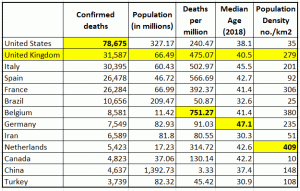
At the start of the week daily death totals (now in all situations) didn’t appear to be falling as quickly as many had hoped, but the last two days’ figures of 346 and 269 were lower, even for a Bank Holiday. By Sunday evening the number of lives lost was 31,855. On a purely numerical measure the UK is second to the US in terms of total deaths. There were more discussions on international comparisons. I have written in previous weeks about statistics and the difficulty of comparing countries. Factors such as the age profile, ethnic mix, housing density in cities, poverty and whether a country is an international ‘transport hub’ need to be considered.
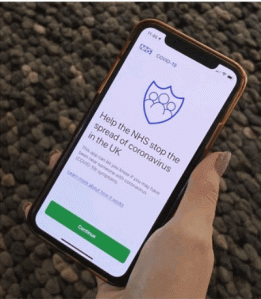
Another topic that took up a lot of time during news bulletins and daily briefings was the launch of a ‘Track Test Trace’ (TTT) application for mobile phones. This is an example of ‘using technology for the good of society’.

On a basic level everyone who downloads the app to their smartphone can collect data about close contact with others who have the same app. If someone shows symptoms of infection by coronavirus they complete some details on the app and a central server sends a message to all of the people they have been in contact with over recent days informing them of steps they need to take. As with all ‘technology’ and especially programmes or apps, things are not so simple as I explain below.
My life using information technology for almost 40 years could be the subject of another blog. Even though one of my sons, now in his 30s, recently called me a ‘dinosaur’ for asking what I considered a reasonable question about how he implements systems in the complex world of on-line and mobile banking apps, I think my knowledge of the principles still stands me in good stead. I am proud of showing him and his brother before they got to secondary school, that there was more to computing than the games they played on our Atari console. This probably helped set them on the way to the complex systems they are responsible for now.

So I asked our two sons their professional opinion on the planned NHS TTT app development, its data usage and architecture. I read some articles with concerns around privacy, and the two departments party to it, the NHS and the intelligence agency GCHQ, not having a good track record with implementation of IT projects. GCHQ is all about surveillance so is the app as much about location as it is tracking the proximity of nearby devices?

Their reports were that most countries are going with an app produced by two of the largest technology companies, Google and Apple joining forces. They are promising an approach where all the data is stored ‘locally’ on the users device which also sends messages to the relevant contacts if required. No central data is held on individuals. Their  ownership of the two operating systems that all smartphones use, means they can maximise the efficiency of the Bluetooth file transfer exchanges and minimise the use of battery power on the devices.  It is this deep technical knowledge that may cause other countries, including the UK, problems in developing their own. 

An example of the problem is that in its standard form Google and Apple restrict apps from broadcasting Bluetooth constantly, as this has been exploited by companies connecting and sending targeted advertising. This means that most apps only broadcast if they are running in the ‘foreground’ or looking at it. If your phone is locked or you are not actively using the app there is a danger that some interactions will not be registered. There is some debate as to what counts as an ‘interaction’ is it that you are close to someone for a certain time such as five minutes, or just when you pass by on the street?

Michael found an article referring to a petition by developers to the French government demanding that there is complete openness on privacy, asking for published details of exactly what sort of data is collected, how it is used and when it will be destroyed after use. This is part of the ‘privacy v health’ debate around such applications. The UK government wants to use data to track the areas the virus is spreading.  David’s ‘research’ concentrated on battery life and foreground running. He says that with Bluetooth there is something called  “Received Signal Strength Indication” to determine distance between devices, but it’s not particularly accurate. This probably means there will be a lot of false positives, and even cases where it’s picked up a neighbour’s signal through a flat or house wall.

Whatever the pros and cons of the privacy debate, my concerns are about the practicalities of the system.

  • What incentive is there to report symptoms when people get them?
  • Alternatively what stops someone maliciously reporting symptoms if they are so minded just to cause a nuisance?
  • Is there a necessity for a positive test before the messages get sent and if not won’t the ‘false positives’ cause a lot of unnecessary disruption?
  • Given that a lot of people will go to a supermarket once a week, many ‘contacts’ will take place. The consequence is that one or two customers getting symptoms can lead to many supermarket workers having to isolate. Similarly, one supermarket worker getting symptoms could lead their fellow workers and hundreds of customers isolating. The result, after a few days, could be no supermarkets open and no customers going in.
  • Most transmission currently seems to be taking place in hospital and care home settings where there are lots and lots of ‘contacts’, so I am not sure how practical it is to use the app in those areas. Most medical staff take care not to contact people at home or outside the work situation anyway.

The biggest problem with the TTT system is the same as with the current hard lockdown. If there is a large minority who don’t engage or download the app, and they are the ones responsible for being lax on other ways of controlling the spread of the virus, they will still be responsible for causing some ‘needless’ cases and deaths.

We await the results of the Isle of Wight larger scale test but given that we have been told the app will be available to us ‘by the middle of the month’ there doesn’t appear to be much time to analyse how the system is working.

Readers of this blog know I love an initialism, so the last word goes to the writer of a blog three days ago suggesting countries trying to develop a (deep breath..) Pan-European Privacy-Preserving Proximity Tracing app or PEPPPT, will find themselves changing course and adopting the Apple-Google model. He predicted that by the end of the month the UK will have done so.

Is the change in message another sign that we are in for a long haul?

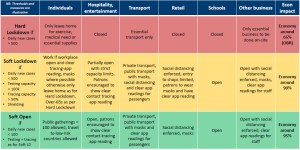
If today’s papers are to be believed Boris’s ‘address to the nation’ this evening will change the message we have been used to seeing as illustrated below.
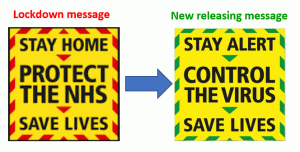
The not so subtle change from red to green along with a ‘traffic light system’ for alert levels suggest to me that we are in for a period of trying changes, and if they don’t work putting restrictions back on. If, as has been trailed in the press, there are a whole variety of ways that businesses, workplaces, schools and social situations will change, then confusion (and some anger and worry) could be widespread.  The words of epidemiologist Professor Peter Horby interviewed on The Andrew Marr Show stood out to me. He is chair of  New and Emerging Respiratory Virus Threats Advisory Group or NERVTAG – sorry folks it is too lovely an acronym to ignore.  He stated

the virus is not like a storm or hurricane where we batten down the hatches until it has passed by, and then emerge into the sunshine and it has gone. It’s still out there and most of us have not had this virus, so if we get this wrong it will very quickly increase across the population and we will be back in a situation of crisis. So we have to be incredibly cautious about relaxing the measures.

NERVTAG told the government that getting the relaxation wrong could lead to a figure of 100,000 deaths in the UK. We still don’t know the proportion of the population who have had covid-19, but if the professor is correct there might be a lower but steady number of deaths for many more months yet.

The fact that the extra Nightingale Hospitals haven’t been closed is probably a sign that the politicians expect if not a ‘second wave’, then a lot more cases. As well as balancing privacy vs health for the new tracking app, there is even more pressure to balance health vs the economy. 

Finally, on Sunday evening we listened to Boris address the nation. He set out the way the five ‘alert levels’ would be set by monitoring the R-level by an advisory group. He set out timescales for now, the end of May, end of June when certain parts of the economy such as construction, manufacturing, garden centres, shops, and eventually limited hospitality would restart.

He encouraged anyone who can’t work from home to return to work tomorrow, and from Wednesday encouraged everyone to take more exercise and play sport with their family.

However, the main ‘confusions’ straight after the announcements were;

  • How people, who the prime minister said should go ‘back to work’ if they could the next day, would get there given limited public transport.
  • The other nations of the UK have announced that they are sticking with the ‘old message’ about staying at home. Scottish First Minister Nicola Sturgeon even asked the UK government not to run the information ads in Scotland. In Wales where you can’t drive for exercise, people from England could get fined for driving to the Brecon Beacons for exercise. Do Welsh workers need to drive to England if their employer decides that they need to work?
  • The detailed instructions for all sorts of workplaces have not been set out, so it is uncertain how that might look.

We will see what happens in the coming week with clarification and further statements to parliament on Monday, and questions from the public in the daily briefings.

Other news this week.

  • VE Day was celebrated in a ‘socially distancing’ way on Friday 8th May. The 75th anniversary was a special one and street parties held, and old-time songs sung. An evening concert held at Buckingham Palace featured a ‘virtual duet’ with Katherine Jenkins and Dame Vera Lynn of the wartime favourite ‘We’ll Meet Again’. One lady told the story that on the original VE Day she and her sister had to ‘socially distance’ and sit on a separate table as they had mumps, and she didn’t think that 75 years later she wouldn’t be able to join in a street party due to social distancing again.
  • In last week’s blog I wasn’t having a go at radio DJ Chris Evans specifically over his fundraising efforts. I listen to Virgin Radio’s Breakfast Show most mornings and Chris and his team try to spread joy and positivity in these difficult times.  He has also been party to raising literally tens of millions of pounds during his time at Radio 2 and Children in Need auctions and events. Chris by his own admission comes from ‘humble roots’, found fame and has had his well-documented ‘excesses’. But he tries to see the best in people and teach others lessons he has learned.  The message from last week was that our much-needed public services should be properly funded by us all and not rely on the charity and voluntary sectors.  Chris, his family and many celebrity friends have now raised in excess of £1 million from two auctions of memorabilia, and his son Noah over £100,000 by sleeping in a den in the garden. This money will go to producing more than 220,000 sets of scrubs for the NHS workers. 
  • On Friday transport minister Grant Shapps gave news of a £2billion scheme to encourage us to cycle or walk to work. For people travelling on public transport to maintain social distancing then they need to run at about 10% capacity. 
  • Other countries started to ease their lockdowns and in Germany Chancellor Angela Merkle allowed all shops to reopen, pupils are gradually returning to classes, and the Bundesliga – the country’s top football league – will restart next weekend. Initial signs are not promising as the dreaded R-number, a measure of the number of people each confirmed patient infects – moved to above 1.

Thoughts at the end of week 7

We continue to enjoy good health and the warm weather meant we ate a few meals outside. Alyson planted more seeds and worked on the garden. I managed to put the last shelf up in our shed in under an hour!

After finishing Terry Waite’s book Alyson has started the one by John McCarthy and Jill Morrell ‘ Some Other Rainbow‘ that documents the same time and similar events. We have been watching some more ‘culture’ on YouTube with recorded performances of Shakespeare and ‘Frankenstein’ by The National Theatre.

At today’s live stream service from Methodist Central Hall, Rev Martyn Atkins talking about being ‘salt and light’ referenced a talk he had heard where a student illustrated Christians being all shapes and sizes of candle, some battered, some old, some coloured – but all shining as a light to others. Something we are called to do at this time. One of his daughter’s friends when she was frightened would ask her dad to ‘turn off the dark’! We needed to use the battered candle I display some Sunday evenings to remember our carers as we had a power cut on Saturday evening.

We have had the usual Zoom meet up with friends and family. The week coming up is both Christian Aid Week and Brain Injury Awareness Week, so I have two ‘Zoom quizzes’ to prepare and host.

Alyson is hoping to get back to ‘frontline’ work by helping the NHS 111 Service and doing calls to patients who have been referred to a pharmacist for advice. She has been training and is waiting on information on how to setup a ‘call centre’ from her study – i.e. our spare bedroom.

I am a follower of a blog by the wonderful modern poet Brian Bilston and if you have never seen his work I can recommend you looking him up. He has produced some thought-provoking work over these last few weeks and I leave you with one of my favourites;

On Leaving the House and Encountering Another Human Being

I’m sorry I dived into the bushes.
It’s not personal, you understand.
You happened to walk in my direction
and my nerves got the upper hand.

I’m sorry I screamed when you came near me.
Don’t take my angry shrieks to heart.
Idiomatically, let’s stay in touch –
and physically, six feet apart.

Apologies if it seems like you repulse me,
that I recoil when you come near.
In other times, we might have spoken,
shared a joke or had a beer,

or waltzed together down the footpath,
perhaps we may yet still one day.
But just for now, embrace the margins
and wave to me from far away.
© Brian Bilston’s Poetry Laboetry
 
 
Keep safe everyone and remember, ‘We’ll meet again some sunny day’.
 

Life & Death – Coronavirus week 6 – light at the end of the tunnel.

Two narratives, but which do you believe?

This week’s total deaths has risen quite sharply as it now includes all deaths in the community (including care homes) and not just hospitals. At the end of the week the UK total is 28,446.

As I have gone through the last few weeks in this series of blogs, I note down topics that interest me and jot them down on my computer with some initial thoughts.  On the Saturday I just start to write my blog and usually an idea comes to the fore, sometimes I write too much or go off in a particular direction and have to scrap large sections or keep them for another time. Often I am up against my own ‘deadline’ of Sunday evening and end up ‘rushing’ the last part.   As I sit here this Saturday I am conflicted.

I have one narrative of the week’s events and my thoughts which some would describe as the ‘mainstream view’ as reported by the BBC and some on-line articles or extracted from large circulation newspapers. This view is dubbed by users on social media as ‘MSM’ or Mainstream Media.  MSM as a term is often used in a pejorative sense as either left- or right-wing bias, depending on the political view of the person passing comment. In that sense it could be described as ‘balanced’ given that some agree, and some disagree. Coronavirus has taken over from last year’s key word ‘Brexit’ as a topic that divides the nation. The division appears not to be the same extent, but there are plenty of people asking hard questions of the government, and much finger-pointing at individuals or institutions/organisations who they consider don’t represent their particular viewpoint or stance.

I am also preparing this weekend for our Bible study group on the sayings of Jesus from the Gospel of Luke, under the title ‘A New Society?’. One of the main reasons I value my faith is the way that Jesus offers a ‘counter-cultural’ challenge to the accepted norm, and is not afraid to take the issue to the ‘powerful’ in society. As it says in the introduction of the book we are using:

Roman, Greek and Hebrew societies were heavily stratified. Fine, if you were a healthy wealthy, educated, well-mannered, pure-blooded male of noble descent and free citizenship; beneath that you were second class or worse all the way down to worthless slaves at the bottom…Samaritans and Gentiles were scum, the poor, the sick and the deformed, the tormented, well, they must have offended God so you avoided them; prostitutes and tax collectors were beneath contempt.

Jesus not only ignores these divisions but takes special delight in raising the status of the poor…..all may come irrespective of their status. The parable of the great banquet reveals that the self-satisfied will be excluded while the poor needy, the rejects of society, will be welcomed in.

Jesus came to abolish the man-made divisions of race, sex and class.

My second version of the review of the week takes is an alternative more ‘radical’, some would say political angle.

The ‘accepted/acceptable’ view…

The week started with Boris Johnson giving a speech on the steps of Downing Street, addressing the nation on his health and the possible steps that would be taken. Apart from being a little breathless he was full of his usual optimism and stressing words and phrases like ‘good’, ‘amazing’, ‘can-do’, heroes and ‘pressing on’. He said that the government were working ‘full-tilt’ to protect the NHS and save lives. He mentioned that it had been 50-50 at one point but that he was back to lead. The analogy he used was of having been in an alpine tunnel to avoid the peak and we could see the bright sunshine and the green pastures at the end of the tunnel.

Lots of people said he was the best communicator that the government have, and it was good to see him back. Things would get better and later in the week he would announce the next steps.

On Tuesday we had a special one minute’s silence to remember the heroes who had died at work in the NHS and care sectors.

Boris didn’t appear at Prime Ministers Questions on Wednesday when Keir Starmer asked searching questions of Dominic Raab. The press and social media were full of posts stating it was good that ‘the other lot’ hadn’t won the December election, and imagined the chaos that a Labour party, led by Jeremy Corbyn, would have made of the current crisis. We learned that Boris and Carrie had a baby boy and Boris had been by their side all the way through. Again, there was great rejoicing and congratulations and many political opponents wished them well.  MPs across the spectrum suggested this joyous occasion would give a lift to the country.

Meanwhile Captain Tom, the war hero, managed to raise over £30 million for NHS charities in time for his 100th birthday. He got an honorary promotion to Colonel along with his card from the Queen and 120,000 from members of the public. Boris recorded a special message. Keeping the war theme going he had a flyover from the RAF of two WW2 fighter planes.  Tom was even number one in the music chart. Tom has inspired many other people to raise funds for the NHS and Virgin Radio DJ Chris Evans held a ‘garage sale’ of a huge amount of expensive memorabilia and items from his self-admitted ‘excess times’ over the last 25 years. This raised just short of £500,000. The money will be going directly to the ‘Scrubs Glorious Scrubs’ who are coordinating the voluntary efforts from seamstresses making much-needed scrubs for NHS frontline staff or, the ‘heroes’.

The daily briefings continued and there was focus on the promised 100,000 daily test target which, by a huge effort and extending the range of people who could get the test, was met when 122,000 were done on Thursday 30th.

That evening Alyson and I joined in the weekly ‘clap for carers’ with most of the people on our street. Drums, pots and wooden spoons, hooters, whistles were used. We talked in slightly derogatory terms about those who have not been out for any of the five times we have done it.

The daily briefings feature a new section whereby members of the public could write or record a question to be put to the briefing. This was welcomed as often these questions cut through the ‘gotcha’ questions often put by the press to try and catch ministers out or show up errors or misjudgements. The first one from Lynne in Skipton simply asked, ‘When will I be able to cuddle my grandchildren, who I am missing terribly’. The minister said he understood the question but reinforced the need to ‘continue with the measures in place’.

When the journalists tried to ask about PPE and a BBC Panorama programme that exposed a shortage in the national stockpile, and an emergency exercise from 2016, the minister said he didn’t believe any of that and that we just needed to carry on.  The press wanted to know more about the R-number and what value it needed to be for lockdown to be released. Professor Whitty was asked when we would learn the lessons of what had gone wrong. He said that would happen, but you don’t start in the middle of trying to focus on fighting the current crisis. When asked why our death total seems to be so much higher than the other European countries and second in the world, he pointed to what he described as a brilliant article in The Guardian by a professor of statistics on the difficulty of comparing countries.

Jeremy Hunt, former Health Secretary was very defensive when asked about the lack of PPE and ventilators. He said that President Macron had apologised for the lack of preparations but that he didn’t think Matt Hancock should and ‘now is not the time for the blame game’.

Rishi Sunak, Chancellor of the Exchequer was praised for putting in place a compensation scheme for the families of NHS and other frontline staff who had died as part of their duties dealing with Covid-19 patients. He also increased the guarantee for business loans from 80% to 100%. The week before he announced help for charities including foodbanks. On Saturday, a package of £76million to support vulnerable children, victims of domestic violence and modern slavery who were ‘trapped’ at home during lockdown. Pharmacies, who had previously been given £300Million to help with extra stock and deliveries, were to use consultation rooms as save havens for victims of domestic violence.

The ‘alternative/critical view’…

I can only imagine the Daily Mail headlines if Boris was the head of a taxpayer funded project managing an emergency caused by not taking the advice of experts from a few years before. Finding out that he had now fathered at least six children during two marriages and one extra marital affair, was not married to his current partner and had to deny several other similar allegations. He wrote a piece for The Spectator  in 1995 where he attacked single mothers saying it was “outrageous” that married couples “should pay for ‘the single mothers’ desire to procreate independently of men”. Not only that but in two months he had taken several weeks paid sick leave from his £150,000 a year job, and now was going on paid paternity leave. He went to his paid for country mansion set in 1,000 acres of Buckinghamshire countryside for a couple of weeks.  His bluff and bluster of a ‘Churchillian’ speech with its talk of light at the end of a tunnel might have been turned on him, and the question asked, ‘are you sure it’s not just an express train coming towards us…’?

The NHS is not a charity and should be fully funded by the government, the clue is in the name. It shouldn’t need Captain Tom or celebrities to get the general public to raise money for it during a ‘special season’. Of course there may well be a need to have a few ‘extras’ like toys/video games for the children’s wards or special luxury equipment for people in rehab or entertainment packages, but not vital equipment or PPE.  Well done Captain  Tom – only another £320million to go in order to fulfil the Brexit bus promise of £350million for the NHS for a week. It needs long-term guaranteed funding.

The NHS staff aren’t ‘heroes’ they are professional trained people who are willing to treat people in a system that has been underfunded and cut during 10 years of austerity.  Some of the work they do is extremely stressful.

Some people are asking the question whether, once this is all over will the government be willing to continue to give the funding needed, and will those people who gave their donation to Captain Tom still be happy if they have to pay an equivalent amount of increased National Insurance every year? Will celebrities who earn tens or even hundreds times more than a nurse or senior doctor be willing to buy less ‘trinkets’ and support their heroes?

Certainly the pharmacy contractors, something I know a little about, will have their £300Million ‘gift’ (actually a loan) clawed back out of future payments. The sunk cost of all the PPE and extra staff they have had to take on and the small profit lost from reduced counter sales, will not be recovered. No doubt they will have to go back to providing unfunded services for quite some time yet.

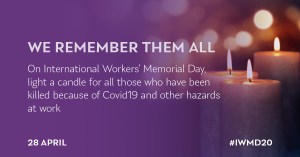
The minute’s silence last Tuesday was on the annual International Workers Memorial Day. An initiative setup by trades unions worldwide to fight for safe working for people whose employers make them work in dangerous conditions or with hazardous substances. The 28th of April is officially recognised by the UK government as a day of remembrance around the world. So should we have an official act of remembrance on the 28th of April every year, not just 2020?

Now is the time to be challenging the government on how it was that emergency supplies of PPE were not replenished after Exercise Cygnus in 2016. Now is the time to make sure the government sets up a suitable commission to investigate and learn the lessons.  A good question to the daily briefing might be;

If now is not the time to start learning the lessons of this crisis, is now the time to commit to setting up a wide-ranging independent group to look at it and report 6 months after the crisis is declared by the WHO to have ended. And is now the time to commit to ‘getting done’ all the recommendations and to fund them whatever it takes?

Those ‘Masters of the Universe’ the bankers, who don’t appear to have changed much since they were supported after the 2008 market crash, will continue to control the supply of much needed loans. Some managed to bring forward their bonuses paid early, despite the Bank of England asking them to delay. Despite being given huge guarantees by the government (again) they will charge huge fees and take a lot of security from the owners of small businesses.

Returning briefly to Jesus, there was a time when people wore badges emblazoned WWJD, meaning ‘What would Jesus do?’ I think the first thing Jesus might have done was to ask the question ‘who are the people that will suffer most from this crisis and the long-term aftereffects?’ He might have decided the following priority list;

  • Take the homeless off the streets and put them all in hotels not currently being used for tourists, give them health screening and mental health support.
  • Before panic buying, make sure the supermarket stocks of food and necessary essential supplies go to foodbanks.  Or better still, miss out the food banks and give £5,000 to every person or family with less than £1,000 of savings in the bank, along with guaranteed delivery of essential food and other items for the duration of the crisis.
  • Guarantee a payment of the average weekly wage to anyone on a zero hours or part-time flexible contract.
  • Provide support to the people who care for our most vulnerable people in care homes or their own homes.
  • Make sure every child living in a poor household is taken to school every day, given a full education, access to technology and two free meals.
  • Pay for all the care needed to support children or adults with a range of special needs for the duration.

Only after that has been done and ‘maximum effort’ has been given to them, and others identified as in danger of potential harm, can civil servants start to plan and implement the type of support package given by the treasury early in this crisis.

So, which narrative would you choose to believe…?

Thoughts at the end of week 6.

The relatively wet weather has confined us indoors. Alyson has been reading Terry Waite’s book Taken on Trust, sewing masks for us all and going for long walks every day.

I have had many more Zoom meetings and took part in an online quiz for Christian Aid. I have two quizzes to write in the coming week. I attended my weekly streamed service from Methodist Central Hall.

We had a family Zoom with 15 of us who should have been at a large house in Ross on Wye for the weekend.

Alyson practiced her skills as a home hairdresser on me with clippers and special scissors I had bought from Amazon.

I managed to put another shelf in my shed and am confident I can now do the last one in under an hour!

Stay safe everyone.


Life & Death – Coronavirus week 5 – what’s the next step?

An uncertain timescale, and new ways of working.

As the total passed 20,000 this week I fear the announcement of a high number deaths in the previous 24 hours is becoming part of our daily routine. I had some favourable comments about last week’s blog on statistics and am grateful to our son David for sending a publicly available link to the NHS Statistics site that details how these are compiled and it is at;

https://www.england.nhs.uk/statistics/statistical-work-areas/covid-19-daily-deaths/

David pointed out that the term ‘daily death toll’ is misleading as they are compiled from a series of numbers, some of which can be from a few weeks before. If you want to see how many have died in your local hospital trust these are on the different sheets in the spreadsheets.

The daily briefings are now showing some of the additional community and care home figures, which increases the totals. There has also been a discussion this week on how exactly registrations of death in the community are classified. The new guidelines allow for dying of Covid-19 or dying with Covid-19 and having one of the reasons as ‘pneumonia-like’ symptoms.

Looking at the current versions of the Johns Hopkins charts from last week’s blog, there is not really a definite ‘plateau’ in the figures, never mind any sign of a decline.

Unlike the virus, the shock of a high number of daily deaths appears to be something we are becoming immune to. Chief Medical Officer (CMO) Professor Chris Whitty suggested the current measures might need to be in place until the end of the year. The situation has been compared to a war, and in my less optimistic moments I worry that like the First World War when the ‘experts’ of the time, the military analysts, declared it would be ‘over by Christmas’, we will need to come to a more realistic appraisal. The first few months of the Great War were characterised by patriotic parades, rousing speeches, a general call to arms, volunteering and government spending. After Christmas, however, when it was clear that the proposed strategy of a short campaign followed by bringing enemies together to negotiate, was not working, countries had to change their economies and society and put them on a ‘war footing’ for the long-haul. Most of the time, however, I am optimistic that we can see out the current ‘war against an unseen enemy’, and a return to ‘normal’ is on the horizon.

No one wants to think of this war going on for a few years and our government having to borrow over 25% of Gross Domestic Product (GDP) annually, as happened in the two wars, compared to the short term 15-20% our chancellor has sanctioned so far. In the two wars GDP increased due to more production of munitions and uniforms etc. There is already some increased activity in sectors of the economy such as supermarkets, food manufacturers, logistics, suppliers of PPE and the pharmaceutical sector supplying medication and carrying out testing.  The problem (as it was during the previous wars) is that much of this expenditure is government-funded and needs to be repaid at some point.

An increasing theme of questions to ministers at the daily briefings, and from some of the government’s own MPs, has been a desire to talk about the plan to get out of lockdown.  The week started with former prime minister Tony Blair’s Foundation the Institute For Global Change producing an outline 10-point plan for how this might happen. It uses a ‘traffic light’ system of the metrics that would allow certain activities when an amber stage is reached, and more when a green might follow. If infections, hospitalisation and deaths start to climb again, it allows for a red stage and return to lockdown.

Nicola Sturgeon Scotland’s First Minister released a similar document to start what she called an ‘adult discussion’ about the gradual release of restrictions.  For example, on how schools might have to be adapted to keep social distancing measures. One of the opposition parties in Scotland claimed that this was as much to do with trying to have a separate track from the UK government, and to steal a march on the ‘English Parliament’, as it is a real attempt to plan.
We had an idea of how releasing the lockdown might look after I joined an ‘on-line queue’ last Sunday to place a small order with DIY retailer Wickes. We had a text on Tuesday when it was ready to collect. Alyson drove to an empty car park where a member of staff brought the order out and put it to one side for her to place in the car. It was so long since Alyson had been out that the car clock was an hour behind. Alyson was so excited that in a Shirley Valentine moment she said, ‘hello car, it’s been a long time, how are you doing?’

It may be that any retailer that wants to re-open, must think about making such adjustments and change the layout and operate a queue and collection system. As our good friend David said during a Skype call ‘every shop will be like Argos’. Talking to my brother-in-law Paul, on a Zoom call for Friday evening drinks, about Jaguar Land Rover (JLR) planning to restart production at two of their car plants, he said they will have ‘re-engineered’ the line. Paul knows about such things having been involved in similar plans before retirement. Instead of having two or three people working on the cars as they go down the line, the engineers will be changing the order and reprogramming the robots used to allow the build to continue within the ‘social distancing’ guidelines. Whether there will be the customers to buy the finished vehicles is a different question.

The UK is fortunate to have some really educated and clever people working in our small and large private and public enterprises. We must hope that, like JLR, they will have been working on ways to ‘re-engineer’ what they do in a ‘post-pandemic’ world. Some of these changes may have been the way to improved productivity anyway, and the space and time during this outbreak was needed to get them implemented. Other businesses less able to adapt and change and whose business model was not ‘fit for purpose’ will disappear.

Apparently a group of experts are meeting with the various sporting bodies to determine how the leagues and events might resume in May/June. There is talk of playing behind closed doors with safety measures in place for players/officials and broadcasters. I will return to this topic in the coming weeks, after more details are released. For now, I am curious how a game of football will look if players must keep two metres apart and the ball must be wiped down with sanitiser after every header or a throw by the goalkeepers!

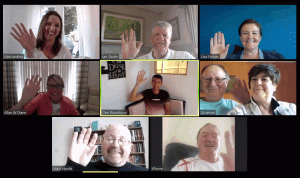
For me the first few weeks of lockdown has brought an increasing number of video calls. Two months ago I knew about Skype, but Zoom was a new product to me. Such is the growth of this platform that, like Google, it has gone from being a noun to a verb quite quickly. We now say we are ‘having a Zoom’ with a colleague or we say we have ‘been Zooming our family’.  Looking back I have had 16 such meetings in the last fortnight and a few more 1-2-1’s helping people setup Zoom. This week we had our first ‘virtual coffee morning’ with members of the head injury charity I am trustee/volunteer for. Given one of our aims is to reduce the social isolation of people who suffer such injuries, I have no doubts that this is an aspect of our work that will continue whenever the situation gets back to ‘normal’. It was a wonderful time of sharing for the ten of us on the call from all over Cheshire.

Technology is another sector of our economy that is booming as people need to be setup for working from home. Some of this business-to-business (B2B) spending is from the private sector so, even if it is funded by borrowing, is adding to our GDP.

Another crisis in the nations’ health being stored for the future?

After last week’s headlines about the current crisis in the care sector, this week doctors leaders and Sir Simon Stevens, Chief Executive of the NHS, highlighted a fall in general attendance at hospitals and GP surgeries. There could be people who need on-going treatment for heart conditions, cancers and other serious issues not getting these. People showing other serious symptoms of stroke, early-warning signs of cancers are choosing not to get checked out. 

Related to this is the mental health of those who are isolated or trapped in homes with an abusive partner or parent. The increase in retail sales of alcohol, the boom in business for wine delivery merchants, some of which is the result of the closure of pubs and restaurants, should also be an area of serious concern.

Alyson and I are blessed to live as a couple with all the interaction that brings and so far are generally getting along amicably! I saw a piece on one of the news channels about the lack of ‘human touch’ that is becoming a real problem even for those who wouldn’t normally classify themselves as ‘touchy-feely’ types. This could be something as simple as a touch of a hand when upset or a hug with a child or grandchild. One new grandparent said, hopefully semi-seriously, ‘well perhaps I will get to see them before their first day of school…’

My thoughts have been with a church friend who lives on her own following the death of her husband last April. This lack of touch is becoming a real problem for her. She had to manage the anniversary of her husband’s death on her own, without the special touch from her son who lives 150 miles away. Her daughter lives in Australia and has a son who was born a few days after her husdand’s death. So she couldn’t even share a first birthday cuddle with him, just a ‘virtual cuddle’ via the ‘FaceTime’ app on an iPad.

Other news this week.

  • Not a new item but a ‘correction’ from two weeks’ ago when I stated that the birds were singing more loudly as a sign of new life. During one of our virtual coffee chats with friends David and Janis, they sent a link to some research showing that the decibel volume of birdsong has actually fallen. This is true particularly in urban areas and near airports as they don’t have to compete with the ambient background traffic noise anymore.
  • This week a potential vaccine against the coronavirus was injected into a human in the first stage of a trial. The remarkable speed at which this has happened is a chance for some optimism, but the scientists tell us that it will take months for any useful results to be available and analysed. In the rush to get this game-changer out to the world, great care needs to be taken to be sure that there are no side-effects that could make the harm done in the long-term far greater than the deaths of the outbreak.
  • The science needed to understand vaccines and terms like re-infection rates, on-going immunity, blind trials, cohort selection, existing morbidities, aggravating factors etc are not simple. I tried to resist mentioning President Trump again this week, but his suggestion of injecting or inhaling disinfectants to ‘clean out the virus in a minute’ was not only dangerous but showed a complete lack of any of the science on which his experts have briefed him. I do think this quote, and his subsequent attempt to pass it off as sarcasm towards the reporters in the briefing room, will be seen as a ‘game-changer’ in the longer term. The idea that a President who has any sort of basic education is unable to see the difference of putting a powerful chemical on surfaces such as metal, porcelain or man-made plastics is no different to the delicate structure of skin or the inside of a human lung is frightening. It is like a parody of the story of ‘The Emperor’s New Clothes’ or in this case ‘The President’s New Coronavirus Treatment’ where everyone else can see it is completely ridiculous idea, but the person elected to lead thinks it is a brilliant one. Will any of his advisors or leaders in his administration have the courage to criticise him in public?
  • There was some ‘outrage’ that Richard Branson would apply for a loan from the government to support his airline Virgin Atlantic. It was pointed out that he has a lot of personal wealth and despite putting his private island (valued at ‘only’ a few tens of millions of pounds) as an asset against the £500Million loan, his press was not favourable. I can see the need to support his employees in the UK, but this is one example for the government and big businesses to negotiate over. The ownership of the company by one of the major US airlines and the tax regimes they operate in needs considering. Denmark was one of the countries this week to announce that any company that hides some of its tax offshore, without true transparency, will not be allowed a loan.
  • On Sunday morning it was announced that prime minister Boris Johnson had recovered enough from his coronavirus after effects to return to Downing Street and lead the government again. Writing as someone who has also come close to death during a 12-week stay in hospital, my hope is that the episode might have given him a new perspective on what really matters in life. The decisions he takes, the way he views the NHS and key workers, might mean a change in approach.

Thoughts at the end of week 5.

Covid-19 has claimed the life of another person I knew. Sharon was a local church treasurer in our circuit, and we talked at meetings. She had some other health problems, but the loss of any life, particularly from this virus, and the effect isolation has on close family is devastating.

The weather continued to be warm and dry so we enjoyed lovely walks outside viewing plants and wildlife. I went for two more substitute parkruns. The goods we managed to get from Wickes meant we could get on with work in the garden and complete painting the fence.

I have really enjoyed all my Zooming this week, particularly catching up with friends and family for coffee and chat.

Alyson continued learning her new skill of sign language and sewed a mask from cotton material should she need to wear it outside.

My lack of any new improved DIY skill was demonstrated by the fact that it has so far taken me over three hours to put up three simple shelves in our garden shed. The phrase ‘all the gear and no idea’ definitely applies to me. What made it worse was that the neighbour who backs onto our garden has made a whole Japanese design inspired pergola from scraps of wood in the same time. Complete with a decorative hand-carved finial. I looked on with some envy at the way he constructed it and used his power tools and screws in a way that I can only dream of. I will report how long it took to put my final shelf up in the next blog.

Stay safe and let’s see what week 6 brings.

Life & Death – Coronavirus week 4 – ‘Squashing the sombrero’

Care homes and the elderly – a hidden crisis revealed?

This week’s main headlines have been dominated by two main issues. The first was around how many people have died from the effects of Covid-19 in care homes and the community. This has put a spotlight on how much this area of our health and social care system appears to have been forgotten, with an extra 4,000 deaths to be added to the total which stands at 16,060 at the end of the week.

I do think after this is all over it will be an issue of collective shame that ‘we’ didn’t bring the care sector into the national effort sooner. Perhaps we assumed that these people were already ‘shielded’ by being in a closed environment; or did we subconsciously think that as they were older, with some nearing the end of their lives, it would be sad, but not so disastrous if that end came sooner.

The other main issue of the week was the review of the lockdown that under the emergency powers the government has taken, needs to be looked at every three weeks. There were calls from the new Labour leader, Keir Starmer, for the government to layout the plans for how the restrictions may be eased. This was echoed by the end of the week when Conservative Ian Duncan Smith MP, a former Work & Pensions Secretary called for ministers to treat the country as grown-ups and not children who couldn’t understand.

We were told that any talk of lifting the lockdown in a few weeks might be giving ‘mixed messages, and lead to us not carrying on with the strict regime. I do begin to understand this, but my analogy would be that when you go on a package holiday and the rep tells you to be at the airport in three weeks for your return flight, I don’t think many people turn up for the flight the next day. They are two quite simple messages. It was good to hear that there is a group of experts looking at what other countries are doing, and data is being collected on the effectiveness of softening each measure.

The discussions are happening anyway, and it seems logical to ‘reverse’ the measures we put in place. This means children (or at least some year groups) going back to school, perhaps after the original end of May Bank Holiday half-term. Then opening some health care settings like dentists, opticians, chiropodists etc (with of course relevant safety measures in place). This could be followed by garden centres and DIY stores so that people can carry on with projects at home and give those businesses for who this season is a large part of their turnover, some much needed cash and return of profit. Many people who are working from home could continue to do so. I hear anecdotally  that many of them like the new way with not having to commute. I imagine those who have been furloughed on 80% (particularly those who are being paid the extra 20%) are enjoying their ‘sabbatical’ and if the good weather continues would be more than happy to carry on.

The government briefings continue to push the message of carrying on until we see a change in the data, and that the peak of infections/hospital admissions has not yet been reached. It came as no surprise that on Thursday it was announced that current measures will be in place until at least the 7th of May. As that is the start of the VE Day (Victory in Europe) Bank Holiday weekend, my own view is that they will be in place until that is over.

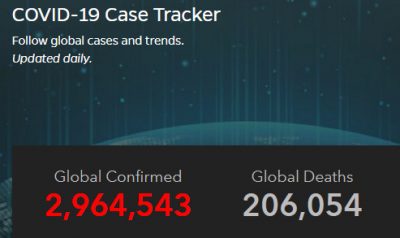
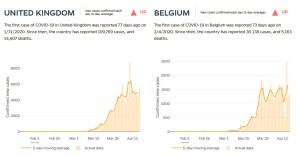
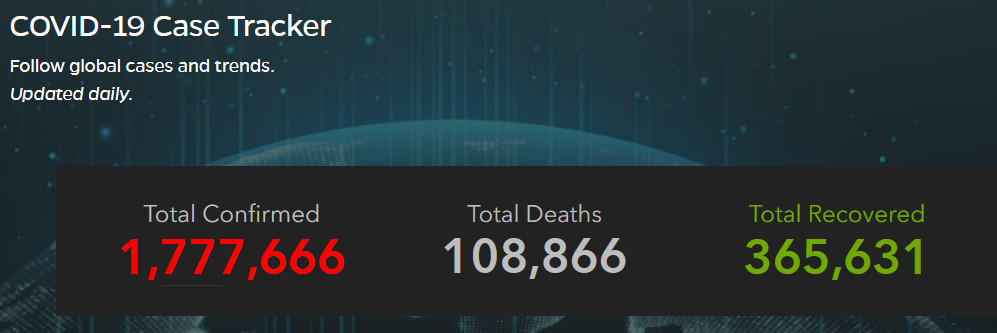
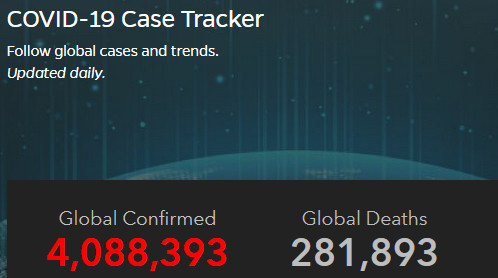
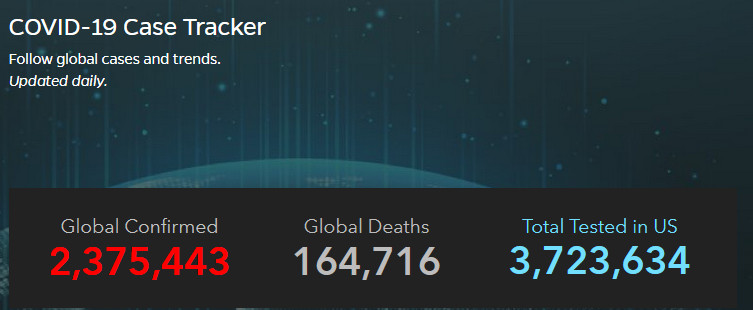
As the figures in the main image show, the death toll across the world keeps rising.  I admit to spending a lot of time looking at graphs trying to interpret ‘trends’.  However, without some deep grounding in statistical methods and how data is reported, some graphs can be ‘misleading’. I have even seen ‘logarithmic scales’ used for the vertical axis of ‘number of deaths’ which flattens the curve and lessens the steepness of the rise. Education is so important in these matters, but some of our journalists appear to think that cramming a few minutes of research via a search engine on epidemiology allows them to ask ‘searching questions’ of the health and science experts. One even got antibody (to see if someone has had the virus in the past and developed some immunity) and antigen tests (finding if someone has the infection now) mixed up.

The figures in this article come from Johns (notice the extra ‘s’) Hopkins University web site. They have a useful set of visual tools that display the data on Covid-19 from all over the world, updated daily.

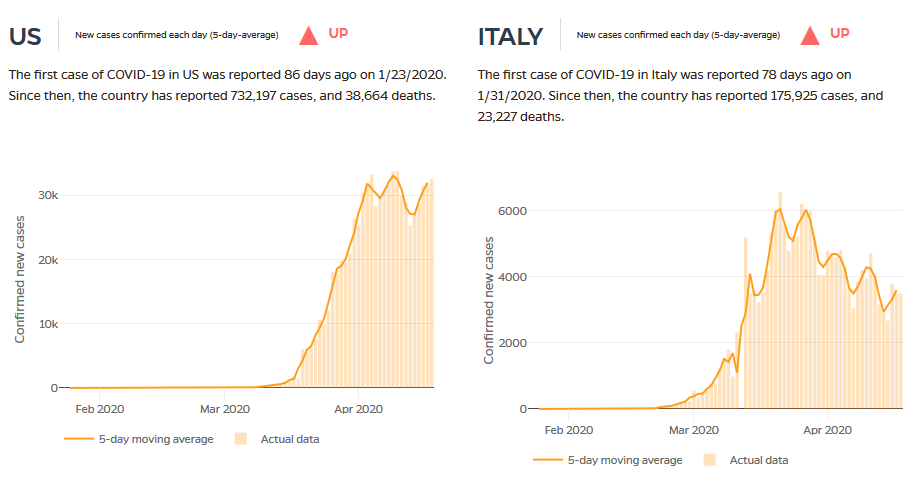
You need to understand what a ‘normal distribution curve’ is to know what the line and the space under it mean. The graphs below appear to give some hope that the ‘curve is flattening’ and, as Boris put it so colourfully in an early press conference, we are ‘squashing the sombrero’.   These are today’s curves of reported cases.

Coronavirus Cases US & Italy 19 April

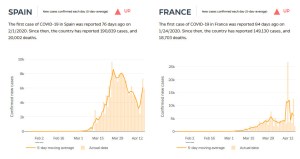
Even these diagrams have very different vertical axes with some in thousands and some tens of thousands. They are useful to see overall trends in the number of cases, but this is dependent upon the same testing regime being in place in a country for the period reported, and even more so when comparing different countries.

This is the one that compares the UK and Belgium.

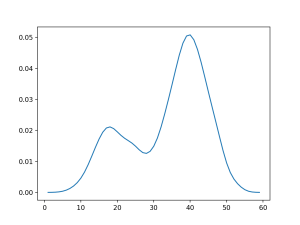
The danger of trying to read trends in these curves is that they could be a small part of an even larger curve or the start of several ‘small peaks’ that go on and on. Looking at the curve below for example, in the data above, we might not quite be at point 20 on the horizontal axis.

The important thing to understand, should this be true, is that the area under the curve represents the total number of deaths. I heard one epedemiologist modelling the outbreak estimate that if we added the extra care home and community deaths, which could be as high as 50%, then even if there is a single ‘normal curve’ we need to double the total deaths currently, resulting in a figure in excess of 40,000.

To add some more ‘worrying’ numbers into the mix if, as some experts are saying, only 15% of the population have had the virus, then to get to the 60% required for the original plan of ‘herd immunity’ would require a total of four such curves and associated lockdowns. It does seem that the crisis will continue in some extended form for many more months.

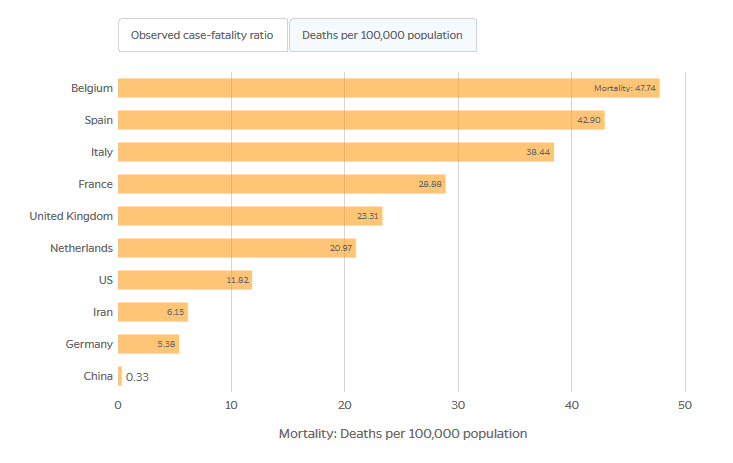
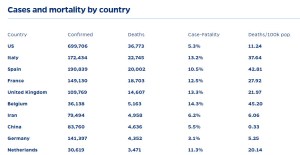
Population numbers and density in a country are important factors that allow another way of looking at the figures. Consider the graphic below showing the number of deaths per 100,000 of the population. with a table below it showing some numbers.

Coronavirus Worldwide Mortality Rate April 2020

These figures are from a few days ago and some countries are at different stages of their outbreak.  There have been questions over the reporting in China where it is alleged that some of the administrators at a state level could be underreporting  numbers for fear of upsetting the central Communist Party. The figures were amended this week on the day China announced a negative Gross Domestic Product (GDP) rate for the first time in nearly 40 years.

Other news items this week.

  • ‘Captain Tom’ who I mentioned last week has now raised over £26 million and promised to keep walking as long as people keep giving.
  • In many countries with more ‘authoritarian’ regimes, there have been examples of extra surveillance via mobile phone location data, and extreme violence by police under the guise of enforcing the measures.
  • Protests have taken place in the USA and Brazil against the lockdowns showing that individuals are rebelling against the situation. In our country, apart from a few examples people have been generally compliant. No one wants to think about us getting the stage of extreme disorder and looting that has been part of the ‘Hollywood narrative’ in the disaster/survival movie genres.
  • President Trump continues to make headlines after declaring himself the only person who could decide when states release lockdown. This is not the legal situation as each of the states has a separate ‘government’ in their federal system. The next day he announced his decision….that each governor could decide when and how to lift their lockdown!

Thoughts at the end of week 4.

The virus has come closer to us after a member of my head injury charity, monthly coffee morning group, died of Covid-19 on Thursday. Blythe had some underlying issues but she was doing well at home after a spell in a care home before Christmas. Another person I know is in hospital with the virus but fortunately not in ICU.

The mother of the partner of one of our nieces died 13 days ago, not of the virus, but his father couldn’t visit her in the nursing home, and the family had the problem of organising a funeral under the new regulations . In addition our niece was furloughed and her partner told to take a 30% pay cut, at a time when his company wanted him to work from home and do even longer hours.

We are still managing to get some daily exercise and no problems with food or other supplies. We have had many Zoom coffee meet-ups with family and friends. I helped lead a Zoom Bible study group on Wednesday evening. We are ready for another extended period of lockdown and the forecast good weather is a real bonus. Alyson is missing trips to see wildlife away from our suburban estate, but is making the most of walks along a stream in woodland nearby.

We are doing more reading, watching films and recorded ‘live musicals’ shows on the Internet. Attending a live-streamed church service from Methodist Central Hall in London is now part of my Sunday routine.

Stay safe and, God-willing, there will be another blog next week.

Life & Death – Coronavirus week 3 (Thoughts and Prayers)

‘We are all in this together…’

When I started thinking about this blog I made a conscious decision not to go straight to the big issues of politics and even more so my personal faith and aspects of religion. The events of this week mean that is not possible.

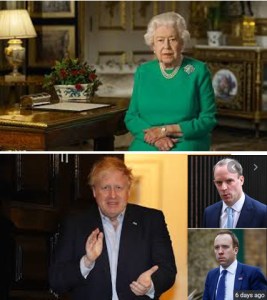
Sunday 5th April brought three things that influenced me and many others in our country. The Queen gave an address to the nation, Boris Johnson, prime minister went into hospital and the Christian Church started Holy Week leading up to Easter. For many on ‘the left’ of politics the Queen and Boris Johnson symbolise what is wrong in our society and underline the differences in our society between the privileged ‘haves’ and the underprivileged ‘have-nots’. How easy it is to decry someone with enormous personal and institutional wealth, socially isolating in a castle giving a message of encouragement to the nation.  Similarly for a ‘posh-boy’ politician with all the advisors and support to go into hospital after getting a test not open to front-line health workers, and then moved to an intensive care unit (ICU), alongside some reports that suggested he might have taken the place of a more ‘needy’ patient.

Those are not my narratives as I was brought up to try and treat everyone the same and to respect our Queen and the role she plays in our country and the mostly unseen support for our national institutions – not least through her weekly meeting with the Prime Minister. Whatever our personal view of the first-name-politician Boris, his part in the Conservative Party over issues like Brexit, his ambition to push others away in pursuit of being the leader, he is our elected Prime Minister with a substantial majority. He is easy to parody and characterise as a clown or buffoon, with that often repeated clip of him dangling from a high wire during the 2012 Olympics as Mayor of London.  I do confess to sharing some of the ‘funny’ pictures and videos on social media. As Prime Minister he has a tough job and is facing something nobody expected to have to manage, and for which there is no real ‘play-book’.

Boris’s ‘friend’ US President Donald Trump increasingly looks like a man lost in the situation. Always over-promising the end of the crisis, trying to provide hope of ‘an amazing and beautiful economic recovery…’, not able to hold supporter rallies and probably worried about the November elections. I am waiting for the day he declares he has managed the virus so well, he is going to issue an Executive Order that gives him the job for a minimum of two more years.

In the earlier part of the last seven days President Trump, and other world leaders were sending ‘thoughts and prayers’ to our Prime Minister and their ‘friend’ Boris. Social media was full of messages from people from all parts of society expressing similar wishes. Easy words to say but I wonder how many people actually said that prayer. Our local churches in Holy Week hold times of daily reflection and I joined those each day at 7pm. We did actually pray for Boris and everyone else in hospital and those who had lost family members. Our minister has had several funerals and dealt with bereaved families who can’t attend the last moments of a loved one.

I have started to hear that phrase that comes out in times of a human or natural disaster, ‘how can God let this happen and why doesn’t he put an end to this…?’. I won’t hold my breath and wait for the time this is all over and people suggest we get together to thank that same God for bringing us through it.

We journeyed through Holy Week with Jesus and shared in his suffering. The Good Friday service is always a moving one and I always leave it in a low mood. On Sunday I shared in a live-stream service from Methodist Central Hall Westminster where we celebrated the  Easter Day promise of new life overcoming death. For those who don’t share our view, signs of new life are all around.  As we walk in the local area blossom is on the trees, birds singing loudly due to the lack of traffic, and there are green shoots in our gardens and parks.

Mention was made of ‘green shoots’ during one of the daily briefings looking at the trends in new infection rates. I will look more at this in next week’s blog.

What has become clear in the last week as we all get used to (some would say bored with) the daily government briefings, is the public and the press are starting to ask the ‘hard questions’, and not allowing ministers to avoid them. There is no doubt they are ‘managing expectations’ or we are being ‘spun’ in a way that governments always do. If the lock-down had started earlier and was announced as up to 12 weeks, there may well have been uproar and even civil disobedience. As we come to the end of the ‘first three weeks’ it seems like this will go on for much longer, and other European Countries like Italy and Spain, who are ahead of us, are not showing any signs of a fully formed exit strategy.

If there is anything other than ‘Coronavirus’ that is likely to make Word of the Year for 2020 it is surely the abbreviation PPE (Personal Protective Equipment). We hear minister after minister saying they have supplied ‘hundreds of millions of items’ to hospitals etc. I am sure there are a lot, but a small calculation can explain away this figure could be ‘misleading’;
There are about 1,250 hospitals, 7,500 GP surgeries and 10,500 pharmacies in the NHS. The numbers of doctors is about 105,000 and nurses 300,000. I suspect in giving us the numbers the following could be true;

A box of 100 pairs of latex gloves = 200 items
a pack of 100 pairs of lower sleeves = 200 items
a pack of 100 plastic aprons = 100 items
a pack of 5o disposable masks = 50 items
a pack of 50 paper hair coverings = 50 items

So if each doctor and nurse is given the above items to last a few days, as they need to change them between patients, that would be
(105,000 + 300,000) x (200+200+100+50+50) = 243 million items

If every surgery & pharmacy was sent the same order this would be another (10,500 +7,500) x 600 = 10.8 million items

So that allows politicians to claim ‘literally hundreds of millions of items’ have been provided. But this leaves care homes, paramedics, home carers etc out of the calculations. Despite reassurances we hear stories in the media every day, and this has been going on for several weeks. There is no doubt it is a huge issue, and getting the kit to the right places at the right time is a massive logistical challenge. But isn’t this is something the NHS supply chain does all the time? Can’t our politicians be honest with us? Some of the ‘lower ranking’ ministers that have been put up to take questions seem to have no empathy at all and simply repeat the same platitudes and ‘party line’.

This week even Matt Hancock, Health Secretary (who is under great pressure and in my opinion seems to be leading well) resorted to apparently accusing NHS staff of ‘misusing PPE’. On Saturday the Priti Patel, Home Secretary gave a half-hearted apology when she said ‘I am sorry if people feel that way…’
On Thursday Dominic Raab, Foreign Secretary stood in for Boris at the briefing and answered a question about rewarding key workers after it was all over and said ‘this has certainly brought into focus who our key workers are’.  He encouraged the country to join in the weekly ‘clap for carers’ at 8pm.  Many of them are unskilled low paid carers, council workers and food delivery drivers.  That same day 9th April the Home Office under Priti Patel released the next stage of the governments immigration policy to limit the numbers of ‘key workers’ coming into the UK. A document on the .Gov.uk website states;

Lower-skilled workers

There will not be an immigration route specifically for those who do not meet the skills or salary threshold for the skilled worker route

On Wednesday evening as the prime Minister left ICU and was reported to be getting better, it was left to BBC reporter Emily Maitlis at the start of a BBC 2 Newsnight report to say;

‘You do not survive the illness through fortitude and strength of character, whatever the prime minister’s colleagues will tell us. The disease is not a great leveller, the consequences of which everyone – rich or poor – suffers the same. This is a myth which needs debunking. Those on the front line right now – bus drivers and shelf stackers, nurses, care home workers, hospital staff and shop keepers – are disproportionately the lowest paid members of our workforce. They are more likely to catch the disease because they are more exposed.

Those who live in tower blocks and small flats will find the lockdown a lot tougher. Those who work in manual jobs will be unable to work from home. This is a health issue with huge ramifications for social welfare, and it is a welfare issue with huge ramifications for public health….

….As the World Trade Organisation warns that it might provoke the deepest economic downturn of our lifetimes, we ask what sort of social settlement might need to be put in place to stop the inequalities becoming even more stark.

One of the hardest things about dealing with graphs and numbers, statistics, targets and flattening or rising curves, is a propensity to forget the names and lives behind the growing death toll. Tonight we want to remember some of those who died while doing their job. They were not soldiers, they did not sign up to a career in which they pledged to give their lives. They would not see themselves as heroes, but as ordinary members of the public doing their work at a time when it required immense courage and kindness’

Among the increasing death toll and loss of around 30 front-line workers, doctors, nurses, pharmacists, physiotherapists, care home staff, teachers and bus drivers were some truly uplifting stories. I watched the tale of Hugh from Market Harborough who went into hospital on day 10 of his suffering straight to ICU where he was put on a ventilator. He described the awful time he went through but also the care of the doctors and nurses he got to know by first name. His father had died the day before he went in, and with his wife and daughter having to self-isolate due to his illness, they watched a video made by his sister from the graveside. Hugh recovered a week later and was applauded out of the hospital by the nurses. Standing in his garden with the sun shining and the birds singing, he looked the happiest man alive. He described the joy of being given a shave and a marmalade sandwich by a nurse as a treat. He could now walk 300 yards unaided. He paid tribute to the staff.

Albert a 99-year-old World War Two (WW 2) veteran who had survived three years in a prison camp and was applauded by nurses as he left hospital after coronavirus. ‘World War Two, done that, Coronavirus, done that too!’ was what Albert said to his nurses.

Then there is another 99-year-old WW2 veteran ‘Captain Tom’ who  wanted to raise money for NHS charities by walking 100 times around his (not small) garden before he was 100. As I write his Just Giving page total is over £305,000. Go Tom!

The prime minister after leaving hospital on Sunday evening thanked many of the grades of workers who had looked after him. He named Jenny for New Zealand and Luis from Portugal who stood by his bedside for 48 hours. Perhaps he needs to have a quiet word with his Home Secretary about her new immigration system, to ensure the future Jennys and Luis’s can still come to work in the NHS.

Other news items this week.

I managed to find a few items related to the disruption caused by the virus that were not widely reported.

  • Yemen – a country ravaged by conflict and bombed by a coalition of countries including Saudi Arabia armed by our own government, recorded its first cases of coronavirus. Large areas of the country are suffering famine, dire water shortages and lack of sanitation (no 20 second hand washing here). Almost half the hospitals have been destroyed or closed and people are living in makeshift camps.  The Financial Times (FT) reported that there were only 205 ventilators in the country but the United Nations (UN) were sending another 420.
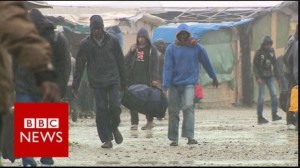
  • Refugee Camps in Calais – Reporter Fergal Keane of the BBC did a report showing the overcrowded camps near Calais where lines of mainly men from The Balkans queued closely together to get food and water handouts.

    A French volunteer interviewed said he was ashamed that we treat people in such an inhuman way. Even if they get over to the UK refugees face discrimination, poor accommodation and access to food vouchers that they can’t use.
  • Dairy Farmers pouring milk down the drain – Given the queues at supermarkets and pictures on news channels of empty shelves, it seems odd that thousands of litres of good milk are being dumped. About half of the daily production was taken by a few larger processors and sold to restaurants, specialist bakers and coffee shops – all now closed.  The demand from supermarkets is up 20% but the other part of the demand is down 70%. Cows are not industrial machines that can be ‘turned off’ and need to be milked. The dairies also aren’t collecting due to driver shortages and have reduced the price per litre the farmers get. So good milk is disposed of.

Thoughts at the end of week 3

We continue to be basically ok and able to find plenty of supplies and enjoy daily exercise, including a replacement form my weekly Parkrun with a course on my own locally.

We had several more ‘virtual coffee meetings’ with friends and family. We even had a couple of ‘virtual Easter cottage holiday’ gatherings and shared a pizza party with birthday cakes and candles, and a treasure hunt for the children.

I am extremely proud of Alyson, my wife, who has setup a WhatsApp group for some former work colleagues struggling with isolation and who had lost contact due to illness or losing jobs. After sharing a positive Easter message she had good feedback that it was helping a lot.

As the UK death toll passed 10,000 0n Sunday, we wonder whether the curve will flatten, whether the prime minister or his deputy and cabinet will review the lockdown  in the coming week, and what the result might be.

I want to finish with a prayer we used this week in one of our daily sessions. It is by John Bell and part of a booklet from the Iona Community in Scotland examining the basis of our economy. I think it resonates even if you don’t have a specific faith.

May it not be long, Lord.

May it not be long
before there are no more beggars at the door
waiting for the crumbs from the tables of the rich.

May it not be long
before the northern exploitation
of the southern economies
is  a  fact  of  history, not a fact of  life.

May it  not  be long
before poor economies
cease to be havens for sex tourism,
child labour and experimental genetic farming.

May It not be long
before  those  nations  we  once evangelised
show  us  the  larger  Christ  whom we,
too often, have forgotten .

May it not be long Lord.

May it not belong
before the governments of our nations legislate
against commercial avarice and  over-consumption which  hurts  the  poor  and  indebts  them.

May it not be long

Before  Christians  in  this  land  examine  their  economic priorities  in  the  light  of  the  Gospel  rather  than  in
its shadow.

May it not be long
before we respond out of love,
not out of guilt.

May it not be long
before we find wells of hope
deeper  than  the  shallow  pools  of  optimism
in  which  we  sometimes  paddle.

May it not be long

Before we  feel  as  liberated  and  addressed  by  your word as  those  first  folk  did who  heard  you   summon  the  oddest  of  people  to fulfil  the oddest  of  callings.

May it not be long, Lord.       Amen

Life & Death – Coronavirus week 2

Introduction

When I attended a meeting of our Constituency Labour Party four weeks ago, I was shocked when one of our local councilors, who looks after the crematorium, gave an update on contingency planning for cornavirus. They informed us, in a matter of fact way, that a large plot had been identified capable of burying hundreds of people in a mass grave. They wouldn’t have capacity to hold funerals or cremations. Families could get bodies exhumed at a later date but there would be no guarantee depending on the numbers.  It really shook me.

Thinking back to when I was first aware of the virus being a potential issue outside China, it was ‘Brexit Day’ at the end of January. We had visited friends on The Wirral when the first coach load of UK citizens arrived at Arrowe Park hospital a couple of miles away. That evening we travelled to London and the taxi we took to our hotel was delayed by the large gatherings celebrating at Parliament Square and other streets which were closed. Over the weekend we caught crowded Tube trains, went to concerts, shows and busy restaurants in the West End. No social isolation, and little extra hygiene measures then. We did pass a light comment when we walked through Chinatown that perhaps we ought not to have gone that way…

Given the pace of the changes since then and the prospects of even worse to come I decided to journal some events and my thoughts in more detail. I want to do this weekly so that when I look back in months’ or years’ time, I can see how my views changed with each dramatic turn.

I also want to explore several aspects of the crisis that may fundamentally change our country, our society and some of the norms we have taken for granted.

None of us know how this will end. We all hope that, like other crises both natural and those as a result of human action, we will come through it . But currently nothing is certain.

Why ‘Week 2’? From a personal perspective this is the end of our second week of serious ‘lock-down’ after some of the less restrictive guidelines and advice. The World Health Organisation (WHO) on 12th January 2020 officially confirmed the new virus and the four Chief Medical Officers (CMOs) in the UK moved the threat from low to moderate on 30th January.  For those in the front-line and our NHS service this is probably week 9.

With no training as an ‘investigative reporter’ and short of time for detailed research, the articles will be my own interpretation of ‘facts’ gleaned from mainstream news, written articles and ‘official’ web sites from some of the organisations involved.  My experience of being a secondary school science and maths teacher, director of operations & IT for a large retail pharmacy group, self-employed IT & business consultant, setting up systems for an accountancy practice, gives me some insight into a variety of processes and analysis. I have produced statutory accounts for a large Methodist Circuit and local Head Injury charity.

This is a public blog so feel free to join in ‘the conversation’, give alternative views, tell me where I am wrong – or right!

Whatever our views or beliefs, I think the majority would agree that we are living in ‘strange times’.

Outline of topics for discussion.

In thinking about what I need to put in the blog some large themes developed in my mind. It is hard to separate out specific topics and most are linked to one or more of the others. This is my initial list in alphabetical order rather than significance.

  • Economics
    How we use our wealth to best effect for what both main political parties agree should be ‘for the many not the few’. How corporations, public bodies, small and medium businesses, wealthy individuals, and every individual supports each other. Do we need a fundamental rethink and ‘reordering’ of past conventions?
  • Education
    Including science and mathematical modelling. Learning the lessons of history. How people react to news and the spread of ‘fake news’.
  • Faith
    In times of trouble and potential death the systems and personal and group support people of all faith and none turn to.
  • Globalisation
    How the virus and the news of it spread from China to the rest of the world. Transport, goods, news channels, sharing vital research and information. How world governments, leaders and organisations like the G20 co-operated or put self-interest before the wider good.
  • Health & Social Care
    Some would say this is the main topic. Clearly it is a health issue with Coronavirus at the centre. Our National Health Service (NHS) is at the forefront.  There are deep concerns over the elderly and vulnerable members of our society who are in hospitals and the care system.
  • Politics
    In the general sense the ways which people make choices, and in a specific sense the way different political parties have reacted and communicated. As I recently joined as a member of The Labour Party, Keir Starmer is elected the new leader as I write. We need to co-operate with the Conservative government but not be afraid to question or hold them to account now, or after it is all over.
  • Science
    The science behind the virus. The knowledge needed to trust the advice of ‘experts’. The way science will help the end the crisis.
  • Society
    How we have reacted and changed in the ways we interact with our neighbours and fellow citizens. The voluntary sector and the good and bad aspects of people’s behaviours. How we enforce those behaviours, and do we need more state surveillance and control to prevent similar crises in the future?
  • Technology
    This is the first time of real crisis when we have seen some of the ‘good’ that technology can do, but also the dangers of misinformation spread. Social Media can also be a force for good, but also a source for terrible harm.

In looking at these topics I will attempt to remember that there are other huge issues facing our world such as poverty, war, conflict, drought, famine and climate change. Many of these seem to have dropped completely from our news agenda. Significant parts of daily life such as arts, culture, sport and of course ‘socialising’ have disappeared completely overnight, and the effect on business is incalculable.

Thoughts at the end of week 2

We are very fortunate that the reality for me and my immediate family is nothing more than a minor inconvenience. We are semi-retired, relatively well off, have a large home with a garden to move around in. Getting food and essentials has not been a problem. Our two adult sons are working from home and still in full employment.
We have got the technology to hold virtual family, friend, church and social club meetings. We are using the time to do jobs around the house and garden, reading and exercising using an indoor bike and Wii Fit console on the TV.

No one we know in family or friends has had the virus (or to be correct has had serious symptoms). It all seems a bit surreal and like a Hollywood movie with empty streets in major cities around the world, and footage of overwhelmed medical facilities.

The daily government briefings are part of our rhythm of the day. They vary in usefulness and the messages can be confused and some ‘facts’ are found to be unreliable or even ‘spin’. The journalists’ questions are sometimes not the ones we need, but lately at least the presenters go back and invite supplementary questions.

While every loss of a life is awful, the rise in the last week in our own country is from passing over 1,000 last weekend to 4,932 now. The numbers in countries that we are supposedly following two weeks behind such as Italy and Spain are 15,887 and 12,418. This is getting serious.

To end I want to quote part of a letter our Chair of District Rev Helen Kirk sent us today as we start our journey through Holy Week from Palm Sunday to Easter Day. Note the use of the word ‘dis-ease‘….

Each year I challenge people to engage with Holy week for although it is not a comfortable place to be, we can too easily pass from the triumph of Palm Sunday to the joy of the Easter Day and miss the impact of the six days in between.

Perhaps that ever darkening week is one we can relate to more than ever this year as we live with the uncertainty, the anxiety, the constant underlying dis-ease that we carry for ourselves, our families, our church and our communities.

And yet for all, life is extraordinarily different and for many difficult; Spring is still arriving with a pace around us. As a novice gardener there is something extremely hopeful about planting seeds and watching as the new shoots grow. And they do grow, regardless of what is happening in my life, the plants in my garden and the seeds in my greenhouse are emerging with new life and beginning to bloom.


Theology Everywhere

Discuss theology today to transform tomorrow

verbalising

ruminations on life at fifty ... or so ...

Discover WordPress

A daily selection of the best content published on WordPress, collected for you by humans who love to read.

The Daily Post

The Art and Craft of Blogging

WordPress.com News

The latest news on WordPress.com and the WordPress community.