
Care homes and the elderly – a hidden crisis revealed?
This week’s main headlines have been dominated by two main issues. The first was around how many people have died from the effects of Covid-19 in care homes and the community. This has put a spotlight on how much this area of our health and social care system appears to have been forgotten, with an extra 4,000 deaths to be added to the total which stands at 16,060 at the end of the week.
I do think after this is all over it will be an issue of collective shame that ‘we’ didn’t bring the care sector into the national effort sooner. Perhaps we assumed that these people were already ‘shielded’ by being in a closed environment; or did we subconsciously think that as they were older, with some nearing the end of their lives, it would be sad, but not so disastrous if that end came sooner.
The other main issue of the week was the review of the lockdown that under the emergency powers the government has taken, needs to be looked at every three weeks. There were calls from the new Labour leader, Keir Starmer, for the government to layout the plans for how the restrictions may be eased. This was echoed by the end of the week when Conservative Ian Duncan Smith MP, a former Work & Pensions Secretary called for ministers to treat the country as grown-ups and not children who couldn’t understand.
We were told that any talk of lifting the lockdown in a few weeks might be giving ‘mixed messages, and lead to us not carrying on with the strict regime. I do begin to understand this, but my analogy would be that when you go on a package holiday and the rep tells you to be at the airport in three weeks for your return flight, I don’t think many people turn up for the flight the next day. They are two quite simple messages. It was good to hear that there is a group of experts looking at what other countries are doing, and data is being collected on the effectiveness of softening each measure.
The discussions are happening anyway, and it seems logical to ‘reverse’ the measures we put in place. This means children (or at least some year groups) going back to school, perhaps after the original end of May Bank Holiday half-term. Then opening some health care settings like dentists, opticians, chiropodists etc (with of course relevant safety measures in place). This could be followed by garden centres and DIY stores so that people can carry on with projects at home and give those businesses for who this season is a large part of their turnover, some much needed cash and return of profit. Many people who are working from home could continue to do so. I hear anecdotally that many of them like the new way with not having to commute. I imagine those who have been furloughed on 80% (particularly those who are being paid the extra 20%) are enjoying their ‘sabbatical’ and if the good weather continues would be more than happy to carry on.
The government briefings continue to push the message of carrying on until we see a change in the data, and that the peak of infections/hospital admissions has not yet been reached. It came as no surprise that on Thursday it was announced that current measures will be in place until at least the 7th of May. As that is the start of the VE Day (Victory in Europe) Bank Holiday weekend, my own view is that they will be in place until that is over.
As the figures in the main image show, the death toll across the world keeps rising. I admit to spending a lot of time looking at graphs trying to interpret ‘trends’. However, without some deep grounding in statistical methods and how data is reported, some graphs can be ‘misleading’. I have even seen ‘logarithmic scales’ used for the vertical axis of ‘number of deaths’ which flattens the curve and lessens the steepness of the rise. Education is so important in these matters, but some of our journalists appear to think that cramming a few minutes of research via a search engine on epidemiology allows them to ask ‘searching questions’ of the health and science experts. One even got antibody (to see if someone has had the virus in the past and developed some immunity) and antigen tests (finding if someone has the infection now) mixed up.
The figures in this article come from Johns (notice the extra ‘s’) Hopkins University web site. They have a useful set of visual tools that display the data on Covid-19 from all over the world, updated daily.
You need to understand what a ‘normal distribution curve’ is to know what the line and the space under it mean. The graphs below appear to give some hope that the ‘curve is flattening’ and, as Boris put it so colourfully in an early press conference, we are ‘squashing the sombrero’. These are today’s curves of reported cases.
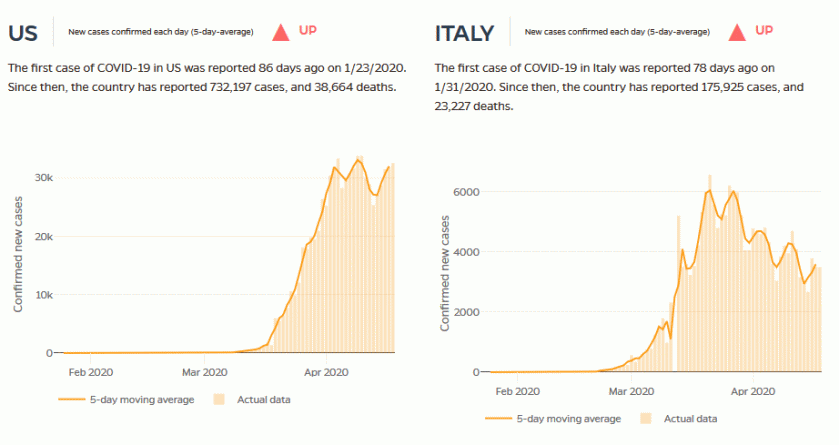
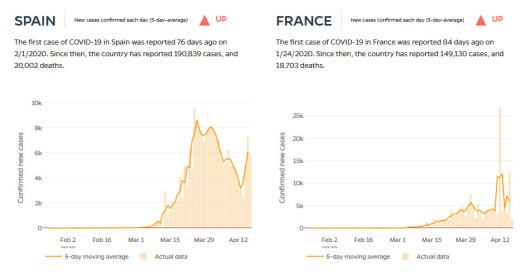
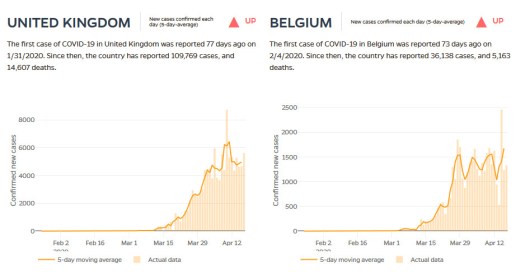
Even these diagrams have very different vertical axes with some in thousands and some tens of thousands. They are useful to see overall trends in the number of cases, but this is dependent upon the same testing regime being in place in a country for the period reported, and even more so when comparing different countries.
This is the one that compares the UK and Belgium.
The danger of trying to read trends in these curves is that they could be a small part of an even larger curve or the start of several ‘small peaks’ that go on and on. Looking at the curve below for example, in the data above, we might not quite be at point 20 on the horizontal axis.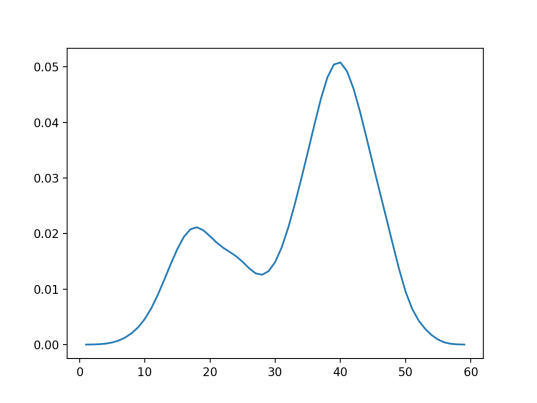
The important thing to understand, should this be true, is that the area under the curve represents the total number of deaths. I heard one epedemiologist modelling the outbreak estimate that if we added the extra care home and community deaths, which could be as high as 50%, then even if there is a single ‘normal curve’ we need to double the total deaths currently, resulting in a figure in excess of 40,000.
To add some more ‘worrying’ numbers into the mix if, as some experts are saying, only 15% of the population have had the virus, then to get to the 60% required for the original plan of ‘herd immunity’ would require a total of four such curves and associated lockdowns. It does seem that the crisis will continue in some extended form for many more months.
Population numbers and density in a country are important factors that allow another way of looking at the figures. Consider the graphic below showing the number of deaths per 100,000 of the population. with a table below it showing some numbers.
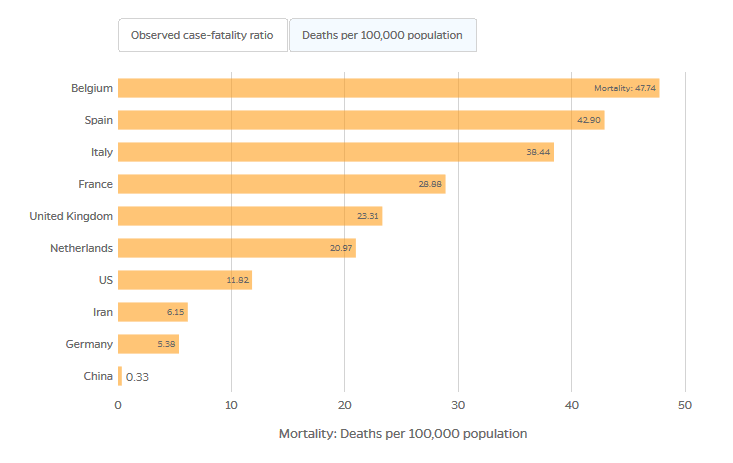
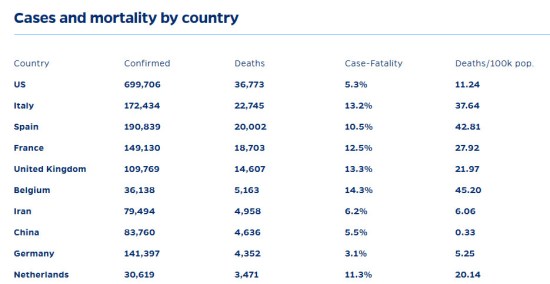
These figures are from a few days ago and some countries are at different stages of their outbreak. There have been questions over the reporting in China where it is alleged that some of the administrators at a state level could be underreporting numbers for fear of upsetting the central Communist Party. The figures were amended this week on the day China announced a negative Gross Domestic Product (GDP) rate for the first time in nearly 40 years.
Other news items this week.
- ‘Captain Tom’ who I mentioned last week has now raised over £26 million and promised to keep walking as long as people keep giving.
- In many countries with more ‘authoritarian’ regimes, there have been examples of extra surveillance via mobile phone location data, and extreme violence by police under the guise of enforcing the measures.
- Protests have taken place in the USA and Brazil against the lockdowns showing that individuals are rebelling against the situation. In our country, apart from a few examples people have been generally compliant. No one wants to think about us getting the stage of extreme disorder and looting that has been part of the ‘Hollywood narrative’ in the disaster/survival movie genres.
- President Trump continues to make headlines after declaring himself the only person who could decide when states release lockdown. This is not the legal situation as each of the states has a separate ‘government’ in their federal system. The next day he announced his decision….that each governor could decide when and how to lift their lockdown!
Thoughts at the end of week 4.
The virus has come closer to us after a member of my head injury charity, monthly coffee morning group, died of Covid-19 on Thursday. Blythe had some underlying issues but she was doing well at home after a spell in a care home before Christmas. Another person I know is in hospital with the virus but fortunately not in ICU.
The mother of the partner of one of our nieces died 13 days ago, not of the virus, but his father couldn’t visit her in the nursing home, and the family had the problem of organising a funeral under the new regulations . In addition our niece was furloughed and her partner told to take a 30% pay cut, at a time when his company wanted him to work from home and do even longer hours.
We are still managing to get some daily exercise and no problems with food or other supplies. We have had many Zoom coffee meet-ups with family and friends. I helped lead a Zoom Bible study group on Wednesday evening. We are ready for another extended period of lockdown and the forecast good weather is a real bonus. Alyson is missing trips to see wildlife away from our suburban estate, but is making the most of walks along a stream in woodland nearby.
We are doing more reading, watching films and recorded ‘live musicals’ shows on the Internet. Attending a live-streamed church service from Methodist Central Hall in London is now part of my Sunday routine.
Stay safe and, God-willing, there will be another blog next week.
 Skat's Chat